


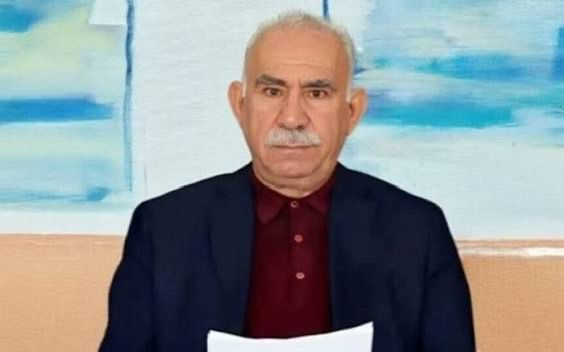
Abdullah Öcalan, the imprisoned leader of the outlawed Kurdistan Workers’ Party (PKK), has renewed his call for legislation to advance Turkey’s peace process with the group, saying a legal framework is needed to remove armed conflict from the country’s agenda permanently.
The initiative began in October 2024, when far-right Nationalist Movement Party (MHP) leader Devlet Bahçeli unexpectedly called on Öcalan to urge the PKK to lay down its arms. Öcalan issued such an appeal in February 2025, after which the PKK declared a ceasefire, announced its dissolution, held a symbolic weapons-burning ceremony in northern Iraq and began withdrawing its fighters from Turkey.
Talks have since focused on legislation governing the laying down of weapons, the legal status of PKK members and their possible reintegration into civilian and political life.
Öcalan’s latest message was released Tuesday by the pro-Kurdish Peoples’ Equality and Democracy Party (DEM Party) following a five-hour meeting Monday at İmralı Prison with delegation members Pervin Buldan, Mithat Sancar and lawyer Özgür Faik Erol.
“The time has come to establish a legal foundation that takes mutual sensitivities into account,” Öcalan said, calling on all sides to “do their part to initiate the legal and legislative process, completely remove conflict and weapons from the equation and open a brand-new chapter.”
The delegation said the meeting covered political developments in the region, the construction of a democratic society, the stage reached in the peace process and the shape of the proposed legal framework.
Öcalan said he remained committed to the spirit of his February 27, 2025, appeal for the PKK to lay down its arms and disband.
“We are on the verge of transforming the historic Kurdish-Turkish alliance and coexistence, a historical reality in Anatolia that has remained intact at every critical stage, into a legal foundation,” he said.
Öcalan urged political actors to abandon what he described as simplistic and narrow approaches that would not serve the future and to work together to build a shared life.
He said the legal process should proceed within the framework set out in a report adopted in February by parliament’s National Solidarity, Brotherhood and Democracy Commission.
“The Kurdish-Turkish alliance is the cornerstone of Anatolia’s shared future,” he said. “Through legal arrangements, it is possible to place this alliance under permanent legal protection and live together equally and freely in a democratic republic.”
The DEM Party delegation described his message as a “historic call” and said it would continue constructive dialogue with parliament and other relevant institutions.
The message came amid intensified debate over legislation expected to regulate the next stage of the peace initiative.
The parliamentary commission recommended a temporary law facilitating the reintegration of PKK members who renounce violence, while making legal steps contingent on verification by state institutions that the group has disarmed. Its report stopped short of recommending an amnesty or Öcalan’s release.
No draft legislation has yet been made public, and the government has not explained whether it will include sentence reductions, reintegration measures or provisions affecting Öcalan and senior PKK figures.
A day before Öcalan’s message was released, the PKK criticized reports that the proposed framework law would exclude him and the organization’s senior leadership.
“A law that does not include Öcalan’s physical freedom would solve no problems,” the group said in a statement carried by the pro-Kurdish Fırat News Agency (ANF), arguing that such legislation would amount to sabotaging the process.
The PKK said the law should cover everyone from Öcalan and senior leaders to rank-and-file members and allow their participation in democratic politics.
The government has emphasized that the PKK’s laying down of weapons and dissolution must be verified but has not publicly committed to Öcalan’s release or a general amnesty.
Buldan and Sancar met with ruling Justice and Development Party (AKP) Deputy Chairman Efkan Ala on July 15 and Bahçeli, an ally of President Recep Tayyip Erdoğan, the following day to discuss the proposed framework.
The PKK, designated as a terrorist organization by Turkey and its Western allies, has waged an armed campaign against the Turkish state since 1984. The conflict has claimed tens of thousands of lives.
An earlier peace process launched in 2013 collapsed in 2015, triggering renewed fighting and extensive destruction in predominantly Kurdish southeastern Turkey.