


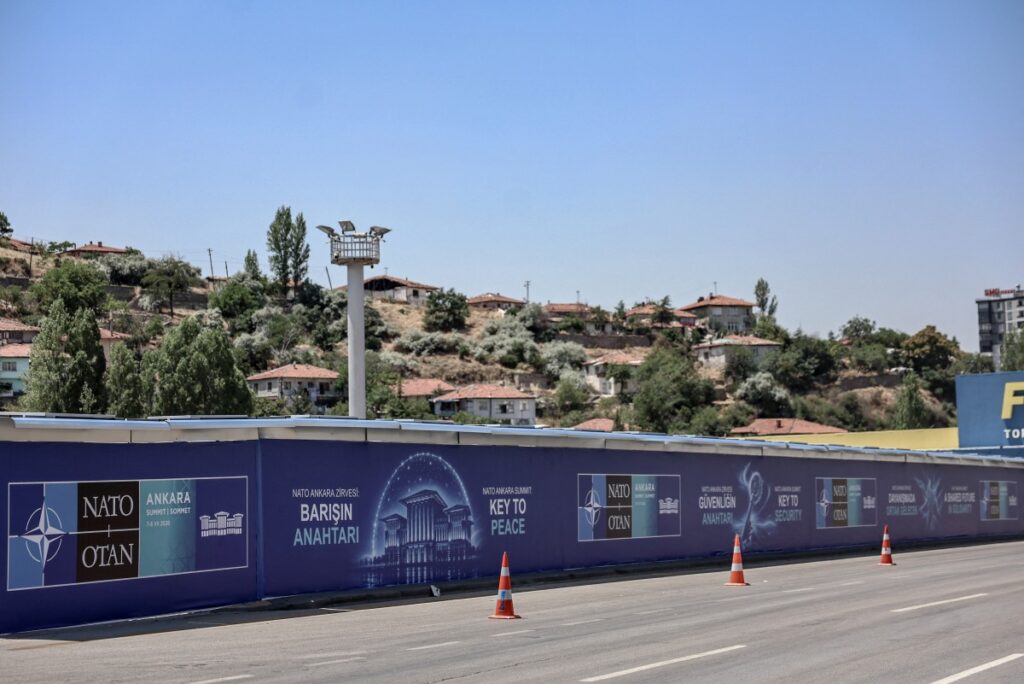
Turkish Interior Minister Mustafa Çiftçi has denied that the government went too far with sweeping security measures imposed during this week’s NATO summit in Ankara, saying the precautions were “as much as necessary” after residents, opposition figures and rights groups criticized the restrictions for disrupting daily life in the capital.
Çiftçi said during a live broadcast on Turkish broadcaster 24 TV on Thursday that some 56,000 police officers and gendarmes had been deployed during the 36th NATO Heads of State and Government Summit, which was held July 7 and 8 at the presidential complex in Ankara.

“We did not exaggerate the measures. We took precautions to the extent necessary,” Çiftçi said, adding that the security officials had reviewed all possible risks before the summit.
The summit, which brought leaders of NATO’s 32 member states to Turkey, was the second NATO summit hosted by the country, after one held in İstanbul in 2004.
Çiftçi said security planning had begun months in advance, with Ankara put at the center of a multi-layered security plan. Surrounding provinces were designated as a first security ring, nearby provinces and port cities as a second ring and border provinces as a third ring.
He said intelligence, cybercrime and counterterrorism units began work a month before the summit, that measures were increased 15 days before the event and that precautions “peaked” in the final 72 hours.
“After all these measures, we got through the summit without any problems or accidents,” Çiftçi said.
His remarks came after days of criticism over the scale of the summit preparations, which included a 13-day ban on public demonstrations, road closures, administrative leave for some public employees, police raids, restrictions affecting shopkeepers and cosmetic work along routes to be used by foreign delegations.
The Ankara Governor’s Office banned meetings, marches, press statements, hunger strikes, sit-ins, rallies and the distribution of leaflets, brochures, posters and banners across the city from June 28 to July 10, citing summit security and public order.
The government also restricted traffic around the presidential complex, delegation hotels and motorcade routes, while public employees in several central districts were put on administrative leave during the summit week unless they were assigned to critical duties.
Reports that shopkeepers were warned against creating “visual pollution,” that stray animals were removed from delegation routes and that beautification work was carried out across parts of the city further fueled criticism that the capital was being turned into a showcase for foreign visitors.
Çiftçi rejected the criticism, comparing Turkey’s preparations with security measures taken at previous NATO summits abroad.
He said 38,000 police officers had been deployed during last year’s NATO summit in the Netherlands and claimed that Turkey’s geography, border provinces and regional security risks required a broader security plan.
“In such an important summit, watched by the whole world and followed by an army of press, even the smallest incident could have negatively affected our country’s image as a safe country,” Çiftçi said.
“Therefore, to avoid allowing such a thing, we took the necessary measures.”
The minister added that intensified security checks during the summit period led to the capture of 4,412 people wanted by law enforcement, including some who had been sentenced to prison or had failed to appear for questioning.
The summit preparations also attracted criticism over detentions carried out before and during the event. Police detained more than 200 people in raids in Ankara, saying the operations targeted suspected links to extremist groups.
Rights groups and opposition figures said journalists, lawyers, academics, labor union representatives, LGBTQ activists and political activists were among those targeted, accusing the government of using summit security as a pretext to suppress dissent.
Çiftçi also denied that the collection of stray dogs in Ankara before the summit was linked to the NATO meeting, saying the work was part of a nationwide program launched months earlier and was aimed at making streets safer for residents, not protecting foreign delegations.
“This is not something specific to the summit,” Çiftçi said, adding that 88 percent of stray dogs across Turkey had been rounded up and that the government’s goal was to remove all stray animals from the streets by the end of the year.
Animal rights advocates have criticized Turkey’s campaign to remove stray dogs from the streets, warning that overcrowded shelters and weak oversight could lead to neglect or mass killings.
The government says the policy is intended to protect public safety while keeping animals in shelters where they can be fed, treated and adopted.