


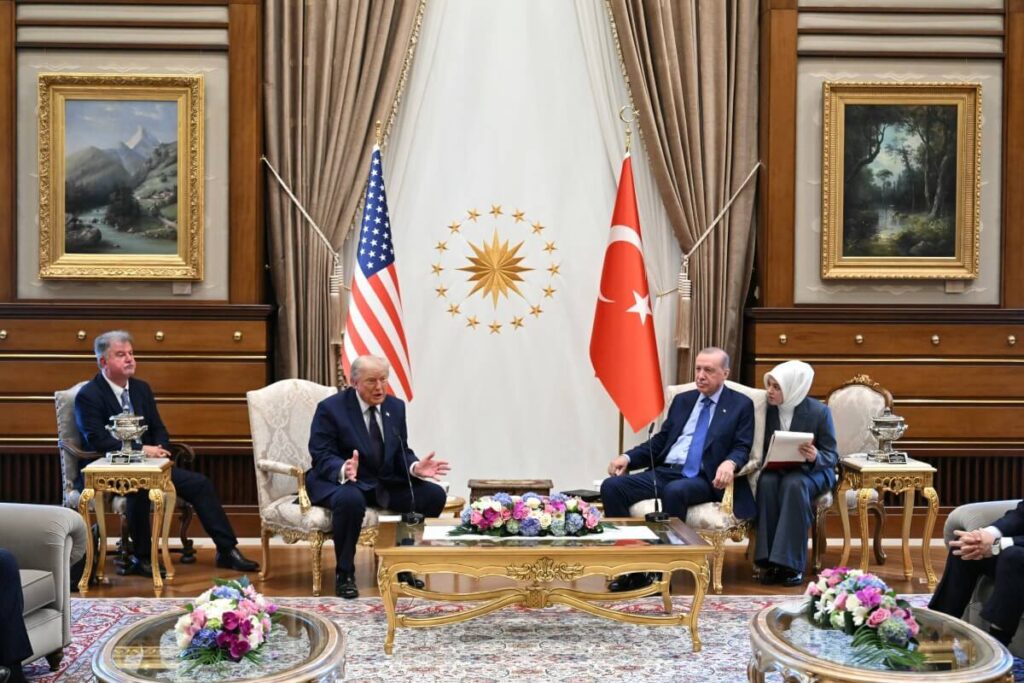
US President Donald Trump said Tuesday that Washington would consider selling F-35 fighter jets to Turkey and lifting sanctions imposed over Ankara’s purchase of a Russian missile defense system, signaling a possible shift in one of the most serious disputes between the two NATO allies.
Trump made the remarks after arriving in Ankara for a NATO summit, where he praised his “chemistry” with Turkish President Recep Tayyip Erdoğan and criticized European allies over their response to his recent war with Iran.
Reporter: Mr. President, are you going to sell F-35s to Türkiye, and what about the legal restrictions?
Trump: We're going to make a decision. I would think that many people — I can tell, many people sitting right here — would say, why wouldn't we do that?
We have a better… pic.twitter.com/VkFnKWorxk
— Clash Report (@clashreport) July 7, 2026
Erdoğan personally greeted Trump on the tarmac as he stepped off Air Force One, before the US president was escorted through the largely empty streets of the Turkish capital by riders on white horses.
ABD Başkanı Donald Trump'ı Karşılama Töreni https://t.co/8kKx5imU9x
— Recep Tayyip Erdoğan (@RTErdogan) July 7, 2026
“That’s a decision we’re going to make,” Trump told reporters in Ankara, where he later met with Erdoğan at the Turkish leader’s presidential palace. “It’s a great plane, the best plane by far, and it’s certainly something we will consider.”
“Turkey has been, in many ways, much more loyal than other countries that we think would be loyal — so, yeah, it’s something certainly we would consider,” he added.
“It’s a chemistry that works between us,” Trump said of Erdoğan.
Turkey was removed from the US-led F-35 program in 2019 after taking delivery of Russia’s S-400 missile defense system, which Washington said could be used to gather intelligence on the advanced fighter jet and compromise its stealth technology.
The decision was a major blow to Ankara, which had been both a customer and an industrial partner in the multinational program. Turkish companies had produced parts for the aircraft, while Turkey had planned to buy around 100 F-35s before the dispute derailed the deal.
The United States later imposed sanctions on Turkey’s Presidency of the Defense Industry under the Countering America’s Adversaries Through Sanctions Act (CAATSA), targeting Ankara’s purchase of the Russian system.
Turkey has long sought to resolve both its possible return to the F-35 program and the lifting of US sanctions, which have strained ties and complicated Turkish defense projects. Ankara had looked to Trump’s visit as a possible opportunity to break the deadlock.
Asked during Tuesday’s meeting whether he would lift the CAATSA sanctions, Trump said, “We’re going to be taking the sanctions off.”
“We don’t want to sanction friends,” he added.
Erdoğan said he was confident Trump would resolve the issue and end the dispute.
“Mr. Trump has also personally given us his word on this matter,” Erdoğan said through a translator. “On this issue, Mr. Trump always stands by his word. Here again, God willing, I believe a favorable decision on the F-35s will emerge from this leaders’ summit.”
When the two leaders met at the White House last September, both said they wanted to move past the dispute, although removing CAATSA sanctions would require action by Congress.
The F-35 and sanctions issue has remained one of the most contentious disputes between the two allies, along with disagreements over Syria, Turkey’s ties with Russia and Washington’s support for Kurdish groups that Ankara considers terrorist organizations.
Trump’s remarks came as he sat next to Erdoğan at the presidential complex in Ankara, where Turkey is hosting the NATO summit. The meeting gave Erdoğan a chance to press for progress on defense issues at a time when Ankara is trying to modernize its air force.
Turkey has also sought new F-16 fighter jets and modernization kits from the United States while developing its own fifth-generation fighter aircraft, KAAN, as part of an effort to reduce dependence on foreign suppliers.
Any renewed move to sell F-35s to Turkey would likely face scrutiny in Congress, where lawmakers have repeatedly warned against allowing Ankara back into the program unless the S-400 issue is fully resolved.
Trump also used his appearance in Ankara to criticize European NATO allies over what he described as their lack of support during the recent US conflict with Iran.
The summit comes at a fraught time for NATO, as Trump has repeatedly criticized allies and raised questions about Washington’s commitment to protecting Europe. European leaders are trying to avoid a clash with Trump that could further damage NATO’s credibility after he repeatedly cast doubt on the US commitment to defending allies.
“I was very disappointed with NATO,” Trump said. “We didn’t need any help at all, and in a way, I was testing people. I was testing to see whether or not they’d be there, because I’ve long said that we helped them, but I’m not sure that they’d be there for us.”
“Italy turned us down, and Germany turned us down, and France turned us down,” Trump said, referring to restrictions some allies placed on US forces using bases at the start of the US-Israeli war on Iran in February.
Trump said his relationship with Erdoğan was one reason he attended the summit. “Frankly, if it weren’t held in Turkey, where my friend happens to be a very strong leader, a very strong person, it’s possible that I wouldn’t have attended,” he said.
His comments added to tensions within the alliance ahead of summit discussions expected to focus on defense spending, Ukraine and the future of the US military role in Europe.
Trump has repeatedly accused European allies of relying too heavily on US protection while failing to spend enough on defense. The Iran conflict has sharpened those complaints, with US officials saying some allies were reluctant to grant access to bases or airspace during the campaign.
Trump also risked reopening another long-running dispute with NATO allies by repeating his view that Greenland “should be controlled by the United States, not by Denmark.”
NATO Secretary-General Mark Rutte has tried to stress allied contributions and preserve unity, but the Ankara summit opened under renewed questions about Washington’s commitment to European security under Trump.
In an effort to show Trump they are making good on a pledge to increase defense spending, NATO allies announced tens of billions of dollars in arms deals ahead of his arrival. Rutte said European countries were “delivering” by increasing military budgets and taking more responsibility for the defense of the continent in the face of Russia.
For Erdoğan, the meeting offered a chance to present Turkey as a key NATO member at a time of uncertainty inside the alliance.
Turkey has NATO’s second-largest military and controls access to the Black Sea through the Turkish Straits, giving it a central role in alliance planning related to Russia, Ukraine and the Middle East.
The war in Ukraine was also expected to feature prominently at the summit. Trump spoke to Russian President Vladimir Putin ahead of the gathering and was expected to meet with Ukrainian President Volodymyr Zelensky on the sidelines on Wednesday.
“I think they both want to make a deal,” Trump said of Putin and Zelensky. “It’s too bad it took so long, but I think something’s going to come out.”
Zelensky urged NATO leaders to step up support for Ukraine’s air defenses, saying shortages of interceptors had made it harder for Kyiv to shoot down Russian missiles. He also renewed his call for Ukraine to join NATO, despite Trump previously ruling out membership.
Turkish Minute with reporting from Agence France-Presse