


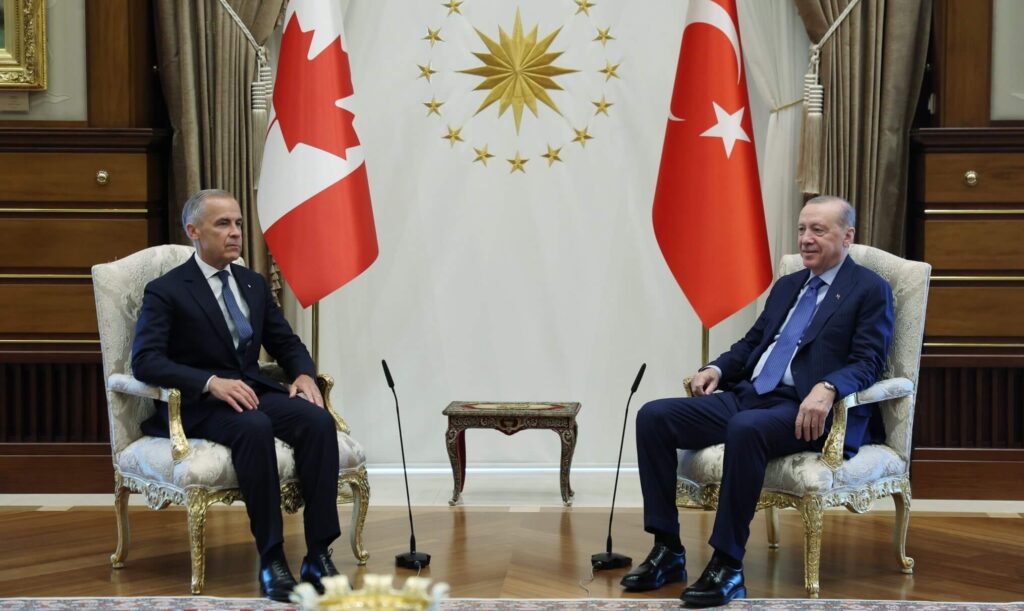
Canada and Turkey have formally launched negotiations for a free-trade agreement, the office of Canadian Prime Minister Mark Carney said Tuesday, following a meeting between Carney and Turkish President Recep Tayyip Erdoğan on the sidelines of a NATO summit in Ankara.
Carney arrived in Ankara to attend the July 7-8 NATO summit, hosted by Turkey at the presidential complex, where leaders from the 32 NATO allies were expected to discuss defense spending, support for Ukraine, defense industry cooperation and alliance unity.
The two leaders announced the start of talks toward what the statement described as a “comprehensive, modern, and mutually beneficial” free-trade agreement between the two countries.
“In the coming months, the technical teams from both countries will undertake the necessary work to define the scope and ambition of the agreement and prepare for the first round of negotiations,” the statement said.
Le Canada et la Türkiye entament des négociations en vue d'un nouvel accord de libre-échange, afin d'ouvrir de nouvelles perspectives pour nos travailleurs et nos entreprises.
Avant le Sommet de l'OTAN, j’ai rencontré le président Erdoğan à Ankara pour discuter du partenariat… pic.twitter.com/9hbYq4T0fm— Mark Carney (@MarkJCarney) July 7, 2026
The announcement marks the next step after Turkish Trade Minister Ömer Bolat and Canadian International Trade Minister Maninder Sidhu met in Ankara on June 9 and agreed to launch exploratory discussions toward a free-trade agreement.
A joint ministerial statement at the time said the move reflected the ambition of both countries to “unlock the full potential of the commercial partnership.”
The June meeting followed a phone call between Erdoğan and Carney, during which both sides reaffirmed their commitment to deepening trade and investment ties, according to the Turkish Trade Ministry.
The ministers also welcomed the recent expansion of a bilateral air transport agreement that increased weekly all-cargo flight rights between Turkey and Canada, saying stronger air links would improve connectivity and create new opportunities for travelers, businesses and exporters.
Energy was identified as another area for cooperation, with the two sides agreeing to explore opportunities in renewable and nuclear energy, including the possible use of Canadian CANDU technology to support Turkey’s energy diversification goals.
The June statement also said the ministers discussed closer cooperation in aerospace, including partnerships related to defense, security and industrial cooperation.
According to Carney’s office, closer economic cooperation would support growth and job creation, strengthen supply chains and help businesses in both countries compete in a changing global economy.
Turkey and Canada are both NATO members, but relations have at times been strained by defense and security issues, including Canadian restrictions on military exports to Turkey following Ankara’s military operations in Syria and the use of Canadian-made drone technology in conflicts involving Turkish drones.
Canada eased restrictions on arms exports to Turkey in 2024 after Ankara ratified Sweden’s NATO membership, a move that helped clear the way for improved defense and trade ties between the two allies.
Trade in goods between Turkey and Canada was about $3.1 in 2024, according to Global Affairs Canada, which manages Canada’s diplomatic and consular relations, promotes Canadian international trade and leads Canada’s international development and humanitarian assistance.