


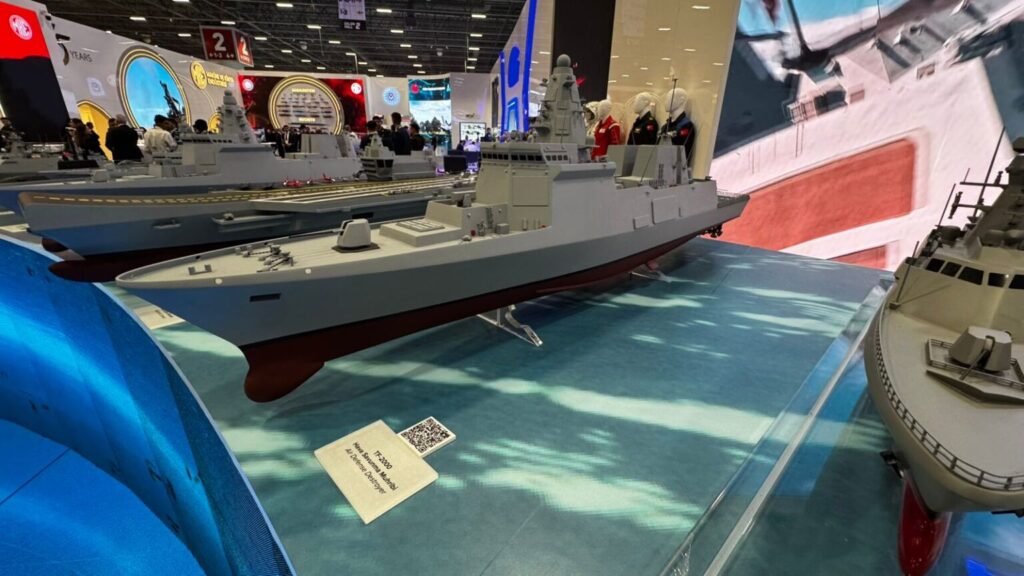
Turkey hopes this week’s NATO summit in Ankara will strengthen its claim to be a key European security partner, as it seeks a bigger role in joint defense projects after years of being left out of some major European programs.
The July 7-8 summit will open with a Defence Industry Forum, once a side event but now formally part of the program. Around 3,500 companies are expected to take part, giving Turkey a platform to promote its fast-growing defense industry.
President Recep Tayyip Erdoğan has repeatedly called for Turkey to be included in Europe’s defense and security structures, including the European Union’s 150 billion euro ($176 billion) Security Action for Europe program (SAFE).
“It is inconceivable to establish European security without Turkey,” Erdoğan has said.
Turkey has NATO’s second-largest army after the United States, with 355,000 troops and another 378,000 reservists. Its defense industry has also expanded sharply over the past decade, helped by government-backed projects, rising exports and growing demand for drones, armored vehicles, air defense systems and naval platforms.
Turkey’s defense industry ranks 11th in the world and accounts for 1.8 percent of the global arms market, according to the Stockholm International Peace Research Institute (SIPRI). Officials said defense exports grew by 48 percent in 2025, after rising 29 percent the previous year.
“We now achieve in one week what we used to achieve in one year,” Erdoğan said last month, referring to exports of drones, tanks, armored vehicles and warships.
He also said one Turkish warship delivered to Romania was the country’s first export of a military ship to an EU and NATO member state.
The summit comes as Ankara seeks to move beyond its role as a defense supplier and be treated as a strategic partner in joint production and technology cooperation.
“We do not want to be seen only as a supplier. We want to be regarded as a strategic partner,” Haluk Görgün, head of the Presidency of the Defense Industry, told the Defence24 news website last month.
But Turkey’s push faces resistance from some NATO and EU members because of disputes over Ankara’s foreign policy and defense choices, especially its 2017 purchase of Russia’s S-400 missile defense system.
“They are asking because of Turkey’s track record with Russia,” Özgür Ünlühisarcıklı, head of the German Marshall Fund in Ankara, told Agence France-Presse. “This is what Turkey needs to persuade France, Italy and Germany about.”
Turkey’s purchase of the S-400 system alarmed NATO allies and led Washington to remove Ankara from the US-led F-35 fighter jet program in 2019. The United States later imposed sanctions under the Countering America’s Adversaries Through Sanctions Act (CAATSA).
Relations with some allies had already been strained by Turkey’s military operations in Syria and Libya and tensions with Greece and Cyprus in the eastern Mediterranean.
Analysts say Turkey’s support for Ukraine has helped improve its standing inside NATO, but the S-400 issue remains a major obstacle, especially in relations with Washington.
Turkey’s defense ties with the United Kingdom and some European countries have improved, but broader cooperation with the EU remains blocked by several member states.
“Today it’s working with the UK and a number of European nations, but it’s not working with the European Union as a whole because there are a couple of members who are blocking it,” Mustafa Aydın, an international relations professor at İstanbul’s Kadir Has University, told AFP.
Under the EU’s SAFE program, companies from non-EU countries such as Turkey can supply only up to 35 percent of the component costs of weapons financed by the scheme. To gain broader access, Ankara would need a security partnership with the EU and a special agreement requiring approval from all 27 member states.
“The political issues blocking Ankara’s access to the SAFE program are the dispute between Turkey, Greece and Cyprus, but also France’s ill will,” Sinan Ülgen, a senior fellow at Carnegie Europe, told AFP.
Ülgen said excluding Turkey made little sense at a time when Europe faces Russia’s war in Ukraine and uncertainty over Washington’s long-term commitment to European security.
Spain, Romania, Poland and Italy have already built closer defense ties with Turkey. Turkish drone maker Baykar has bought Italy’s Piaggio Aerospace and signed a partnership with defense company Leonardo over the past 18 months.
Outside the EU, Britain is cooperating with Turkey’s KAAN fighter jet project, Ankara’s effort to develop a fifth-generation stealth aircraft.
Turkey also hopes the NATO summit will help unblock the delivery of US-made jet engines for KAAN when US President Donald Trump visits Ankara. The engines are needed for early versions of the aircraft while Turkey works on a domestically produced engine.
© Agence France-Presse