


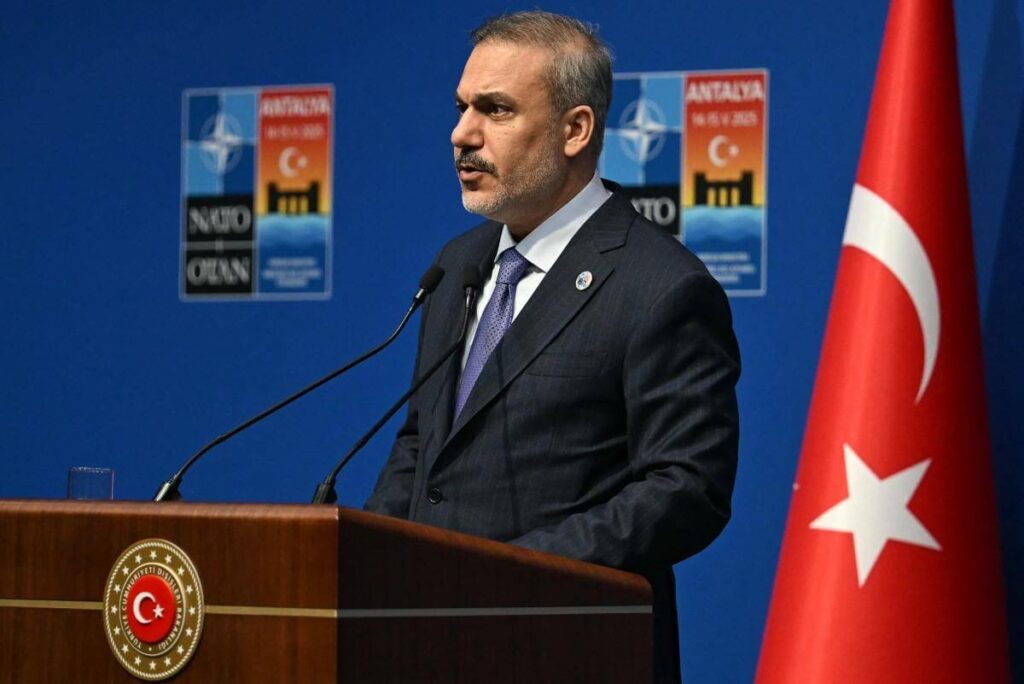
Turkish Foreign Minister Hakan Fidan has said the NATO summit in Ankara will define and approve what he called “NATO 3.0,” framing next week’s meeting as a turning point in the alliance’s shift away from a security model in which the United States has carried much of Europe’s defense burden.
Fidan made the remarks in an interview with CNN’s Turkish franchise, where he described the July 7 and 8 summit as the largest in NATO history and linked its importance to US President Donald Trump’s confirmed attendance.
He said NATO now contains three broad groups: the United States, European Union member states and allies outside the EU.
Those countries are trying to manage different threat perceptions, economic pressures and efforts to redefine their relations with one another, Fidan added.
He said it was important that they would come together in Ankara to reconcile those views, adding that “Ankara will be the place where NATO 3.0 is defined and accepted.”
Fidan said the burden-sharing system built from World War II until 2026 was no longer the same. “We are now changing the European security system in which America was dominant and carried the burden,” he said.
Fidan said that shift was not only a decision forced by Washington but also one that European countries had begun to see as necessary, adding that they needed to reduce dependence and carry more of their own burden.
He pointed to the 5 percent defense spending target as a key part of that process and said it was significant that all allies had accepted it and would act accordingly.
NATO says the Ankara summit will review progress since last year’s summit in The Hague and set a roadmap for the alliance’s goals, including defense investment, defense industry production and support for Ukraine.
The alliance says NATO members agreed last year to invest 5 percent of gross domestic product in defense and related measures, including 3.5 percent for core defense needs and 1.5 percent for broader security needs such as infrastructure and cybersecurity.
Fidan also said one reason the Ankara summit was being described as historic was that a NATO Defense Industry Forum would become part of the alliance’s official program for the first time at such a scale.
He said that showed defense industry had become one of the main pillars of defense strategy.
NATO says the forum will take place on July 7 in Ankara and bring together senior allied officials, industry leaders and others involved in defense production, investment and innovation.
The forum will focus on turning higher defense spending into production, joint procurement and what NATO calls industrial deterrence.
Fidan also linked the debate to Europe’s search for a defense order in the event of a smaller US role.
He said European countries had fought one another throughout history and still had unspoken sensitivities as they tried to build defense cooperation without full US backing.
Fidan said Turkey was ready to play an active role in regional security, but he argued that European countries were still struggling to turn political debates into strategy and practical policy.
He also criticized what he described as a more protectionist EU approach through defense programs such as SAFE and “Made in Europe” initiatives.
His remarks came as NATO leaders prepare to meet in Ankara amid debate over how far Washington will remain involved in Europe’s defense.
Reuters reported Friday that European leaders will seek at the summit to show Trump they are raising defense spending and taking more responsibility while trying to avoid open disputes over Iran, Greenland and reduced US commitments to the alliance.
Trump complained this week that the United States was spending money to protect NATO members “without getting any benefit.”
NATO Secretary General Mark Rutte has argued that European allies and Canada are taking more responsibility for conventional defense in Europe while preserving NATO as a transatlantic alliance.
“The summit next week will focus on turning extra spending into combat-ready capabilities and significantly scaling up our defense industries,” Rutte said in Berlin on Wednesday.
The summit will be the second NATO leaders’ meeting hosted by Turkey. The first was held in İstanbul in 2004.
For Ankara, the summit also offers a stage to underline Turkey’s position as a non-EU NATO member with a large military, a growing defense industry and an interest in shaping European security debates from outside the bloc.
Turkey has long argued that European defense planning cannot exclude it, especially as EU members expand joint procurement and defense industry programs.
The issue has gained weight as Ankara seeks access to European defense funding and markets while pursuing the removal of US sanctions imposed after Turkey bought Russian S-400 missile defense systems.
Fidan said in the same CNN Türk interview that President Recep Tayyip Erdoğan and Trump had a strong will to remove sanctions imposed under the Countering America’s Adversaries Through Sanctions Act (CAATSA) and that Turkey was taking the necessary steps to accomplish it.
The sanctions were imposed in 2020 over Turkey’s purchase of the S-400s, which also led Washington to remove Ankara from the F-35 fighter jet program.
Fidan said Trump’s participation in the Ankara summit was a major development for NATO and attributed it in part to Erdoğan’s invitation.
He said the current conflicts, pressures and shifts inside the alliance made that attendance important.
The summit is expected to bring together leaders from NATO’s 32 member states and key partners.
Ukrainian President Volodymyr Zelenskyy is expected to attend a dinner hosted by Erdoğan, while support for Ukraine will remain one of the summit’s main agenda items.
The summit is also taking place under a crackdown on dissent, with Turkish authorities imposing a province-wide ban on public gatherings in Ankara from June 28 to July 10 and rights groups accusing the government of using security preparations to suppress antiwar and anti-NATO protest. Amnesty International and Human Rights Watch have called for the release of people detained or put under house arrest in operations linked to the summit.
The measures have renewed criticism that NATO allies are willing to overlook Erdoğan’s authoritarian rule while relying on Turkey’s military, defense industry and role in Ukraine, Syria and European security. Reuters reported this week that allied criticism of Turkey’s human rights record has become muted as Ankara seeks defense deals and a larger place in European security planning.