


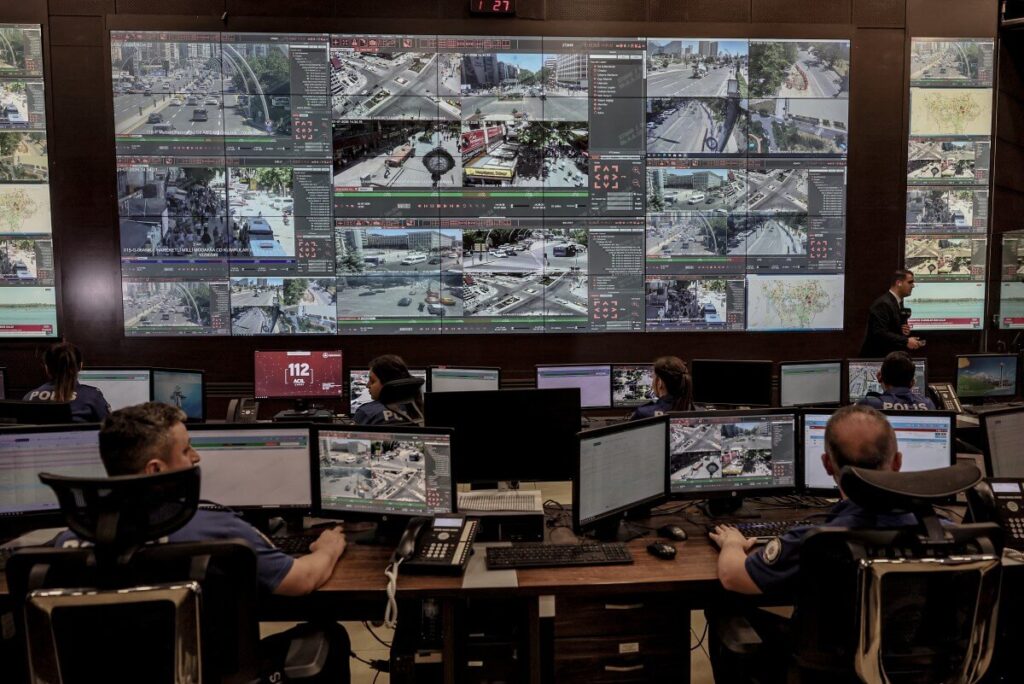
Ankara police said Friday they had apprehended more than 4,000 people wanted by authorities and checked more than 1.5 million people in security operations carried out over nearly three months before next week’s NATO summit in the Turkish capital.
Police said some 930,000 vehicles were also checked between April 4 and July 1 in operations conducted to secure the summit, which is scheduled for July 7 and 8.
The inspections covered public areas, hotels, cafes, restaurants, entertainment venues, car rental companies, parking lots, daily rental accommodations and other businesses, Turkish media reported.
Ankara Police Chief Maksut Yüksek took part in some of the inspections, visited checkpoints and met with officers assigned to summit security, according to Turkish media.
The announcement gave no breakdown of the cases involving the more than 4,000 people, leaving unclear how many were sought over ordinary criminal allegations, broad terrorism accusations, political investigations or other proceedings.
The figure added to criticism that Ankara has put the capital under conditions resembling emergency rule before the summit, with police checks, protest bans, traffic restrictions, campus measures, media exclusions and detentions over anti-NATO activity reshaping daily life in the city.
The latest detentions directly linked to anti-NATO protests took place outside Ankara.
A member of the Turkish Communist Party (TKP) was detained in the southern province of Osmaniye over social media posts against NATO, Turkish media reported Friday.
Counterterrorism police detained the party member at home late Thursday and accused the person of “inciting hatred and hostility,” according to Turkish media.
Six TKP members were detained in İstanbul on Thursday while putting up posters against NATO in the Kadıköy and Beşiktaş districts. Three were accused of “inciting crime,” and all six were later released, according to Turkish media.
The cases suggested that the pressure on anti-NATO speech and organizing has extended beyond Ankara, where the summit will bring leaders of the 32-member alliance to the presidential complex.
The measures have also affected universities in the capital.
Students at Middle East Technical University (ODTÜ), said dormitory residents without a “valid excuse” were told they could not stay in university housing from July 4 to July 13 because of summit security measures.
The university administration said personnel and vehicle entry to the campus would be restricted from July 6 to July 12 and that accommodation, food, cleaning and other support services would not be provided during that period.
Students protested the decision Thursday night, saying they had been given little time to leave and no alternative housing.
Bilkent University had earlier taken similar measures, while reports in June said some state-run dormitories were also being emptied before the summit.
The broader crackdown began with police raids on June 23, when authorities detained 225 people in an investigation into alleged links to armed groups.
Courts later jailed 178 people pending trial, placed 34 under house arrest and released six, according to rights groups and Turkish media.
Those detained included environmental volunteers, lawyers, an academic and journalist Yıldız Tar, a prominent LGBTQ rights activist.
The Ankara Chief Public Prosecutor’s Office said the operation targeted people suspected of links to armed groups. Rights groups said the authorities had not presented evidence of specific criminal acts and warned that counterterrorism laws were being used to silence dissent before the summit.
Amnesty International called on Turkey to lift what it described as a blanket protest ban in Ankara and release people it said had been arbitrarily detained or put under house arrest in connection with the summit.
The Ankara Governor’s Office banned public gatherings, marches, press statements, hunger strikes, sit ins, protests, rallies, stands, tents, leafleting, posters and banners from June 28 to July 10.
The governor’s office said the restrictions were needed to protect national security, public order, public safety, the rights and freedoms of others, foreign delegations and Turkey’s international reputation.
Other provinces have imposed similar restrictions. The Osmaniye Governor’s Office banned anti-NATO protests, press statements, signature campaigns, banners, tents and leaflets from July 1 to July 10.
The Osmaniye ban also restricted people and vehicles entering or leaving the province to support such events.
Authorities in Ankara have announced traffic and transport restrictions for the summit period.
Scooters and motorcycle couriers will be barred from key routes, delegation hotel areas and summit zones from July 6 to July 9.
Heavy vehicles, including fuel tankers, cement mixers and tow trucks, will be restricted from entering the city from July 5 to July 10.
A June circular by the Ankara Governor’s Office also put most public employees in nine districts on administrative leave from July 6 to July 12, except those assigned to summit duties or critical public services.
The same circular said public institutions and civil society groups should not hold examinations, panel discussions, symposiums, graduation ceremonies, festivals, concerts, entertainment events or celebrations during that week.
Press groups have also criticized NATO and Turkey after several Turkish outlets and journalists were denied accreditation to cover the summit.
The affected outlets include Halk TV, Sözcü TV, Cumhuriyet, T24, ANKA and Medyascope, according to Turkish journalism groups and international press freedom organizations.
NATO has said it relies on the host country’s assessment for local media accreditation when summits are held outside Brussels.
The measures have turned the summit into a test of how far the alliance is willing to overlook Ankara’s record on freedom of expression, assembly and the press.