


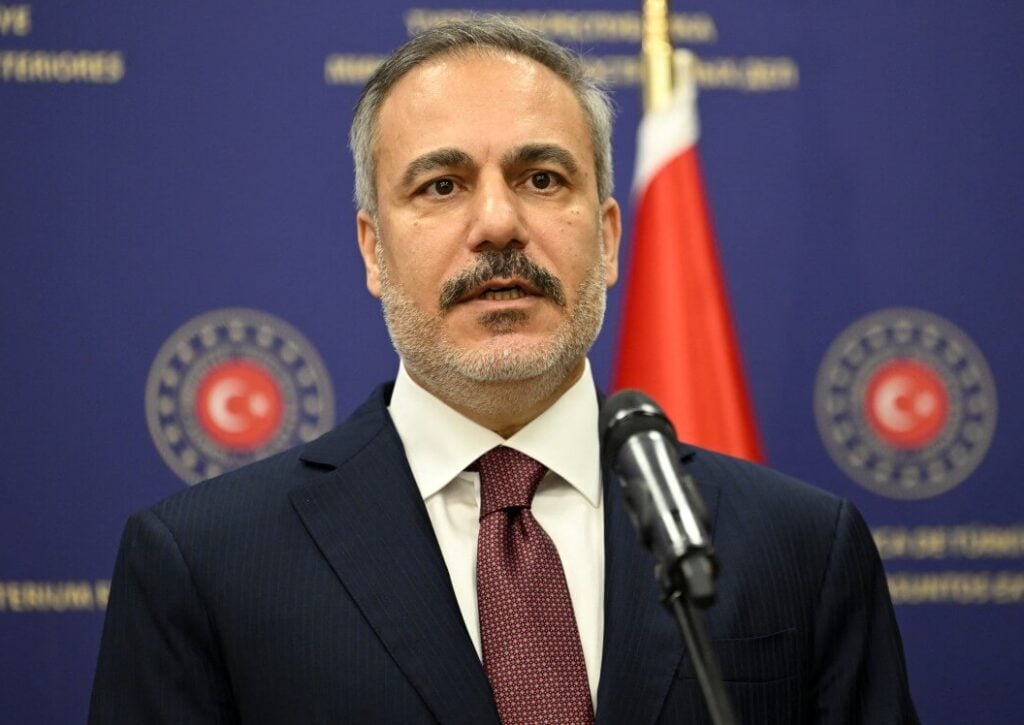
Turkish Foreign Minister Hakan Fidan said on Wednesday that Turkey is interested in joining the Single Euro Payments Area (SEPA), a European payment system that could make funds transfers between Turkey and Europe cheaper and faster, according to Turkish media reports.
Speaking at a joint news conference with his Kyrgyz counterpart, Jeenbek Kulubayev, Fidan said the relevant financial institutions in Turkey were already working on the issue.
SEPA covers 41 countries and allows people and businesses to make cross-border euro payments under common rules. The system is meant to make euro transfers between participating countries as simple as domestic bank transfers.
Fidan said relations between Turkey and the European Union were moving in a constructive direction, adding that high-level talks on the economy, trade, migration and science had resumed.
His remarks came after talks in Ankara on Tuesday with EU foreign policy chief Kaja Kallas, Marta Kos, the EU commissioner for enlargement, and Magnus Brunner, the commissioner for internal affairs and migration.
Reuters reported in March that the EU had proposed Turkey’s participation in SEPA as part of an effort to deepen economic ties and reduce the cost of sending money abroad.
Jurgis Vilcinskas, the EU’s chargé d’affaires in Ankara, told Reuters at the time that the proposal was discussed during European Commissioner for Enlargement Kos’s February 6 meeting with Fidan in Ankara.
According to the European Commission, smaller candidate countries that joined SEPA last year — Albania, Moldova, Montenegro and North Macedonia — could together save up to 500 million euros.
Vilcinskas said Turkey’s participation could reduce transfer costs for businesses, consumers and members of the Turkish diaspora in Europe.
Data cited by Reuters showed that sending between 1,000 and 5,000 euros from Europe to Turkey can cost up to 40 euros, depending on the bank and transaction size.
Turkey would need to align with EU rules on payment services, anti-money laundering and data protection before joining the system, Vilcinskas said, adding that the European Commission was ready to support Ankara in the process.
The issue falls under the responsibility of Turkey’s Finance Ministry, a Turkish diplomatic source told Reuters in March.
The EU remains Turkey’s largest trading partner, with annual trade exceeding 200 billion euros.
Although Turkey’s EU accession talks have been largely frozen for years, both sides have recently stepped up talks on economic cooperation, migration, customs union modernization and regional security.