


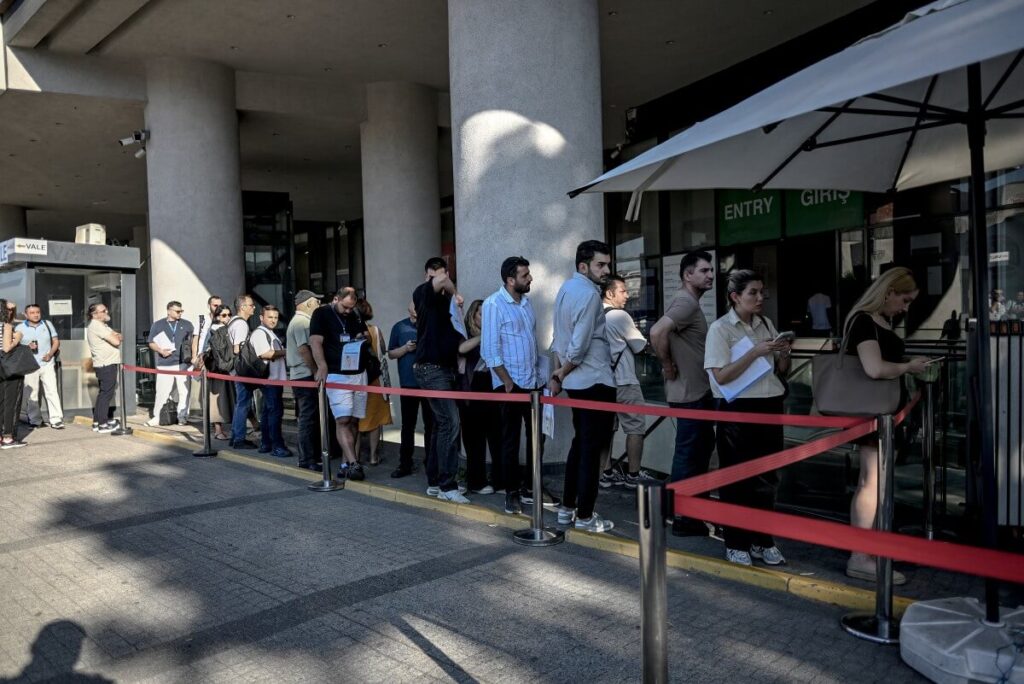
Outside an EU visa application center in an İstanbul shopping mall, a large crowd waits patiently, clutching thick folders and checking lists of required documents one last time, their anxiety clear as they wait for a security guard to call their names.
With senior European Union officials in Ankara ahead of next week’s NATO summit, the long-promised visa liberalization scheme for Turkish citizens was likely among the issues raised as frustration grows in Turkey over Schengen visa delays, rising rejection rates and the difficulty of securing appointments.
Güney Hazan, a 19-year-old student, was one of the lucky ones.
“Finally!” he shouted after opening the envelope containing his passport and finding a Schengen visa inside, clearing the way for a university exchange program in Germany.
“Even though all my documents were in order, I was anxiously awaiting the result. You never know these days,” he told Agence France-Presse.
With demand rising and backlogs growing, applicants routinely face a long, stressful and often expensive process.
“It has become torture for us. We feel like third-class citizens,” said a 25-year-old waitress after submitting her documents. She asked not to be named for fear that her application for a French visa could be rejected.
“They used to give me a five-year visa, but now I only get a two-year one. In the meantime, my application has been rejected twice without any explanation,” she said.
“It’s because of the situation in Turkey,” her friend said.
“Since Europe doesn’t approve of Turkey’s policies, it doesn’t want its citizens either,” she added, also asking not to be named.
In recent years, concerns have grown over declining political and civil freedoms under Turkish President Recep Tayyip Erdoğan, prompting many people, especially younger Turks, to look to Europe for better opportunities, observers say.
Risk of asylum claims
Turkish nationals submitted 1.25 million visa applications for the Schengen zone last year, up from 906,000 in 2019, according to European Commission figures.
Of those applications, 1.07 million were approved.
But as applications have surged, the rejection rate has also risen, from 9.7 percent in 2019 to 14.6 percent in 2025, fueling headlines in Turkey about a “visa crisis.”
A diplomatic source at the French Embassy said Turkey’s economic crisis, with annual inflation at 32.6 percent in May, had changed the profile of visa applicants.
“Some aren’t granted visas because their economic situation has deteriorated, even though our criteria remain the same,” the source said.
To obtain a Schengen tourist visa, applicants must show they have had at least 2,800 euros ($3,200) in their bank account for the previous three months, more than five times Turkey’s minimum wage.
Asylum figures have also added to European concerns. Turks ranked fifth among asylum seekers in Europe last year, according to the European Union Agency for Asylum.
This means Schengen countries are “strictly applying the criteria and, above all, closely assessing the risk of migration,” the French diplomatic source said.
Germany, one of the EU’s most influential members, said visa liberalization depends on “reforms.”
In 2013 Brussels laid out a roadmap of 72 conditions Ankara must meet for Turkish citizens to gain visa-free travel to the Schengen area. Turkey has still not met all of them, a German Federal Foreign Office spokesperson said.
One of the remaining conditions requires Turkey to reform its counterterrorism law, which critics say is used to punish dissent.
Bots hijack the appointment system
For many applicants, the hardest part is securing an appointment to submit their documents.
“You can wait nearly a year for an appointment. I was on the waiting list for two months without knowing when I’d get a response,” said a 22-year-old student waiting to start a computer engineering internship in Germany.
Private agencies authorized by consulates collect applications and manage appointments based on quotas set by European countries.
Under normal circumstances, a visa application costs 90 euros ($103), plus an agency fee of about 30 euros.
But the appointment system has been exploited by automated software bots that grab available slots as soon as they are released. The appointments are then resold at high prices to applicants desperate to file their paperwork.
“We’ve seen visa appointments being sold on the black market at very high prices — up to 300, 500 or even 1,000 euros in urgent cases,” said Hamit Kuk, head of the Turkish Travel Agencies Association (TÜRSAB).
“It’s like a game of chance,” said the young waitress, who fears she may have to repeat the whole process if her application is rejected.
“We’ve rolled the dice. Now we wait and see.”
© Agence France-Presse