


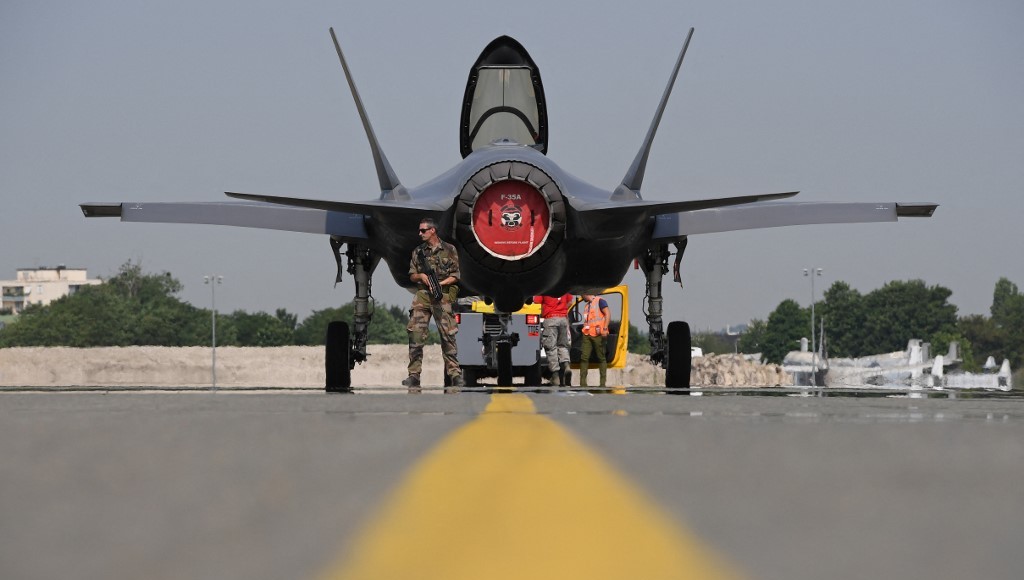
A group of US lawmakers is urging House leaders to be ready to block any attempt by the Trump administration to allow Turkey to acquire F-35 fighter jets despite Ankara’s continued possession of a Russian-made S-400 air defense system, the Greek Kathimerini newspaper reported on Sunday.
The lawmakers, led by Democratic Rep. Dina Titus of Nevada, are preparing a letter to House Majority Leader Steve Scalise and House Minority Leader Hakeem Jeffries calling for a Joint Resolution of Disapproval if the administration seeks to return Turkey to the F-35 program without meeting US legal requirements.
The letter, expected to be sent after lawmakers finish collecting signatures, says Congress should be prepared to act if the administration tries to bypass or effectively waive requirements under the Countering America’s Adversaries Through Sanctions Act, (CAATSA) without a credible legal basis.
“Readmitting Turkey into the F-35 program would place the Administration in direct conflict with its own statutory obligations,” the letter says, according to Kathimerini, which obtained a copy.
The move comes after US President Donald Trump said last week that he would “probably do something” that would make Turkish President Recep Tayyip Erdoğan “very happy” when asked whether Turkey could regain access to F-35 fighter jets.
Vice President JD Vance later said any sale of F-35s to Turkey would require approval from Congress and compliance with US law.
The F-35, a stealth fighter made by Lockheed Martin, was developed by the United States in partnership with other NATO countries, including Turkey, under the Joint Strike Fighter program.
Washington removed Turkey from the program in 2019 after Ankara took delivery of the Russian S-400 missile defense system, saying it could compromise the security of the aircraft.
The purchase also triggered US sanctions under CAATSA, which remain in effect.
The lawmakers’ letter recalls that the first Trump administration imposed sanctions in December 2020 on Turkey’s Presidency of Defense Industries over the S-400 purchase and says the conditions that led to those sanctions have not been remedied.
“Nothing in the public record suggests Turkey has disposed of the S-400 system, removed it from operational service, or otherwise remediated the underlying concern that triggered sanctions in the first place,” the letter says.
The lawmakers also cite the 2020 National Defense Authorization Act (NDAA), which separately bars the transfer of F-35 aircraft to Turkey unless Ankara no longer possesses the S-400 system, provides assurances that it will not acquire it again and certifies that it has not accepted further deliveries linked to the S-400 or another system that could threaten US weapons platforms.
US Ambassador to Turkey Tom Barrack said in April that any deal allowing Turkey back into the F-35 program would require Ankara to fully comply with US law by verifiably ending possession and use of the S-400.
Barrack said any resolution would have to satisfy Section 1245 of the NDAA, which requires certification to Congress that Turkey no longer possesses or operates the system and that it poses no risk to sensitive F-35 technology.
The lawmakers also warned that allowing Turkey to acquire F-35s would send a damaging message to US partners in the Eastern Mediterranean.
“Turkey’s conduct in recent years has not been that of an ally acting in good faith with its NATO partners,” the letter says, citing Ankara’s posture toward Greece and Cyprus, its support for Azerbaijan in its conflict with Armenia and its hostility toward Israel.
The Hellenic American Leadership Council, a US-based Greek-American advocacy group, has also launched a nationwide campaign urging Americans to contact members of Congress in support of Titus’s proposed resolution and against any move to restore Turkey’s access to the F-35 program.
The group has also criticized the Trump administration’s approval of a more than $700 million sale of GE F110 engines for Turkey’s KAAN fighter jet program, calling it “a major gift to President Erdoğan.”
The planned sale covers GE F110 engines, which Turkey wants to use in the early production phase of KAAN, its domestically developed fighter jet. Although Ankara presents KAAN as a national project aimed at reducing reliance on foreign suppliers, the aircraft’s first versions are expected to depend on US-made engines until Turkey develops a local alternative.
The dispute over the S-400 has been one of the main sources of tension between Ankara and Washington for years.
Turkey says it turned to the Russian system after failing to secure comparable air defenses from its NATO allies, while US officials have warned that the S-400 could allow Moscow to gather data on the F-35’s stealth capabilities.