


Bünyamin Tekin/Orhan Sait Berber, Strasbourg
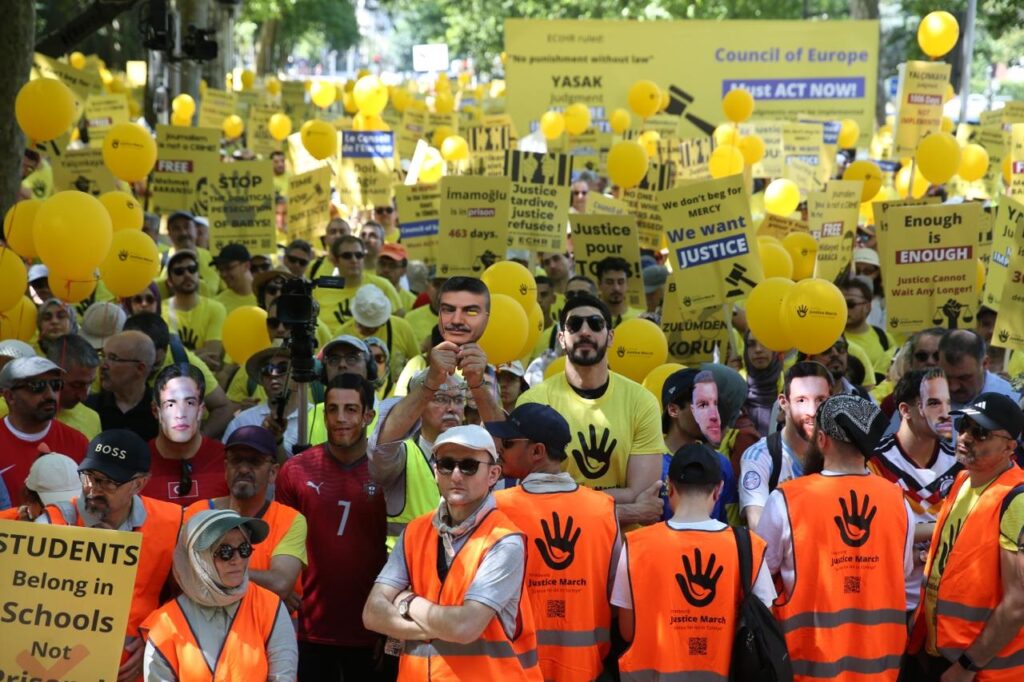
Thousands of Turkish expatriates, purge victims and human rights advocates rallied outside the Council of Europe in Strasbourg on Wednesday, urging Europe’s main human rights bodies to move beyond criticism and take concrete action over Turkey’s failure to implement landmark European court rulings.
The demonstration, the fifth annual Justice March organized by the Peaceful Actions Platform, brought together people from several European countries in front of the Council of Europe, the 46-member body that oversees the implementation of judgments by the European Court of Human Rights (ECtHR).
Organizers and speakers put the crowd at more than 5,000. Participants carried banners calling for “Justice for Everyone” and demanded the implementation of ECtHR judgments in cases involving imprisoned businessman and civil society figure Osman Kavala, Kurdish politician Selahattin Demirtaş and former teacher Yüksel Yalçınkaya.
The protest began with a morning gathering, followed by the formation of a cortege, a march toward the stage area, the delivery of a letter to the Council of Europe and a youth theater performance. The stage program included speeches by European politicians, academics, activists and victims, along with video messages, music, slogans and a closing statement.

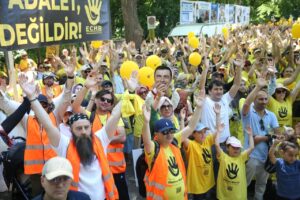
The central demand was simple and repeated throughout the event: ECtHR judgments are binding, not advisory, and the Council of Europe must use its enforcement tools when a member state refuses to comply.
“We are tired of condemning,” former NBA player and human rights advocate Enes Kanter Freedom told the crowd. “We would like to see concrete actions against those in power in Turkey.”
Freedom, a Turkish-born former basketball player who has become one of President Recep Tayyip Erdoğan’s most outspoken critics abroad, said the protesters were not targeting Turkey as a country.
“Our problem is not with Turkey. Our problem is not with our flag or our people. Our problem is with the current regime,” he said, adding that mothers, teachers and children were among those waiting for help in Turkish prisons.
Speaking to Turkish Minute, Freedom said the protest was meant to show victims in Turkey that they had not been forgotten.
“Five thousand people are here demanding only one thing. We want justice back to Turkey,” he said. “We are tired of hearing condemnation because while they are condemning all the atrocities, innocent people are suffering in jail.”
Former #NBA player Enes Kanter Freedom (@EnesFreedom), who has lived in exile in the US since Turkey revoked his passport in 2017, joined today’s #Strasbourg protest calling for justice in Turkey.
“We are tired of hearing condemnation. We want concrete action,” he told Turkish… pic.twitter.com/vRguDF5AaE— Turkish Minute (@TurkishMinuteTM) June 24, 2026
The event came nearly 10 years after a failed coup in Turkey triggered a sweeping purge of state institutions and a crackdown on people accused of links to the faith-based Gülen movement, inspired by the late Turkish cleric Fethullah Gülen.
Turkish President Recep Tayyip Erdoğan has targeted followers of the movement since corruption investigations in December 2013 implicated him as well as some members of his family and inner circle. He dismissed the investigations as a Gülenist conspiracy and a coup attempt against his government, later designating the movement as a terrorist organization in May 2016. The crackdown intensified after an abortive putsch in July of the same year, which Erdoğan accused Gülen of masterminding. The movement denies involvement in the coup attempt or any terrorist activity.
According to the latest figures from the Justice Ministry, more than 126,000 people have been convicted for alleged links to the movement since 2016, with 11,085 still in prison. Legal proceedings are ongoing for more than 24,000 people, while another 58,000 remain under active investigation nearly a decade later.
Following the coup attempt, Turkey declared a state of emergency that remained in effect until July 19, 2018. During that period, the government purged state institutions by emergency decree-laws, removing more than 130,000 public servants, including 4,156 judges and prosecutors as well as more than 24,000 members of the armed forces, for alleged membership in or links to terrorist organizations.
The Strasbourg gathering framed those post-coup measures as part of a broader rule-of-law crisis that now also affects opposition politicians, Kurdish political actors, elected mayors, journalists, lawyers, students, teachers and civil society groups.
A key part of the program focused on the Yalçınkaya judgment, a 2023 Grand Chamber ruling in which the ECtHR found violations of the right to a fair trial, no punishment without law and freedom of association in the conviction of Yüksel Yalçınkaya, a former teacher accused of links to the Gülen movement.
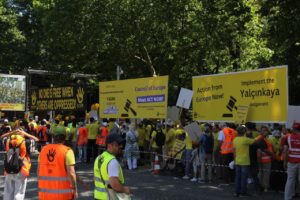
The organizers described Yalçınkaya as an ordinary teacher whose lawful activities were later treated as evidence of terrorism.
“He was not a powerful man. He was not a public figure. He was not dangerous,” one of the hosts said. “He was simply a teacher, a person who believed in education.”
Turkish courts had treated ordinary acts such as depositing money in a legally operating bank, reading certain newspapers, membership in trade unions or associations and using a messaging application as evidence of terrorism, according to the organizers.
The ECtHR said in the Yalçınkaya case that the problems leading to violations were systemic and that Turkey needed to take general measures, especially regarding the judiciary’s approach to ByLock, an encrypted messaging application treated by Turkish courts as evidence of Gülen movement membership.
The court also said about 8,500 similar applications were pending before it. Rights advocates say the number of people affected inside Turkey is far larger because many similar cases remain before domestic courts.
Despite the Grand Chamber judgment, a Turkish court convicted Yalçınkaya again, a decision protesters and rights groups describe as evidence that Ankara is refusing to address the systemic problem identified by the European court.
US academic Sophia Pandya, one of the day’s most forceful speakers, said she had traveled from California to stand with victims of Turkey’s purge.
“I’ve come all the way from California to stand with you today in solidarity for all that you’ve went through,” she told the crowd. “You’ve been robbed of your human rights.”
Pandya said judicial independence and the rule of law were meant to protect religious and ethnic minorities as well as everyone’s human rights but that Turkey had failed to uphold those protections.
“Turkey is one of the founding members of the Council of Europe and one of the first signatories onto the European Convention on Human Rights, but it has failed you,” she said.
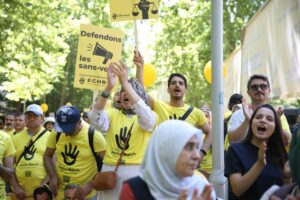
She cited the aftermath of the 2016 coup attempt, saying Turkey had suspended the European Convention on Human Rights and then arrested, tortured and detained people while shutting down schools, tutoring centers, newspapers and other institutions.
Pandya also referred to the ECtHR’s Grand Chamber ruling in the case of Demirtaş, the former co-chair of the pro-Kurdish Peoples’ Democratic Party (HDP) who has been in prison since 2016.
The ECtHR ruled in 2020 that Demirtaş’s detention pursued an ulterior political purpose and called for his immediate release. He remains behind bars.
“He should be set free, and so should all of the mothers and babies that are held in jail,” Pandya said.
Pandya said she had interviewed 75 victims of Turkey’s purge during three summers in Greece and heard accounts of torture, sexual violence, overcrowded cells and family separation.
“I’m still holding those stories with me, and I will probably hold them with me forever,” she said.
James MacCleary, a British Liberal Democrat member of Parliament for Lewes, told the crowd that the Council of Europe building behind the protest represented a promise that rights would be protected and governments would not be allowed to do whatever they wanted.

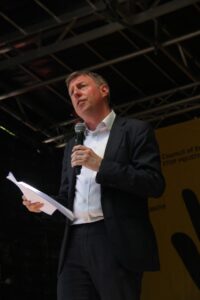
“Today we’re here because that promise is being broken to the people of Turkey,” MacCleary said.
He said the crisis extended beyond the cases of Gülen-linked defendants and political prisoners to the recent detention of İstanbul Mayor Ekrem İmamoğlu and pressure on Turkey’s main opposition Republican People’s Party (CHP).
“We have also seen the continued imprisonment of Ekrem İmamoğlu, the elected mayor of İstanbul, a man with a clear democratic mandate for millions of citizens,” MacCleary said. “His imprisonment is not only an attack on one individual. It is an attack on every voter who chose him.”
İmamoğlu, widely seen as Erdoğan’s strongest electoral rival, was arrested in March 2025 and jailed pending trial in a case his supporters describe as politically motivated. His detention triggered nationwide protests and intensified concerns that the judiciary is being used to sideline opposition figures.
MacCleary also referred to a court decision removing CHP leader Özgür Özel and the party leadership, saying courts should not decide who leads the opposition.
“A political party must be chosen by its members, not by a court acting under government pressure,” he said. “When the courts are used to decide who may lead the opposition, then democracy itself is on trial.”
He called on the Council of Europe not to “look away” and urged European governments not to “trade away human rights for short-term convenience.”
“Release political prisoners. Respect democratic mandates. Stop using the courts to crush opposition,” he said in a message directed at Erdoğan’s government.
The protest also featured video messages from European lawmakers and public figures.
Jan Paternotte, parliamentary group leader of the Dutch social liberal Democrats 66 (D66) party in the House of Representatives, said Strasbourg was symbolically important because it is home to the European Court of Human Rights.
“The European court has spoken, and its rulings are not there for show. They are there to be honored,” Paternotte said.
He said speaking up was not an attack on Turkey because Turkey remained an important ally.
“That is precisely why we speak up among friends. You tell each other the truth,” he said, adding that he hoped for İmamoğlu’s release, free and fair elections and “a Turkey where criticism is never a crime.”
Raquel García Hermida-van der Walle, a Dutch member of the European Parliament from D66 and the liberal Renew Europe group, praised protesters for gathering in Strasbourg to defend the rule of law, democracy and freedom in Turkey, describing them as European values as well.
Kathleen Van Brempt, a Belgian member of the European Parliament and vice president of the Socialists and Democrats group, said silence only helps autocrats.
“For all the people, the journalists, the researchers, the women, civil society organizations and minorities, all under attack, let this be my message to you today: People of Turkey, we see you, we hear you, and we will stand by you,” she said in a video message.
Michael Bloss, a German member of the European Parliament from the Greens, said the Council of Europe had to enforce the rulings of its own court.
“A binding judgment left unenforced is a right denied,” he said.
He said Turkey’s failure to make progress on the rule of law, democracy and human rights also made the resumption of European Union accession talks impossible.
Thomas Bruning, general secretary of the Dutch Association of Journalists (NVJ), addressed the protest in a video message from what appeared to be the association’s general assembly, focusing on press freedom.
“A lot of journalists in Turkey are not free to do their work. They are jailed or they had to flee the country,” Bruning said.
Prof. Dr. Han Entzinger, professor emeritus of migration studies at Erasmus University Rotterdam and former chair of the Scientific Committee of the European Union Agency for Fundamental Rights, said independent journalism, reliable data and a varied press were essential to the protection of rights.
“The implementation of all this and the enforcement of the rule of law, including the judgments of the European Court of Human Rights, urgently needs improvement in Turkey,” Entzinger said.
The gathering also included cultural and symbolic elements, including a Justice Wall, music, slogans and a performance about children separated from imprisoned parents. One segment told the story of Ahmet Burhan Ataç, a child with cancer who died in 2020 after being separated from his imprisoned father, whose passport had been revoked.
The performance portrayed the suffering of children whose families were caught up in Turkey’s post-coup crackdown, saying “the burden of separation was never meant for children.”
Hilal Nesin, a Turkish artist and performer, told Turkish Minute that she attended the demonstration “for justice” and on behalf of millions of people in Turkey who cannot speak freely.
“I am here on behalf of 86 million people,” she said. “I am here not only for the innocent, but also for ordinary people who cannot speak in Turkey.”
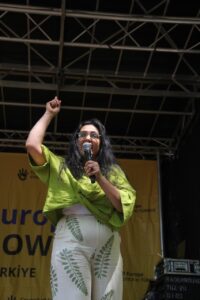
Nesin said the annual gatherings had grown from a small group into a mass protest.
“When I first attended, we were 13 people. Today there are thousands of people here,” she said. “We will continue to insistently demand justice.”
Dutch political historian and journalist Ewout Klei told Turkish Minute that he was covering the demonstration and hoped it would put pressure on European institutions, though he cautioned that ECtHR procedures can be slow.
He said Turkey’s NATO role and Europe’s dependence on Ankara, especially amid Russia’s invasion of Ukraine and uncertainty over US policy, weakened pressure on Turkey over human rights.
“Turkey is still a member of NATO, and they help us also with NATO with the conflict in Ukraine,” Klei said. “From a geopolitical perspective, Russia is the biggest threat for Europe.”
Klei said the demonstrators’ moderate message could be effective if combined with lobbying.
“You can have demonstrations, but if you really want to have influence, you have to conquer the hearts and minds of people,” he said.
#Dutch political historian and journalist Ewout Klei also attended today’s #Strasbourg protest to report on the demonstration and spoke briefly to Turkish Minute.
Klei said #Europe has become increasingly dependent on #Turkey for its security, a dynamic he said has had a… pic.twitter.com/Cfj2qjbHYt
— Turkish Minute (@TurkishMinuteTM) June 24, 2026
The Strasbourg protest has been an annual event since 2022, when Turkish expatriates and purge victims gathered outside the ECtHR to demand justice for victims of Turkey’s post-coup crackdown. Later gatherings expanded the focus from Gülen-linked purge victims to broader categories of political prisoners and rights victims, including Kavala, Demirtaş, Kurdish politicians, journalists and elected mayors removed from office.
This year’s event continued that expansion under the slogan “Justice for Everyone,” arguing that Turkey’s rule-of-law crisis is no longer confined to one political or social group.
The Peaceful Actions Platform said it was calling on the Council of Europe to use its supervisory tools, defend the authority of the ECtHR and ensure full, effective and prompt implementation of the court’s rulings.
The closing statement thanked parliamentarians, legal professionals, members of the media and participants who had come to Strasbourg to speak for people who could not be present.
“We demand justice for all now,” the statement said.