


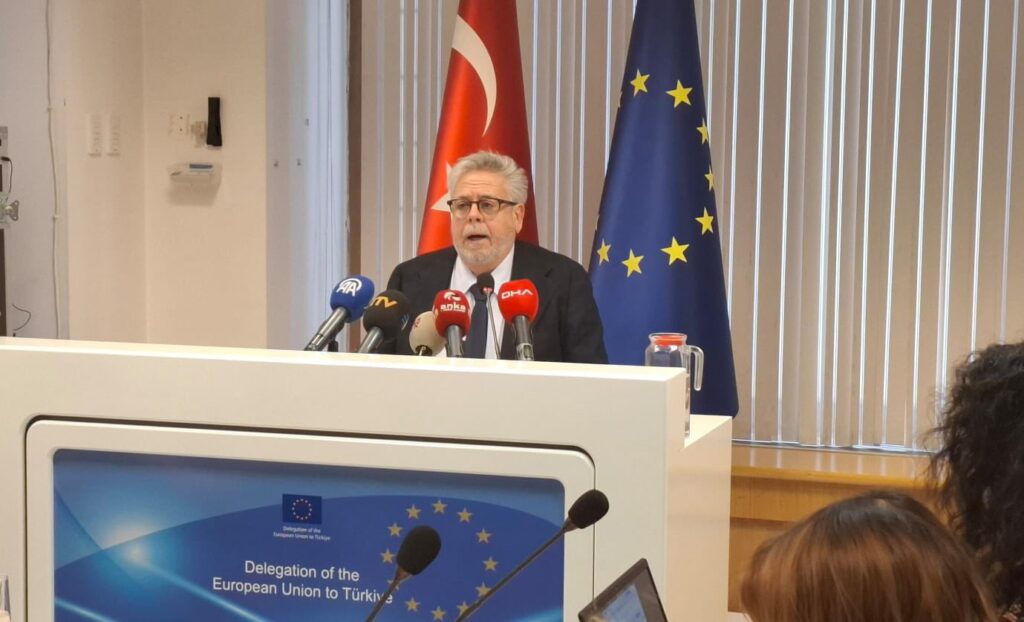
The European Parliament’s rapporteur on Turkey said Ankara could not use its drone industry and military power as a substitute for democratic reform, arguing that the country’s road to Europe begins at the prison holding İstanbul Mayor Ekrem İmamoğlu, philanthropist Osman Kavala and other government critics.
Nacho Sánchez Amor made the remarks Wednesday at an official European Parliament press conference in Strasbourg after lawmakers adopted their annual report on Turkey.
“When you talk about approaching the European Union, trying to be a member, this is not about drones,” Sánchez Amor said. “This is not about geopolitics, this is not about military capability. This is about democracy.”
He said the path to Europe did not begin in drone factories but in Silivri, referring to the prison complex west of İstanbul where jailed İstanbul Mayor İmamoğlu, philanthropist Kavala and other prisoners are being held.
İmamoğlu, President Recep Tayyip Erdoğan’s main political rival, has been jailed since March 2025 and is standing trial with more than 100 İstanbul municipal officials in a case the main opposition Republican People’s Party (CHP) says was designed to remove him from politics.
Kavala has been imprisoned since 2017 despite European Court of Human Rights rulings ordering his release.
Sánchez Amor was responding to a journalist’s question about Cyprus and Turkey’s efforts to join new European defense initiatives.
He said Turkey wanted to showcase its defense capabilities and participate in European Union security structures while maintaining troops in northern Cyprus, supporting a two-state settlement on the island, possessing Russian S-400 missiles that are incompatible with NATO systems and aligning with only a small share of the European Union’s foreign policy positions.
“Do you really want to be part of our defense system, having Russian missiles incompatible with the NATO systems?” Sánchez Amor said.
He said Turkey’s defense capabilities could be discussed as part of a partnership with the European Union but could not be used to weaken the democratic conditions attached to membership.
“Membership is about democracy, partnership is about interest,” he said.
The European Parliament adopted the 2025 Turkey Report by 381 votes to 107, with 171 abstentions.
The nonbinding resolution said Turkey’s accession negotiations, stalled since 2018, could not resume without progress on judicial independence, the rule of law, human rights, press freedom and democratic standards.
It accused Erdoğan’s government of moving toward an authoritarian system and condemned the prosecution of İmamoğlu, the judicial removal of the CHP leadership, the replacement of elected opposition mayors with government-appointed trustees and Turkey’s refusal to comply with European Court of Human Rights judgments.
The report also urged European Union foreign policy chief Kaja Kallas to consider sanctions under the EU Global Human Rights Sanctions Regime against Turkish officials accused of serious violations of human rights and fundamental freedoms.
It named Justice Minister Akın Gürlek, who served as İstanbul’s chief public prosecutor before Erdoğan appointed him to the ministerial position in February.
Gürlek oversaw the investigations targeting İmamoğlu and other CHP officials during his tenure as chief prosecutor.
The report described Gürlek as a key figure in what it called the state’s “repressive machinery” and said his appointment as justice minister reinforced concerns that he had acted throughout his judicial career as a political figure pursuing a political agenda.
Adoption of the report would not place Gürlek on a European Union sanctions list.
Sanctions, including an asset freeze and travel ban, would require a separate decision by the governments of the European Union’s 27 member states.
Turkey’s Foreign Ministry denounced the report hours after the vote, saying it contained assessments based on unfounded allegations and misinformation supplied by groups hostile to Turkey.
The ministry accused some European Parliament members of pursuing an ideological political agenda intended to damage relations between Ankara and Brussels at a time when Turkey’s strategic importance to Europe was increasing.
It rejected what it called the distortion of legal proceedings conducted by Turkey’s judiciary and the targeting of Gürlek with baseless accusations.
“The Turkish judiciary, one of the fundamental pillars of our state’s sovereignty, is not open to interference by any international institution, external actor or political circle,” the ministry said.
The ministry did not respond separately to the report’s findings about İmamoğlu, Kavala, the CHP crackdown or Turkey’s failure to implement European court judgments.
Presidential Communications Director Burhanettin Duran said Turkey rejected the report “in the strongest terms,” accusing the European Parliament of using distorted information and ideological arguments.
Duran criticized sections concerning the Blue Homeland doctrine, under which Ankara claims maritime rights across parts of the eastern Mediterranean and Aegean seas.
He accused the parliament of supporting what he called Greece’s maximalist demands and adopting a biased position on Cyprus.
Duran also rejected the report’s criticism of the judiciary and Gürlek, saying Turkey conducted legal proceedings through its own institutions under the rule of law.
Akif Çağatay Kılıç, Erdoğan’s chief adviser on foreign policy and security, said the report reflected established prejudices and political reflexes rather than an objective evaluation of Turkey.
Kılıç described the criticism of Gürlek and continuing prosecutions as an unacceptable attempt to interfere in Turkey’s judiciary and domestic legal processes.
He also denied an allegation in the report that Ankara used Turkish communities in Europe to influence European Union policy, saying it treated people exercising their democratic rights as instruments of political influence.
Kılıç said relations should be based on common interests, mutual respect and cooperation in areas including security, energy, the economy and regional stability.
Justice and Development Party (AKP) Secretary-General Eyyüp Kadir İnan said the vote demonstrated the European Parliament’s double standards and political prejudice against Turkey.
“Turkey is not a country that will seek permission from reports or foreign centers,” İnan said.
Before the vote, Gürlek had dismissed European Parliament reports as nonbinding political documents and accused lawmakers behind the sanctions proposal of ideological prejudice.
The opposition, rights groups and European institutions say the Turkish courts have increasingly been used to remove Erdoğan’s political rivals and suppress government critics.