

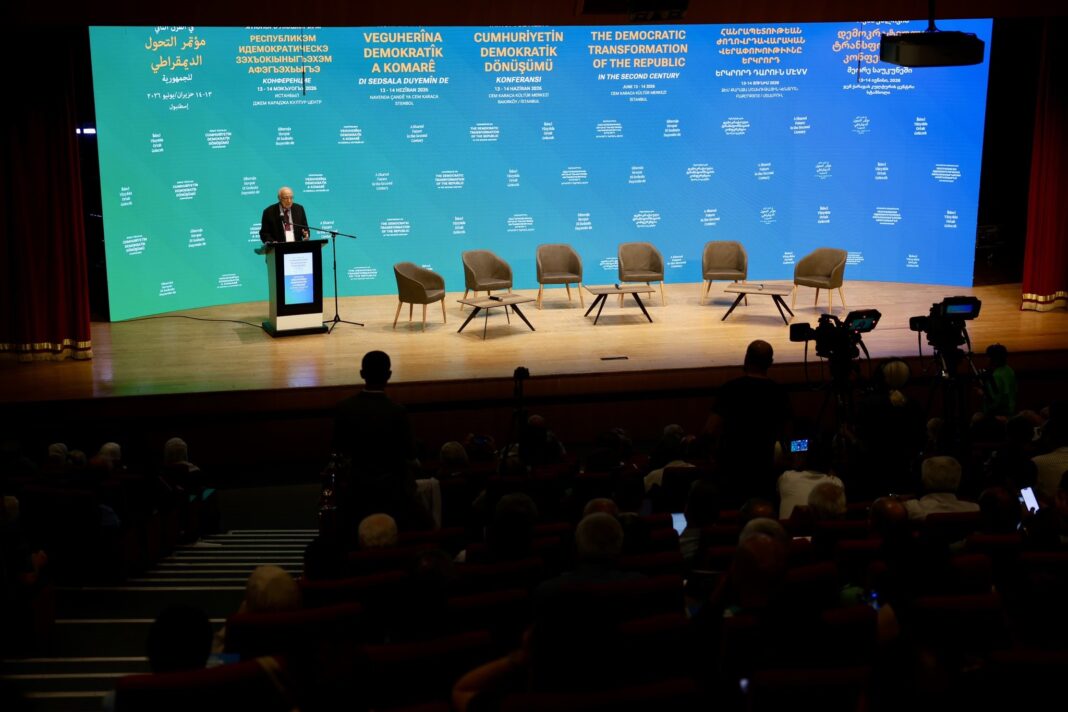

A two-day conference bringing together Kurdish politicians, rights advocates, academics and writers opened in İstanbul on Saturday with calls to link Turkey’s Kurdish peace effort to a broader campaign for democratic reform.
The Conference on the Democratic Transformation of the Republic in Its Second Century was organized by 29 public figures to discuss equal citizenship, political participation, fundamental rights and a peaceful resolution of Turkey’s Kurdish conflict.
The title refers to the second century of the Turkish Republic, which was founded in 1923.
Former European Court of Human Rights judge Rıza Türmen and Kurdish politician Gültan Kışanak delivered the opening speeches at the Cem Karaca Cultural Center in İstanbul’s Bakırköy district.
Türmen said Turkey had reached a choice between the consolidation of President Recep Tayyip Erdoğan’s centralized system of government and the creation of a new democratic movement.
He accused Erdoğan’s ruling Justice and Development Party (AKP) of dismantling the political consensus on which the republic was founded without replacing it with a democratic alternative.
“At no point in its history has the republic been this far removed from democracy,” Türmen said.
Türmen, who represented Turkey on the European rights court between 1998 and 2008 and later served as a lawmaker for the main opposition Republican People’s Party (CHP), called for a coalition of political parties, civil society groups and citizens.
He said such a movement should connect the erosion of democratic institutions with poverty and other problems affecting daily life.
Türmen also condemned a May 21 appeals court ruling that invalidated the CHP’s 2023 leadership congress, removed Özgür Özel as chairman and reinstated his predecessor, Kemal Kılıçdaroğlu.
The CHP and rights groups have described the ruling as part of a government-backed judicial campaign against Erdoğan’s political opponents.
“The fundamental contradiction is not the rivalry between two chairpersons,” Türmen said. “The real contradiction is between those who stand for democracy and those who seek to eliminate democracy and establish a one-man regime.”
Türmen said Turkey’s renewed effort to end its Kurdish conflict would fail unless it included democratic and legal reforms.
“The Kurdish issue can only be resolved within a democratic framework,” he said. “Without democracy, the Kurdish issue cannot be resolved.”
The initiative began in 2024 and, in February 2025, led to a call by Abdullah Öcalan, the imprisoned founder of the outlawed Kurdistan Workers’ Party (PKK), for the PKK to lay down arms and disband.
The PKK, which has waged an armed campaign against the Turkish state since 1984, announced its dissolution in May 2025 and later began withdrawing its remaining fighters from Turkey.
A parliamentary commission approved a report in February recommending legal reforms to accompany the PKK’s giving up of arms, but the government has yet to enact the main measures proposed in the report.
Ankara says it must first verify that the PKK and its affiliated groups have fully given up their arms.
Türmen said Kurds should be included as founding participants in any effort to build a democratic system.
“This conference should not be an end; it should be a beginning,” he said. “It must become the starting point of a new popular movement and a new democracy movement.”
Kışanak, a former co-mayor of the predominantly Kurdish southeastern city of Diyarbakır who spent more than seven years in prison, said democratic transformation required the direct participation of the public.
“The foundation and subject of democratic transformation is the people,” she said. “If society’s dynamic and transformative power experiences structural silence, democracy dies.”
Kışanak said Turkey was facing connected crises involving authoritarian government, the economy, the environment, gender inequality and disputes over identity.
She said the Kurdish conflict had shifted from a debate over separation to one concerning recognition, rights and inclusion within Turkey’s legal system.
“What must be done is to transform the republic from a fortress of fears into a common home of freedoms,” she said.
She welcomed the parliamentary commission’s joint report as a step toward political consensus but said the court intervention in the CHP threatened both democracy and the peace initiative.
“Peace and democracy are inseparable,” Kışanak said. “The broadest possible social and political consensus is the guarantee of peace.”
The conference was attended by senior members of the pro-Kurdish Peoples’ Equality and Democracy Party (DEM Party) and the Democratic Regions Party (DBP), along with representatives of civil society and the arts.
Sessions scheduled for Saturday and Sunday will examine the foundation of the Turkish Republic, the treatment of Kurds and other excluded communities, women’s citizenship rights, political participation and proposals for a democratic settlement of the Kurdish issue.
The gathering is expected to conclude with the release of a declaration titled “A Democratic Call for the New Century.”