


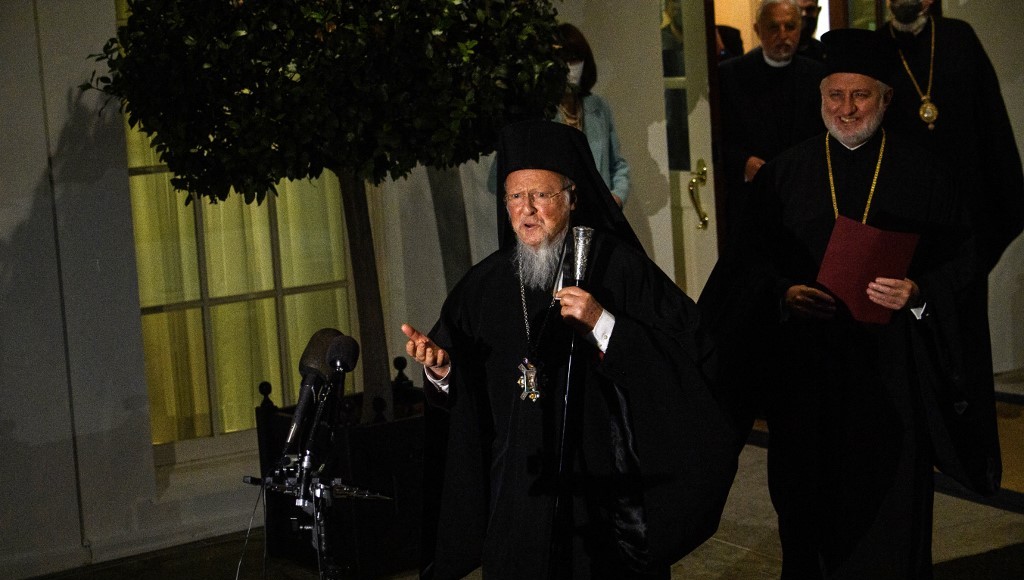
Ecumenical Patriarch Bartholomew I has said minorities in Turkey and Greece should not be treated as hostages to political disputes between the two countries, while expressing hope that a long-closed Greek Orthodox seminary in İstanbul could be allowed to reopen after restoration work is completed in September.
In an interview with the Hürriyet daily published Friday, Bartholomew, 86, said the situation of minorities in the two countries should not be handled depending on the course of Turkish-Greek relations.
“We are not representatives of one country in the other country; moreover, no one should turn us into hostages of political disputes and calculations,” Bartholomew said in response to a question about assessments that Greece sees the Turkish minority in the country as a national security threat.
The comments referred to minority communities whose status has long been shaped by the history of Turkish-Greek relations, including Turkey’s Greek Orthodox community and the Muslim Turkish minority in Greece’s Western Thrace region.
The 1923 Treaty of Lausanne formally recognizes the rights of Armenians, Jews and Greek Orthodox Christians in Turkey, while also regulating the status of the Muslim minority in Greece.
Despite this legal framework, minority rights have remained a recurring source of tension between Ankara and Athens.
Bartholomew said members of Turkey’s Greek Orthodox minority are law-abiding citizens who want equal treatment and to feel like an integral part of the country, not second-class citizens, adding that he believed minority members shared the same desire in Greece.
Christians make up a very small share of Turkey’s population of 86 million, with only around 100,000 Christians living in the country. Their numbers were sharply reduced by mass deportations as well as population exchanges and pogroms that led many Greek Orthodox Christians to leave Turkey in the early 20th century.
Hope for Halki Seminary reopening
Bartholomew also addressed the long-running question of the Halki Seminary on Heybeliada, one of İstanbul’s Princes Islands, whose possible reopening has remained one of the most closely watched issues for the Greek Orthodox community.
He said restoration, reinforcement and renovation work at the Halki Seminary is expected to be completed in the coming months, adding that permission from Turkish authorities for the school to resume operations would be “a source of great happiness” for the patriarchate, the church and the community.

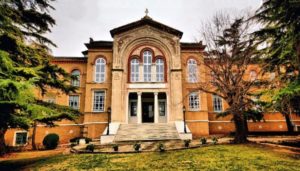
The Halki Seminary opened in 1844 and served as the main theological school for the Eastern Orthodox Church until it was closed under a Turkish law in 1971 after the Turkish Parliament enacted legislation banning private institutions of higher education.
It trained many Orthodox leaders, including Bartholomew, and has remained shut despite decades of calls for Ankara to allow it to reopen.
The seminary’s continued closure has been one of the most prominent issues raised by the Greek Orthodox Church and international actors in discussions about religious freedom in Turkey.
The US State Department’s 2022 Report on International Religious Freedom said Christians in Turkey experience various challenges and rights violations, noting that Christian denominations continue to face limitations on their religious rights despite the protections formally recognized under Lausanne.
Bartholomew said Turkish President Recep Tayyip Erdoğan instructed Education Minister Yusuf Tekin in 2024 to examine the possibility of reopening the school. Tekin visited the seminary in May 2024, after which a constructive dialogue began among the Education Ministry, Turkey’s Council of Higher Education (YÖK) and the patriarchate, he added.
“I pray that this dialogue will reach a favorable outcome and that a decision allowing the school to reopen will be taken,” Bartholomew said, adding that as a graduate of the historic institution, he hopes to see it resume operations as a center for theological education, brotherhood, love and peace.
Bartholomew said in Athens in May that extensive renovations to the seminary’s building complex would be completed in the coming months and that, “God willing,” its inauguration would be celebrated in September.
The patriarchate later clarified that this referred to the renovated building, not the reopening of the seminary, which would still require a formal license from Turkish authorities.
Historical disputes in Turkish-Greek ties
Bartholomew’s remarks came at a time when Ankara and Athens have sought to maintain dialogue despite long-running disputes over the Aegean, Cyprus, migration, maritime jurisdiction and competing historical narratives.
Historical disputes between the two countries resurfaced most recently in May, when Turkey’s Foreign Ministry criticized Greek officials and public events marking what Greece officially describes as Pontic Greek Genocide Remembrance Day.
Turkey accused Athens of using history for political purposes and said the claims lacked legal foundation.
Greece officially established May 19 as the Day of Remembrance of the Genocide of the Greeks of Pontus under a 1994 law.
Turkey denies that the events amounted to genocide and argues that the Greek position distorts the history of the period, frequently pointing instead to crimes committed against Turks and other ethnic groups during the Greco-Turkish War of 1919 to 1922.
The exchange shows how historical issues can still interrupt efforts to improve bilateral relations, even as both governments continue to emphasize dialogue and regional stability.
Asked what was needed to turn the renewed dialogue between Ankara and Athens into lasting trust, Bartholomew said the patriarchate has always encouraged reconciliation and dialogue.
“Dialogue is the only way to resolve all kinds of disagreements among people, nations and states,” he said.
Bartholomew also said there had been significant progress in Turkey since 2000 in the rights and religious freedoms of Greek Orthodox and other non-Muslim minorities, particularly between 2000 and 2010.
He said political will and Turkey’s rapprochement with the European Union had played a role in those improvements.
One example, he said, was Gökçeada, an island in the northern Aegean province of Çanakkale and his birthplace, where the reopening of minority primary and secondary schools allowed some Greek Orthodox families who had left the island to return.