


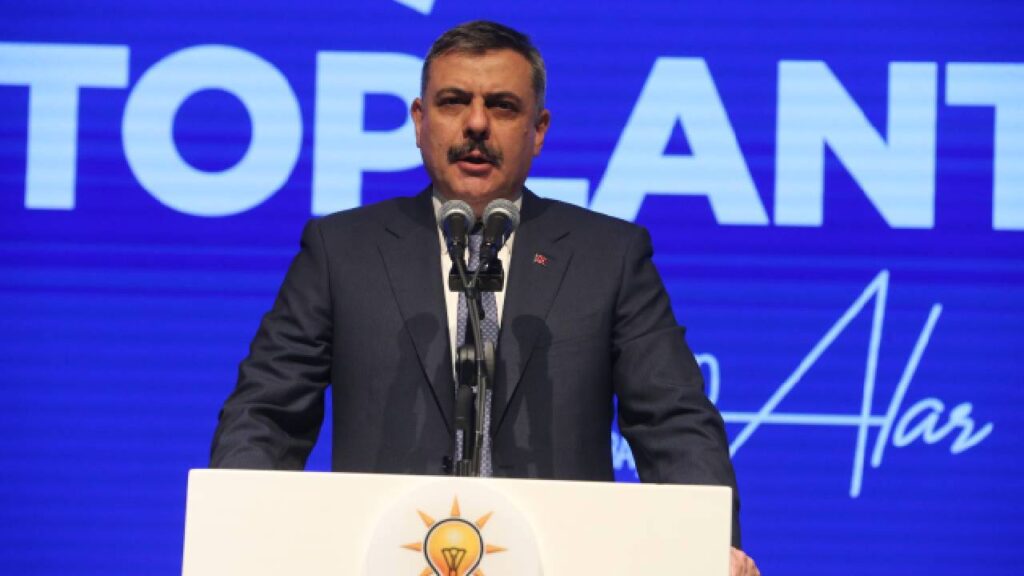
Turkish Interior Minister Mustafa Çiftçi prompted a sharp backlash from Israel after saying he hoped one day to serve as governor of Jerusalem and suggesting that the city would again come under Turkish rule.
In remarks shared on social media, Çiftçi said that just as people had seen “the liberation of Damascus, Aleppo and Karabakh,” they would one day also see “the liberation of Jerusalem.”
Çiftçi, a former governor, said he had long prayed to be given the chance to serve as governor of Jerusalem, “even for one day.”
“I believe that God will show us those days. He certainly will,” Çiftçi said. “Just as in the past, those places will again be ours. They will again, God willing, come under our rule and authority. Because we have a global leader, a world leader, like Recep Tayyip Erdoğan at our head.”
Çiftçi, 55, was appointed interior minister in February after serving as governor of Erzurum and Çorum provinces.
His remarks came on Saturday at an event in Çorum.
A career bureaucrat and hafiz, meaning he has memorized the Quran, he has attracted criticism from secularist and opposition circles over public gestures seen as reflecting Turkey’s long-running divide over religion and the state.
His remarks drew a sharp response from Israeli Defense Minister Israel Katz, who addressed Çiftçi directly in a Turkish-language post on X.
“To the Turkish interior minister who dreams of governing Jerusalem and makes threats, I say this: Jerusalem is not Constantinople and the State of Israel is not a collapsing Crusader Empire,” Katz said.
Kudüs’ü yönetmeyi hayal eden ve tehditler savuran Türkiye İçişleri Bakanı’na şunu söylüyorum:
Kudüs, Konstantinopolis değildir ve İsrail Devleti de çökmekte olan bir Haçlı İmparatorluğu değildir. İsrail, her türlü tehdide karşı kendini savunma kapasitesini kanıtlamış güçlü ve…
— ישראל כ”ץ Israel Katz (@Israel_katz) June 7, 2026
He said Israel was “a strong and determined state” that had proven its ability to defend itself against all threats.
“Jerusalem has been the capital of the Jewish people for 3,000 years and will remain the capital of Israel forever,” Katz said, adding that the Ottoman Empire “collapsed and will never return.”
Katz also accused Çiftçi and Erdoğan of failing to learn from the legacy of Mustafa Kemal Atatürk, the founder of modern Turkey, and of trying to drag the country “into an era of darkness and backwardness.”
Israel’s Foreign Ministry also responded in a separate post on X, saying: “Wake up and smell the coffee. The corrupt Ottoman Empire is gone. Forever. Jerusalem DC (David’s capital) shall remain the eternal capital of Israel. Forever.”
Çiftçi’s remarks recalled Erdoğan’s 2020 claim in Turkey’s parliament that “Jerusalem is our city, a city from us,” a reference to centuries of Ottoman rule over the city before World War I.
The exchange came amid long-running tensions between Turkey and Israel, whose relations have sharply deteriorated over Israel’s military campaign in Gaza.
Turkey and Israel were close military and diplomatic partners in the 1990s, but relations deteriorated after Israel’s 2008-2009 war in Gaza and collapsed after the 2010 Mavi Marmara raid, when Israeli commandos killed 10 Turkish activists aboard a ship trying to break the Gaza blockade.
Relations thawed in 2022 when Israeli President Isaac Herzog visited Ankara, but Israel’s military campaign in Gaza, launched after the Hamas-led attack on Israel on October 7, 2023, reignited hostile rhetoric between the two countries.
The campaign has devastated the Gaza Strip, killing more than 75,000 Palestinians, according to Gaza health authorities, and displacing nearly the entire population of more than 2 million.
The dispute over Jerusalem’s sovereignty is one of the core issues in the Israeli-Palestinian conflict.
Israel occupied East Jerusalem in the 1967 Arab-Israeli War and later annexed it, a move not recognized by most of the international community.
Palestinians see East Jerusalem as the capital of a future state, while Israel claims the entire city as its capital.
The United States recognized Jerusalem as Israel’s capital under President Donald Trump in 2017 and moved its embassy there, breaking with decades of international consensus.
Turkey strongly condemned the US decision at the time. Erdoğan had warned before the announcement that recognizing Jerusalem as Israel’s capital would cross a “red line” for Muslims and after Trump’s declaration he called the move “null and void.”
Ankara also led international opposition to the move, accusing much of the international community of failing to respond strongly enough.