


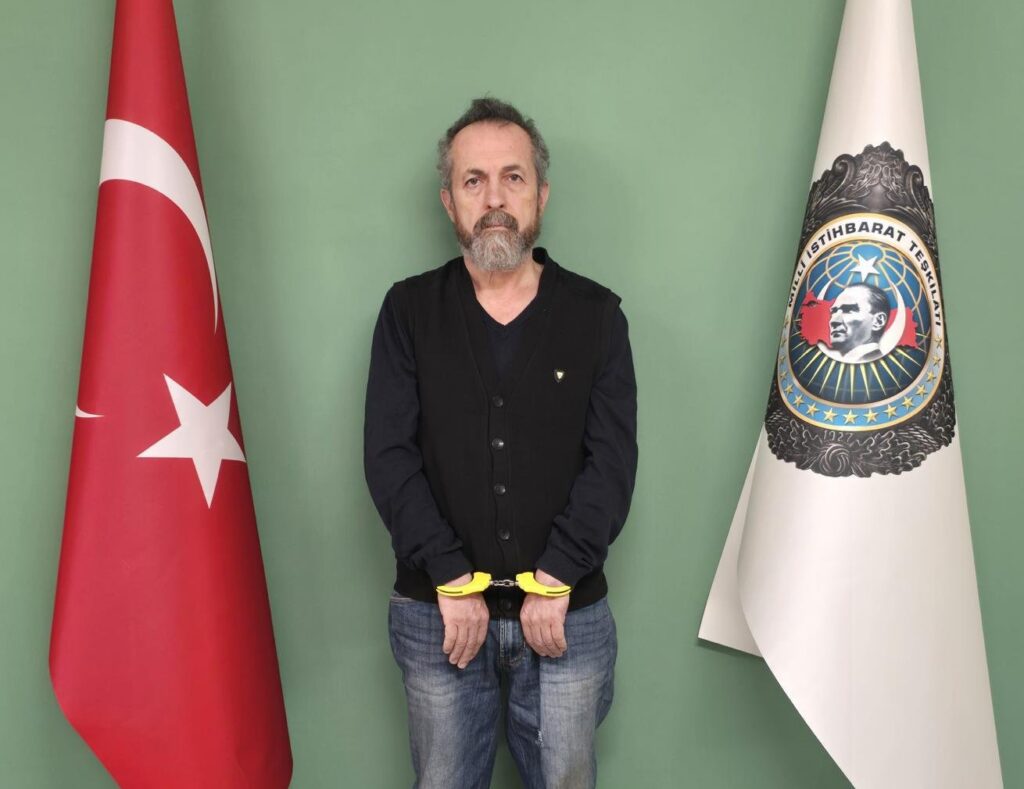
A former Turkish intelligence officer faces a life sentence on accusations that he helped Bashar al-Assad’s intelligence service abduct two Syrian opposition commanders from Turkey and later supplied Turkish state secrets to Syrian and Russian intelligence agencies.
Prosecutors are also seeking up to 35 years in prison on a separate charge of disclosing confidential national security information for the purpose of espionage.
The indictment of Önder Sığırcıkoğlu, a former officer at Turkey’s National Intelligence Organization (MIT), was accepted by the Ankara 28th High Criminal Court, Turkey’s state-run Anadolu news agency reported on Wednesday.
The case stands out for its scope, combining an alleged wartime abduction from Turkish territory with claims that an intelligence insider later worked for the Assad regime for a decade after escaping from prison.
Prosecutors also asked the court to hold the trial behind closed doors, citing the alleged presence of state secrets in the case.
The case centers on the 2011 abduction of Lt. Col. Hussein Harmoush and Maj. Mustafa Kassum, two commanders linked to the Free Syrian Army, from Hatay province in southern Turkey.
The Free Syrian Army was an early armed opposition force formed by defectors from Assad’s military after Syrian security forces used violence against anti-government protests in 2011.
Harmoush was one of the first senior Syrian officers to defect during the uprising against Assad.
His defection carried weight because he publicly urged Syrian soldiers to leave the army while Assad’s forces were crushing protests and defections were beginning to shape the armed phase of the uprising.
Harmoush fled to Turkey but disappeared from a refugee camp in southern Turkey in 2011 and later appeared in Syrian regime custody in what opposition figures said was a coerced televised statement.
Turkish prosecutors say Sığırcıkoğlu knew Harmoush and Kassum through his work for MİT and helped deliver them to Syrian regime intelligence.
The indictment says the abduction allowed the Assad regime to stage a show of force against defectors and created fear among Syrian refugees who had sought protection in Turkey.
Sığırcıkoğlu was convicted in 2012 by the Adana 10th High Criminal Court of depriving a person of liberty through force, threat or deception and sentenced to 20 years in prison.
Turkey’s Supreme Court of Appeals upheld the conviction, according to the indictment.
Prosecutors say Sığırcıkoğlu escaped in 2014 while being transferred to Osmaniye Prison after he was given 10 hours of travel leave.
The indictment says he fled to Syria, where he was received by Assad regime intelligence officers.
Prosecutors allege that from 2014 to 2024, Sığırcıkoğlu lived in several parts of Syria under the protection of the Assad regime and worked as an intelligence asset.
The indictment says he passed information about MİT, its personnel and its activities to Syrian regime intelligence and Russian intelligence services.
Prosecutors said Sığırcıkoğlu joined MİT in 1993 and worked for the agency until 2012.
After the Syrian civil war began, he was assigned to refugee camps in Yayladağı, a district of Hatay province near the Syrian border, according to the indictment.
Prosecutors allege that he used his position there to collect information about Syrians opposed to Assad, MİT operations and internal MİT reports and pass them to Syrian regime intelligence.
The indictment also says he secretly recorded a meeting with a Syrian tribal leader using a pen capable of audio and video recording and sent the recording to Syrian intelligence.
Prosecutors said Sığırcıkoğlu later disclosed the names of some MİT personnel in an interview with a journalist to prove his loyalty to the Assad regime.
The indictment also alleges that between 2014 and 2016 he acted with Mihraç Ural, the leader of a leftist Turkish militant group fighting for Assad, and Yusuf Nazik, who was captured in 2018 over the 2013 Reyhanlı bombings in southern Turkey.
The Reyhanlı attacks, two car bombings in Hatay province near the Syrian border, killed more than 50 people and remain among the deadliest attacks linked to the spillover of the Syrian conflict into Turkey.
Prosecutors said Sığırcıkoğlu gave interviews during his years in Syria and took part in propaganda against Turkey.
After the Assad regime fell in December 2024, Sığırcıkoğlu first fled to Lebanon and then to Russia, according to the indictment.
The indictment says he later returned to the region and was captured near the Syrian-Lebanese border in a MİT operation.