


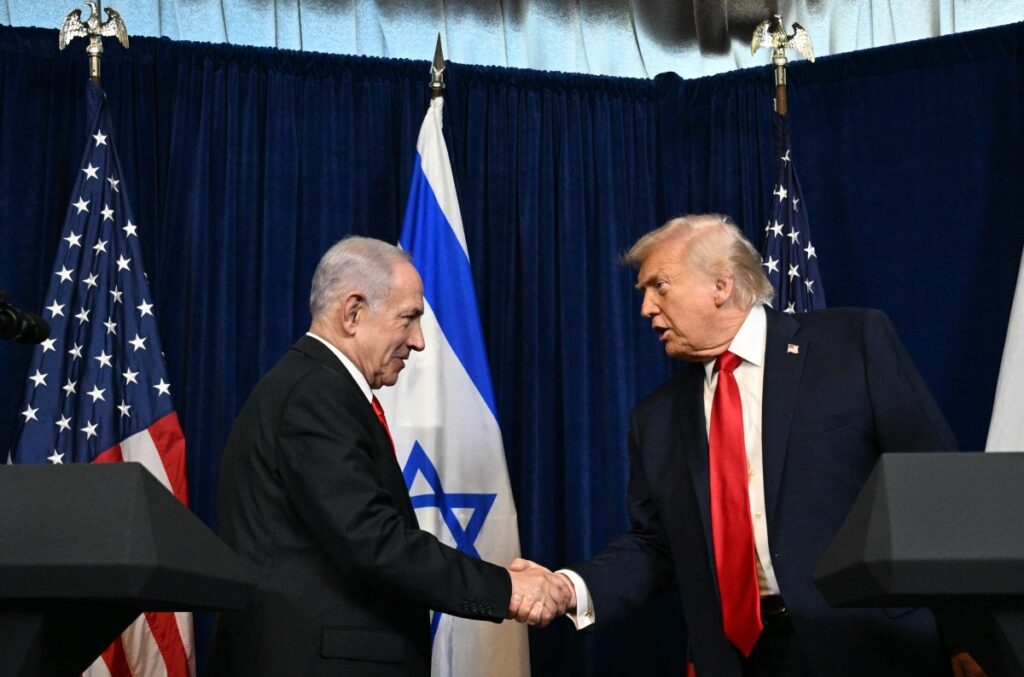
US President Donald Trump has called on Turkey and other Muslim-majority countries to join the Abraham Accords, the US-backed framework for normalizing relations with Israel, as part of what he described as a broader Middle East settlement linked to efforts to end the war with Iran.
Trump made the appeal Monday in a lengthy social media post after a Saturday conference call with leaders from several countries, including Turkey, about efforts to reach a peace deal with Iran.
“After all the work done by the United States to try and pull this very complex puzzle together, it should be mandatory that all of these Countries, at a minimum, simultaneously, sign onto the Abraham Accords,” Trump wrote.
“Those Countries discussed are Saudi Arabia, The United Arab Emirates (already a Member!), Qatar, Pakistan, Turkiye, Egypt, Jordan, and Bahrain (already a Member!).”
The Abraham Accords were brokered by Trump in 2020 and led to the normalization of relations between Israel and several Arab and Muslim-majority countries.
Turkey already recognizes Israel and has had diplomatic relations with the country for decades. Its inclusion in Trump’s proposal would therefore mean joining a US-backed regional framework for public normalization and cooperation with Israel, rather than recognizing Israel for the first time.
The accords remain unpopular among many in the Middle East because they do not address the Israeli occupation of Palestinian territories.
Saudi Crown Prince Mohammed bin Salman told Trump in November 2025 that the kingdom was open to joining the Abraham Accords if there was “a clear path” toward a two-state solution.
Trump said most countries he spoke to “should be ready, willing, and able to make this Settlement with Iran a far more Historic Event than it would, otherwise, be.”
“It should start with the immediate signing by Saudi Arabia and Qatar, and everybody else should follow suit. If they don’t, they should not be part of this Deal in that it shows bad intention,” he wrote.
Trump even appeared to suggest that Iran, Israel’s main regional adversary, should eventually sign on to the accords.
Aaron David Miller, a senior fellow at the Carnegie Endowment for International Peace, said Trump’s appeal was unlikely to succeed, citing regional rivalries and the lack of clear incentives for Gulf states to normalize ties with Israel.
“It seems to me highly unlikely in the near term you’re going to see any broadening of these accords,” he said.
“The Saudis are not going to join the Abraham Accords. The Saudi-Emirati rivalry prevents that,” he added. “What’s in it for the Gulf states in agreeing to normalize with Israel?”
Miller said Trump made a similar request after an October 2025 agreement between Israel and Hamas to end the war in Gaza.
Over the three-day US holiday weekend, Trump and Secretary of State Marco Rubio offered varying assessments of the timing of a deal to end the Iran war, at times suggesting an agreement was close.
Trump said Monday that negotiations with Iran were “proceeding nicely,” while Iran warned that no agreement was near.
Iran’s top negotiator, Mohammad Bagher Ghalibaf, arrived in Qatar on Monday as part of the “diplomatic process” to end the war with the United States, state media reported.
With reporting by Agence France-Presse