


Adem Yavuz Arslan*
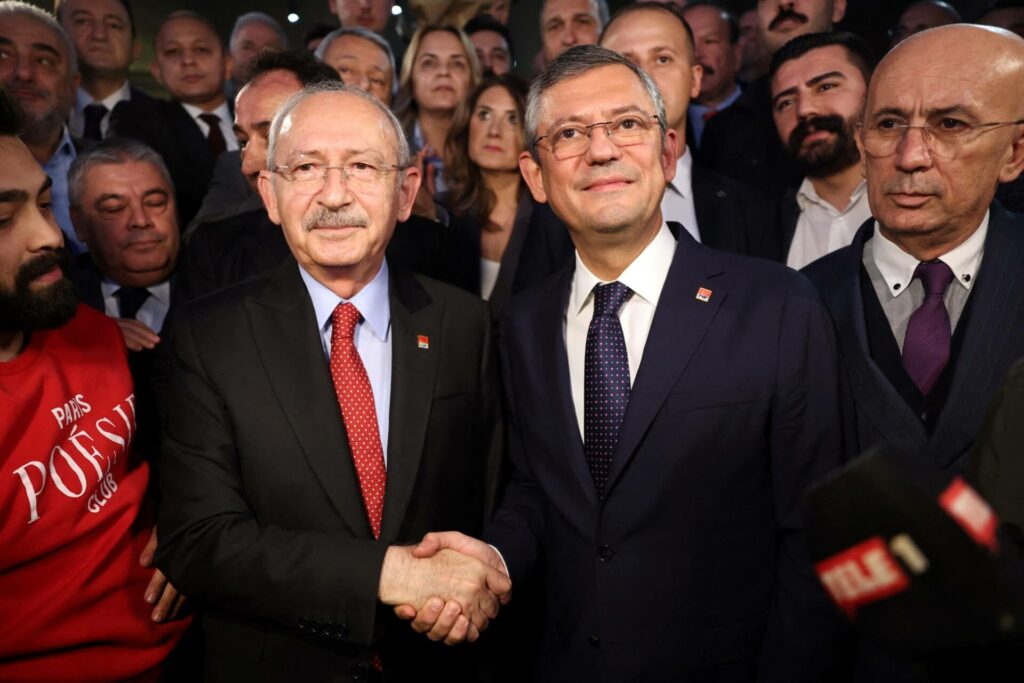
Turkey’s political landscape entered a new and dangerous phase after a court ruling that directly targets the country’s main opposition party, the Republican People’s Party (CHP). A regional appeals court in Ankara annulled the CHP’s 2023 party congress, where the party’s current leader Özgür Özel replaced longtime leader Kemal Kılıçdaroğlu as chairman, and effectively suspended the current party leadership.
The ruling did more than invalidate a congress. It also called into question later party decisions made under Özel’s leadership and reinstated Kılıçdaroğlu and the former party administration through judicial intervention rather than an internal political process.
For a party that won Turkey’s 2024 local elections and controls the country’s largest cities, the ruling is not merely an internal legal dispute. It is a direct intervention in the organization of the main opposition at a time when the government of President Recep Tayyip Erdoğan is already using the courts to pressure CHP-run municipalities, elected mayors and potential presidential rivals.
One of the most troubling aspects of the ruling is its immediate effect. Legal disputes over party congresses usually move through a lengthy appeals process before producing binding consequences. In this case, however, the court used an interim measure to enforce the outcome at once, before the appeals process was exhausted. Critics say this bypassed an important safeguard and created a precedent for direct judicial intervention in the internal structure of a major political party.
The result is institutional chaos. From party headquarters to provincial branches and municipal administrations, the authority of party officials has suddenly been thrown into doubt. The CHP now faces not only political pressure from outside but also an organizational crisis imposed from the courts.
For many in Turkey’s opposition, this is not an ordinary lawsuit. It is part of a broader effort to reshape the political field before the next presidential election. Erdoğan has dominated Turkish politics for more than two decades, and since a failed coup on July 15, 2016, the judiciary has increasingly become one of the main instruments through which political competition is managed.
The most visible target of this strategy has been İstanbul Mayor Ekrem İmamoğlu, widely seen as Erdoğan’s strongest potential challenger in a future presidential race. İmamoğlu’s university diploma was annulled in a move that could affect his eligibility to run for president, since Turkey’s constitution requires that presidential candidates have a university degree. Soon afterward, in March 2025, he was arrested as part of an investigation into the İstanbul Metropolitan Municipality along with dozens of municipal officials. They strongly deny the accusations and say the cases targeting the CHP are politically motivated.
The court ruling against the CHP now appears to be the next phase of the same strategy. It has created two competing centers of authority within the party. Özel has vowed not to leave party headquarters, while Kılıçdaroğlu has so far avoided returning to the building in order not to appear as a leader imposed by police power. Legally, however, the ruling places authority back in Kılıçdaroğlu’s hands. The result is a de facto split inside Turkey’s main opposition movement.
At the same time, Erdoğan appears to be pursuing a parallel strategy toward Turkey’s Kurdish political movement. In late 2024 Erdoğan and his ally, Nationalist Movement Party (MHP) leader Devlet Bahçeli, launched what they called the “Terrorism-Free Turkey” initiative. Initially presented as a framework for addressing the Kurdish issue, the process gradually narrowed into a focus on the disarming of the outlawed Kurdistan Workers’ Party (PKK).
The shift was especially striking because of Bahçeli’s role. The MHP has long represented one of Turkey’s hardest nationalist lines on the Kurdish issue. Yet Bahçeli began using surprisingly conciliatory language about jailed PKK leader Abdullah Öcalan, referring to him the “founding leader” of the PKK and even suggesting that he could address parliament if the PKK laid down its arms. For many Turks, this was a political earthquake.
This new climate has also weakened the pro-Kurdish DEM Party’s room for maneuver. Party officials have repeatedly emphasized Öcalan’s central role in any process, leaving the party hesitant to strongly confront the government at a time when pressure on the CHP is escalating. Critics increasingly argue that Erdoğan’s aim is to secure enough Kurdish political support, directly or indirectly, to extend his rule.
That support could be decisive. Erdoğan faces constitutional obstacles to running again for president unless parliament calls an early election or amends the constitution. Both options require support beyond his own ruling bloc. In that equation, the DEM Party’s votes could become critical.
For this reason, the judicial intervention against the CHP and the outreach to Kurdish political actors should not be viewed as separate developments. They are two parts of the same survival strategy: weaken and divide the main opposition while trying to broaden the ruling coalition enough to keep Erdoğan in power.
The danger is not simply that one opposition leader has been removed by court order. The deeper danger is that elections are being hollowed out. Opposition parties may still exist, campaigns may still be held and ballots may still be cast, but the political field is increasingly shaped before voters ever reach the ballot box.
This is how competitive authoritarian systems consolidate themselves. Courts, election boards, prosecutors and police do not cancel politics outright; they narrow the space in which politics can function. Rivals are disqualified, mayors are arrested, party congresses are annulled and elected leaders are replaced through legal mechanisms that preserve the appearance of procedure while destroying the substance of democratic competition.
Turkey is moving closer to that model. Western governments have mostly responded with caution, partly because of Turkey’s geopolitical importance. But if the European Union and other democratic actors continue to treat these developments as isolated legal disputes, they will miss the larger pattern.
The ruling against the CHP is not just a party matter. It is a warning about the future of Turkish democracy. If the main opposition can be reorganized by court order, then the ballot box itself is no longer the final arena of political competition. It becomes only one stage in a system where the real outcome is decided elsewhere.
*Adem Yavuz Arslan is a journalist with over two decades of experience in political reporting, investigative journalism and international conflict coverage. His work has focused on Turkey’s political landscape, including detailed reporting on the 2016 coup attempt and its aftermath, as well as broader issues related to media freedom and human rights. He has reported from conflict zones such as Bosnia, Kosovo and Iraq, and has conducted in-depth research on high-profile cases, including the assassination of Turkish-Armenian journalist Hrant Dink. Arslan is the author of four books and has received journalism awards for his investigative work. Currently living in exile in Washington, D.C., he continues his journalism through digital media platforms, including his YouTube channel, Turkish Minute, TR724 and X.
Disclaimer: The views expressed in this opinion piece are those of the author and do not necessarily reflect the editorial stance of Turkish Minute.