


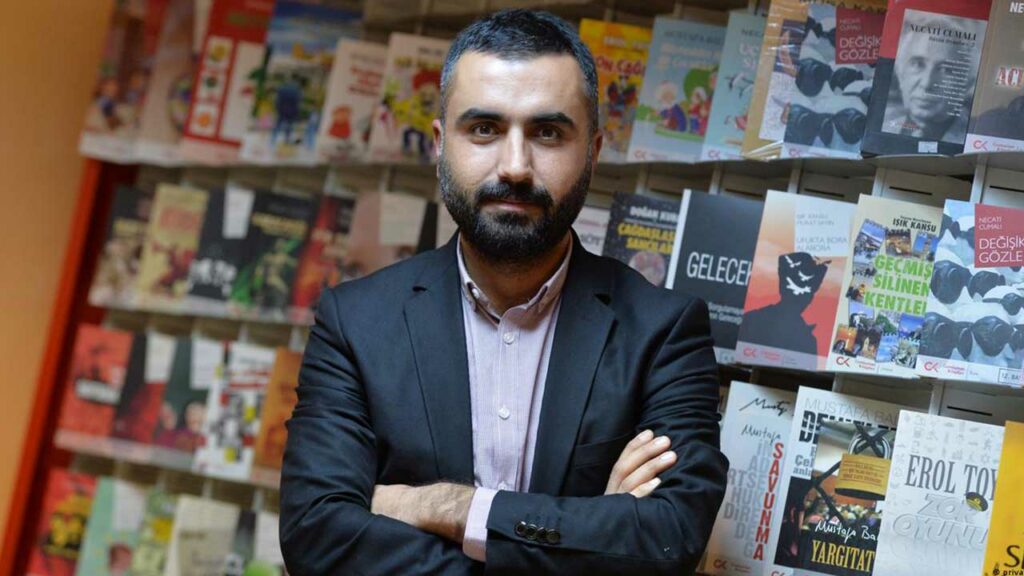
A Turkish court on Thursday ordered the conditional release of Deutsche Welle journalist Alican Uludağ, who had been held for 90 days on charges of insulting President Recep Tayyip Erdoğan and spreading false information, the German broadcaster said.
Uludağ went on trial before the Ankara 57th Criminal Court of First Instance, appearing from İstanbul’s Marmara Prison in Silivri via the Audio and Visual Information System (SEGBİS).
He was detained at his home in Ankara on February 19 over several posts on X and later arrested on accusations of “insulting the president” and “disseminating false information.”
“I was detained, but I did not commit a crime that warrants arrest. … I am a journalist who is being silenced,” Uludağ told the court, according to DW. Uludağ has worked as a judicial reporter for 18 years.
“I made general criticisms. I criticized the relationship between the judiciary and politics. As a judicial reporter, I criticized operations in the judiciary on social media. I want to know what’s criminal about that?” he said.
About an hour into the hearing, the judge ordered his conditional release and adjourned the trial. The next hearing was scheduled for September 18, DW said.
The case was initially handled in İstanbul.
The İstanbul 26th Criminal Court of First Instance accepted the indictment on April 1 but later ruled that it did not have jurisdiction and sent the file to Ankara.
Uludağ’s lawyers requested his release after the file was sent to the Ankara court, but the court rejected the request and ordered his continued pretrial detention pending the first hearing.
Berlin had denounced the allegations against him as “baseless,” while Amnesty International had called for his release.
Reporters Without Borders (RSF) Turkey representative Erol Önderoğlu, welcomed Uludağ’s release but said his imprisonment would remain “90 days of ill-treatment inflicted on an investigative journalist.”
“He should not have spent even a single day in prison for his reports or comments,” Önderoğlu said.
Amnesty International’s Turkey director, Ruhat Sena Akşener, said all journalists and media workers who face rights violations, criminalization and imprisonment solely because of their journalism should be immediately released.
Kenneth Roth, the former executive director of Human Rights Watch and a visiting professor at Princeton University, said on X that “the Turkish government of autocratic President Erdogan is targeting press freedom in the prosecution of Deutsche Welle’s Alican Uludağ …”
The Turkish government of autocratic President Erdogan is targeting press freedom in the prosecution of Deutsche Welle's Alican Uludag, who has been in custody for three months, in part on charges of "insulting the president." https://t.co/cKGrF2zeLd
— Kenneth Roth (@KenRoth) May 21, 2026
Known for his reporting on human rights violations and corruption cases, Uludağ has received awards from the Contemporary Journalists Association, the Turkish Journalists Association and the Germany-based Friedrich Naumann Foundation.
Prosecutors on Thursday also opened a new investigation into two senior staff members at the left-leaning BirGün newspaper, Sefer Selçuk Özbek and Gökay Başcan, on allegations of insulting the president in a report about university students who joined protests, the newspaper said.
Many people in Turkey, including journalists, politicians, students and even a former Miss Turkey, have faced charges of insulting the president in recent years. Rights groups say the charge is frequently used to silence criticism of Erdoğan.
Journalists in Turkey operate in an increasingly restrictive environment, particularly when reporting on politically sensitive issues or criticizing the government or its allies. They are frequently targeted under laws criminalizing insulting public officials, spreading false or misleading information and disseminating terrorist propaganda.
According to Expression Interrupted, a press freedom monitoring group, 26 journalists are currently behind bars in Turkey. Turkey fell to 163rd out of 180 countries in the 2026 World Press Freedom Index published by Reporters Without Borders (RSF) earlier this month, down from 159th in 2025, as the group warned that authoritarianism is deepening and media pluralism is increasingly under threat in the country.