

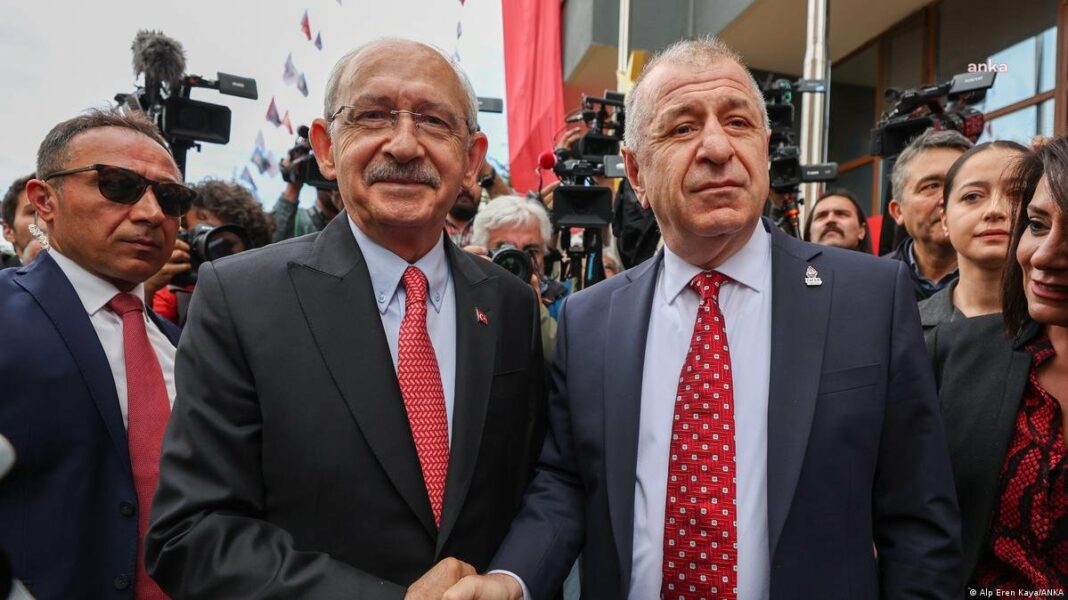
, of helping President Recep Tayyip Erdoğan consolidate Turkey’s current presidential system by failing to confront the country’s election authority on the night of a disputed 2017 referendum.)
Far-right Victory Party leader Ümit Özdağ has accused Kemal Kılıçdaroğlu, the former chairman of Turkey’s main opposition Republican People’s Party (CHP), of helping President Recep Tayyip Erdoğan consolidate Turkey’s current presidential system by failing to confront the country’s election authority on the night of a disputed 2017 referendum.
Speaking on internet personality Oğuzhan Uğur’s “Mevzular Açık Mikrofon” program, Özdağ said the CHP failed to mobilize its lawmakers and supporters after the Supreme Election Council (YSK) decided during the count to accept unstamped ballots in the April 16, 2017, vote.
The referendum replaced Turkey’s parliamentary system of governance with an executive presidency, abolishing the post of prime minister and giving Erdoğan the power to appoint ministers, issue presidential decrees and exert greater influence over the judiciary.
“This regime was established jointly by Erdoğan and Kemal Kılıçdaroğlu,” Özdağ said, in one of his strongest accusations against the former CHP leader.
Özdağ, who was a lawmaker at the time, said he went to the YSK building in Ankara on referendum night while protesters gathered outside, but that the main opposition party, then led by Kılıçdaroğlu, did not come.
“They had more than 100 lawmakers. Not one of them came to the YSK,” Özdağ said. “Their chairman did not come either.”
Özdağ described the YSK’s decision to count unstamped ballots as a direct assault on the constitutional order. He said no court or state institution had the authority to change election law during a vote.
“The YSK staged a coup against the constitution,” he said. “It violated the constitution. It usurped the authority of the Turkish Parliament.”
Özdağ said he confronted then-YSK chairman Sadi Güven inside the building and told him that members of the board had violated the constitution and would one day stand trial.
Özdağ said Kılıçdaroğlu later told him the party had considered marching to the YSK building but backed down after hearing that armed men were waiting along the route and might open fire on demonstrators.
Özdağ called the explanation “disastrous.”
“What does this mean? It means, ‘We knew the constitution was being trampled on and violated, but we allowed it because we feared for our lives,’” Özdağ said. “If you are not brave enough to defend the constitution, if you look the other way because you fear for your life, then don’t tell me you’re the opposition. This is not how opposition politics is done.”
He also rejected the claim that armed groups were waiting in the streets that night, saying there were no such groups and that police were focused on preventing a clash outside the YSK.
Özdağ also accused the CHP leadership of failing to pursue legal remedies over the referendum, saying the main opposition party could have taken the case to the European Court of Human Rights (ECtHR).
Former CHP lawmaker Atilla Kart had previously claimed that he was authorized after the referendum to challenge the Supreme Election Council’s unstamped ballot decision in the party’s name, first in Turkish courts and then before the European Court of Human Rights, but that the party leadership later withdrew support and told him to proceed only in his own name. Kart says the later ECtHR application filed by CHP headquarters was a different case, aimed at the referendum as a whole, and not the administrative-law challenge to the election board decision that he had prepared.
The CHP did file an ECtHR application on July 4, 2017, but the court rejected it as inadmissible, finding that the convention provision on free elections did not cover referendums. Kart’s allegation is therefore not that the party never went to Strasbourg, but that it abandoned a separate legal route built around the election board’s decision to count unstamped ballots.
The 2017 referendum passed by a narrow margin, with 51.41 percent voting “yes” and 48.59 percent voting “no,” according to the final results announced by the YSK. Opposition parties challenged the result after the YSK allowed ballots without official polling station seals to be counted, despite a legal requirement for such seals.
International observers also criticized the vote. The Organization for Security and Co-operation in Europe’s Office for Democratic Institutions and Human Rights said the referendum took place on an unlevel playing field, that fundamental freedoms were curtailed under the state of emergency and that late changes in counting procedures removed an important safeguard.
The Parliamentary Assembly of the Council of Europe also said voters were not given impartial information about key aspects of the constitutional changes and that the “yes” campaign benefited from the involvement of national and local officials.
A peer-reviewed forensic analysis published in scientific journal PLOS One later found statistical patterns in the official polling station data consistent with ballot stuffing and voter intimidation.
The study, by researchers Peter Klimek, Raúl Jiménez, Manuel Hidalgo, Abraham Hinteregger and Stefan Thurner, said the 2017 referendum showed “systematic and highly significant” indications of both forms of malpractice and estimated signs of ballot stuffing in about 11 percent of polling stations.
The authors said the scale of the anomalies might have been large enough to change the outcome from a “no” majority to a “yes” majority, while cautioning that statistical forensics alone cannot prove fraud.
The referendum remains one of the most contested moments in Turkey’s shift from parliamentary rule to Erdoğan’s executive presidency, and Özdağ’s remarks revive a long-running debate inside the opposition over whether the CHP failed to resist a decision that helped reshape the country’s political system.