


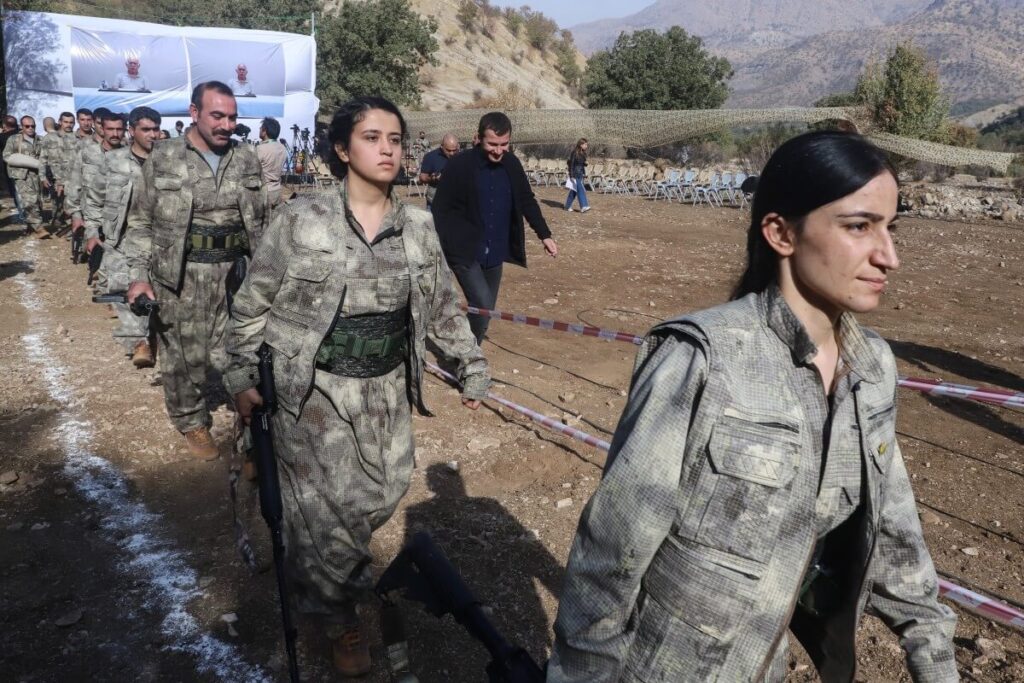
A new nationwide poll shows limited public confidence in Turkey’s renewed dialogue with the outlawed Kurdistan Workers’ Party (PKK), with only 21.8 percent of respondents saying they believe it could end positively and nearly half expressing little or no trust in the initiative, the Germany-based, pro-Kurdish Yeni Özgür Politika newspaper reported.
The process refers to a new effort backed by the Justice and Development Party (AKP) government and its nationalist ally, far-right Nationalist Movement Party (MHP) leader Devlet Bahçeli, to end the PKK’s four-decade armed campaign against Turkey through a series of steps expected to include the group laying down its arms, possible legal arrangements and a broader political framework involving parliament.
The survey, conducted by the SAMER Field Research Center between May 7 and 10 with 1,995 respondents across 18 provinces, measured public attitudes toward the process that has been ongoing since October 2024 and is referred to by the government as its “Terrorism-free Turkey” initiative.
Asked whether they thought the current process could have a positive outcome, 21.8 percent of respondents said “yes,” while 26.5 percent said “no.” Another 20.7 percent said “partly,” 14.9 percent said they were undecided, 12.3 percent said they had no opinion and 3.8 percent said there was “no process.”
The findings point to limited public confidence at a time when the initiative has shown signs of strain, with Kurdish political figures accusing the government of delaying legal steps and Ankara insisting that the PKK must first take verifiable steps to lay down its arms.
The ongoing peace process follows an earlier attempt by Ankara and the PKK that began in late 2012 but collapsed in 2015, leading to renewed clashes, particularly in Turkey’s predominantly Kurdish southeast.
Respondents were also asked to rate their level of trust in the process on a scale from 1 to 5. A total of 22.9 percent said they had no trust in the process, while 23.2 percent said they did not trust it. Another 25.9 percent said they had little trust.
Only 16.8 percent said they trusted the process, while 7.4 percent said they had a high level of trust. Taken together, those who clearly expressed trust accounted for 24.2 percent of respondents.
The survey also found that respondents put primary responsibility for advancing the process on the government.
Asked which institution or actor had the main responsibility for ensuring progress, 40.7 percent named the government. Parliament followed with 25.9 percent, while 11.2 percent cited the opposition, 10.3 percent named Abdullah Öcalan, the imprisoned leader of the PKK, and 8.1 percent cited the PKK.
A majority of respondents said the institution or actor they considered primarily responsible was not fulfilling that responsibility. Asked whether the responsibility was being carried out, 52.7 percent said “no,” while 26.9 percent said “yes” and 16.6 percent said “partly.”
The PKK, which is designated as a terrorist organization by Turkey and its Western allies, has waged an armed campaign against the Turkish state since 1984. More than 40,000 people have been killed in the conflict.
The current process began in 2024, and Öcalan in February 2025 called on the group to lay down its arms. The PKK later said it had decided to dissolve itself and end its armed campaign.
MHP leader Bahçeli has played a central role in the new initiative despite leading a party long known for its hardline stance on the PKK.
Bahçeli on Monday proposed the formation of two commissions to oversee the process, signaling an effort to give it a more formal structure amid disputes over sequencing.
One commission would be formed in parliament with members from all political parties, while a second body would be established under the leadership of the vice president and include several ministries and the National Intelligence Organization.
His proposal appeared aimed at addressing one of the main criticisms of the process: the lack of a public mechanism explaining how the next steps would be handled by parliament and state institutions.
A parliamentary commission headed by Parliament Speaker Numan Kurtulmuş approved a report in February outlining a roadmap for legal steps linked to the process. But no law has yet moved forward, and the pro-Kurdish Peoples’ Equality and Democracy Party (DEM Party) has accused the government of acting slowly.
Despite the lack of concrete legislation, President Recep Tayyip Erdoğan said last month that the process had passed “many critical thresholds” and that the government would “walk patiently” until it reached its goal.
Kurdish figures have offered a more cautious assessment. The PKK’s Murat Karayılan later said the process had been “frozen,” citing the lack of recent contact with Öcalan and the absence of legal guarantees.