


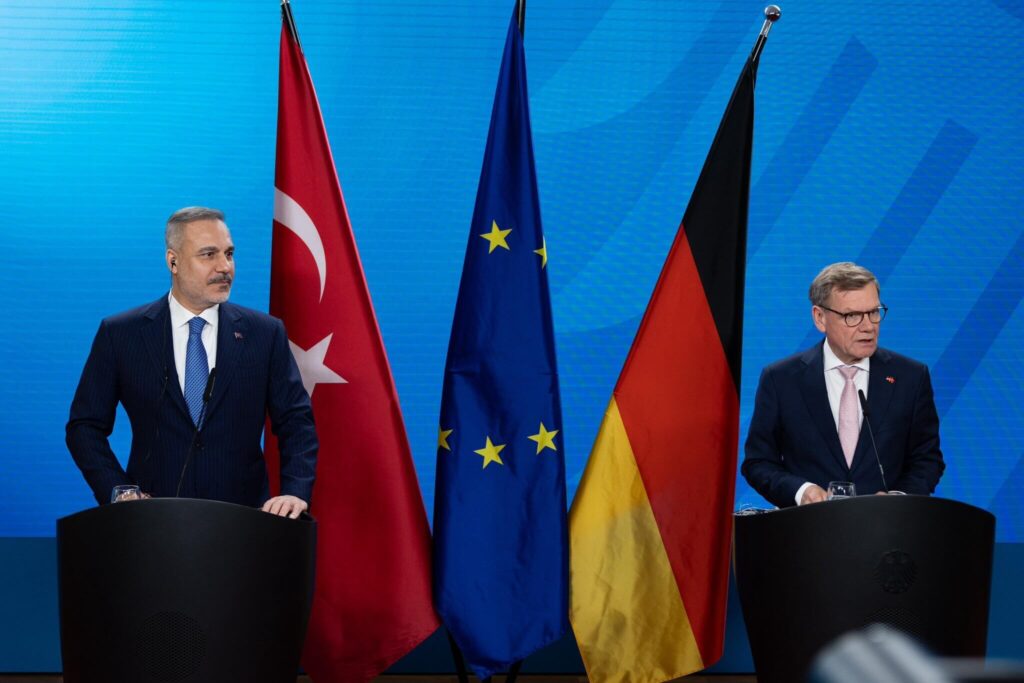
Germany voiced support for closer ties between Turkey and the European Union as the foreign ministers of the two countries met in Berlin for the third meeting of a revived strategic dialogue mechanism on Monday aimed at deepening relations between Ankara and Berlin, according to the state-run Anadolu news agency and German media.
Speaking at a joint press conference with Turkish Foreign Minister Hakan Fidan, Johann Wadephul welcomed the Turkish government’s stated commitment to the goal of joining the bloc but stressed that Ankara would have to meet all accession criteria.
“If Turkey wants to move toward the European Union, then it will have a friendly and reliable partner in Germany,” Wadephul said.
Turkey’s EU accession talks, formally launched in 2005, have been effectively frozen for years due to concerns over the rule of law, fundamental rights, judicial independence and democratic backsliding.
Despite the stalled process, Ankara has repeatedly said full membership remains a strategic objective.
Bakanımız @HakanFidan, Almanya Federal Dışişleri Bakanı Johann Wadephul ile Berlin’de biraraya geldi. pic.twitter.com/CyniYZpsa9
— T.C. Dışişleri Bakanlığı (@TC_Disisleri) May 18, 2026
The Berlin meeting came as Germany increasingly views Turkey not only as a major NATO ally but also as a key partner in Europe’s security and industrial policy, particularly in light of Russia’s war on Ukraine and ongoing conflicts in the Middle East.
Wadephul described Turkey as an important NATO ally and a significant trading partner of the EU, saying Ankara should be taken into account as the bloc expands its defense and industrial policy.
EU ties at center of talks
Wadephul said Germany considers it desirable to further expand the strategic relationship between Turkey and the EU, highlighting in particular the modernization of the EU-Turkey customs union.
The customs union, in force since 1995, covers mainly industrial goods and processed agricultural products, while Turkey has called for it to be expanded to areas such as services, agriculture and public procurement.
Hakan Fidan, for his part, raised the issue of visa liberalization, a longstanding demand of Ankara.
Turkey and the EU launched a visa liberalization dialogue in late 2013, but Turkish citizens still need visas for short-term travel to the Schengen area because Ankara has not met all the required criteria, including changes to its counterterrorism legislation.
According to Turkish Foreign Ministry sources cited by Anadolu, working groups on bilateral relations, Turkey-EU relations, security and defense and regional issues were expected to meet on the sidelines of the Berlin talks and present their reports to the two ministers.
Strategic dialogue revived after years of tension
The visit took place within the framework of the Germany-Turkey Strategic Dialogue Mechanism, which was first launched in 2013 to structure bilateral relations, deepen strategic cooperation and support Ankara’s EU accession process.
A meeting as part of the mechanism was held only twice before being effectively frozen after the second meeting in İstanbul in 2014, as relations between the two countries deteriorated over a series of political disputes.
Ties were strained in particular after a failed coup in Turkey in 2016, Turkey’s 2019 military operation in northern Syria and escalating sovereignty disputes in the eastern Mediterranean in 2020 and 2021.
The decision to revive the format was made during German Chancellor Friedrich Merz’s official visit to Ankara last year, when he and Turkish President Recep Tayyip Erdoğan agreed to resume the “strategic dialogue of foreign ministers.”
Security cooperation and NATO role
The Berlin talks also took place against the backdrop of growing security concerns in Europe and the Middle East.
Germany announced that it would temporarily deploy a Patriot air defense system to Turkey to support NATO air defense on the alliance’s southeastern flank.
The German Defense Ministry said a Patriot fire unit and 150 soldiers based in Husum, a town in northern Germany, would be sent to Turkey at the end of June, with the deployment expected to last until September.
“Germany is taking more responsibility within NATO,” Pistorius said. “The close work our soldiers are carrying out with our Turkish and American partners shows how reliably we cooperate with our allies.”
The Patriot is an American-made mobile air-defense system designed to intercept tactical ballistic missiles, low-flying cruise missiles and aircraft.
The US unit had been moved to boost Turkish defenses in response to Iranian rocket attacks that hit American allies in the region after the United States and Israel launched their war on Tehran at the end of February.
NATO forces have downed Iranian ballistic missiles over Turkey at least three times since war started.
Germany previously deployed Patriot systems to Turkey from 2013 to 2015 to help protect air space on the border with Syria.
A deployable Patriot system consists of up to eight launchers as well as a radar unit and a fire control post, the defense ministry said.