


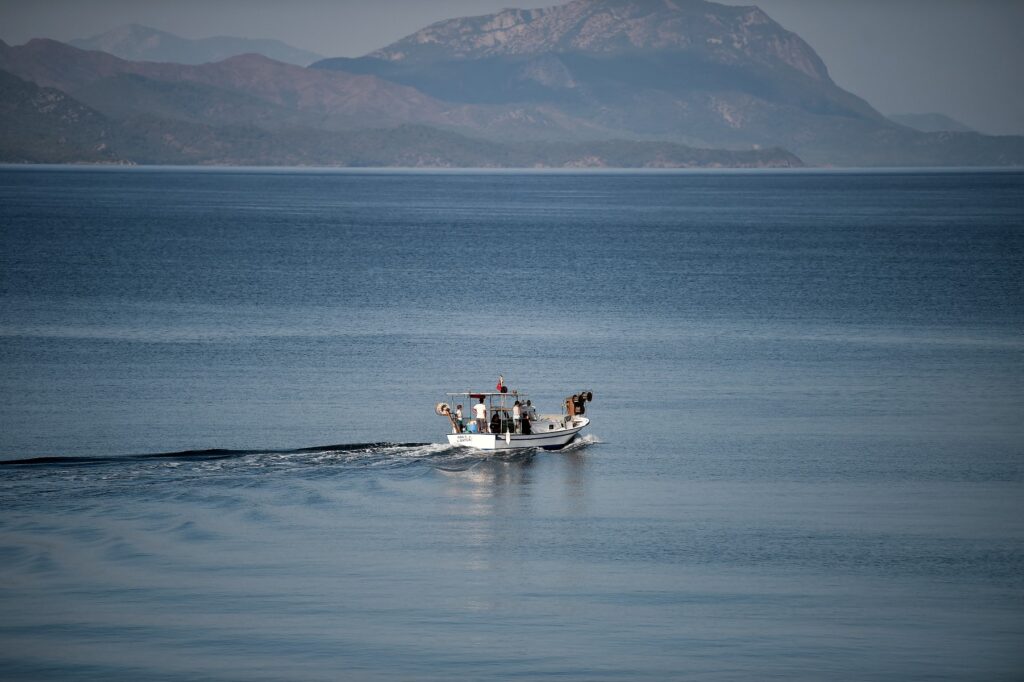
Greece has asked the European Union to intervene in what it says is illegal fishing by Turkish vessels in the eastern Mediterranean and violations of international maritime law, according to Greek media.
After meeting with European Commissioner for Fisheries and Oceans Costas Kadis in Athens on Friday, Greek Maritime Affairs and Insular Policy Minister Vassilis Kikilias said he had raised concerns about what he called the “provocative behavior” of Turkish fishermen, accusing Turkish vessels of illegal fishing, disregarding the law of the sea and challenging Greek sovereign rights.
“I raised the major issue facing Greece regarding our fishermen and fishing sector, as well as the provocative behavior of our Turkish neighbors, involving illegal fishing, disregard for the law of the sea and challenges to our sovereign rights,” Kikilias said.
The Greek minister called for stronger EU action, saying Greece’s maritime borders are also the bloc’s external borders.
“We are asking for these issues to be addressed accordingly, since our maritime borders are also European borders and the law of the sea applies to everyone,” he said. “We want solutions to be provided to an issue of vital importance for a very significant sector of our economy, namely fisheries.”
Turkey and Greece, both NATO members, have long been at odds over the Aegean Sea, where they dispute the extent of territorial waters, airspace, continental shelf rights and the maritime zones generated by Greek islands close to Turkey’s western coast.
The dispute comes as Turkey is reportedly drafting legislation to assert maritime jurisdiction in contested areas of the Aegean and Mediterranean seas, a move that could further strain relations with Greece and Cyprus over maritime boundaries and offshore energy resources.
Citing people familiar with the matter, Bloomberg reported last week that the bill would seek to formalize Ankara’s claims in waters where Turkey, Greece and Cyprus have competing positions.
Greece argues that islands have rights to continental shelves and exclusive economic zones under international law, while Turkey rejects the view that islands should generate the same maritime claims as mainland territory in all cases.
Turkey is not a party to the United Nations Convention on the Law of the Sea, the main treaty governing maritime zones.
Despite the renewed friction over fishing rights, Kikilias said cooperation with Turkey on migration had improved, adding that joint efforts to reduce irregular migration flows had produced results.
“Regarding illegal migration, there is cooperation and effort with Turkey aimed at limiting migration flows,” he said, adding that arrivals from Turkey fell by 45 percent in 2025.
Migration has been another long-running source of tension between the two neighbors and between Turkey and the EU.
Turkey hosts one of the world’s largest refugee populations and remains a key transit country for migrants and asylum seekers trying to reach Europe, while Greece has often accused Ankara of failing to do enough to stop crossings to its islands and land border.
Turkey, in turn, has accused Greece of illegal pushbacks, an allegation Athens denies.