


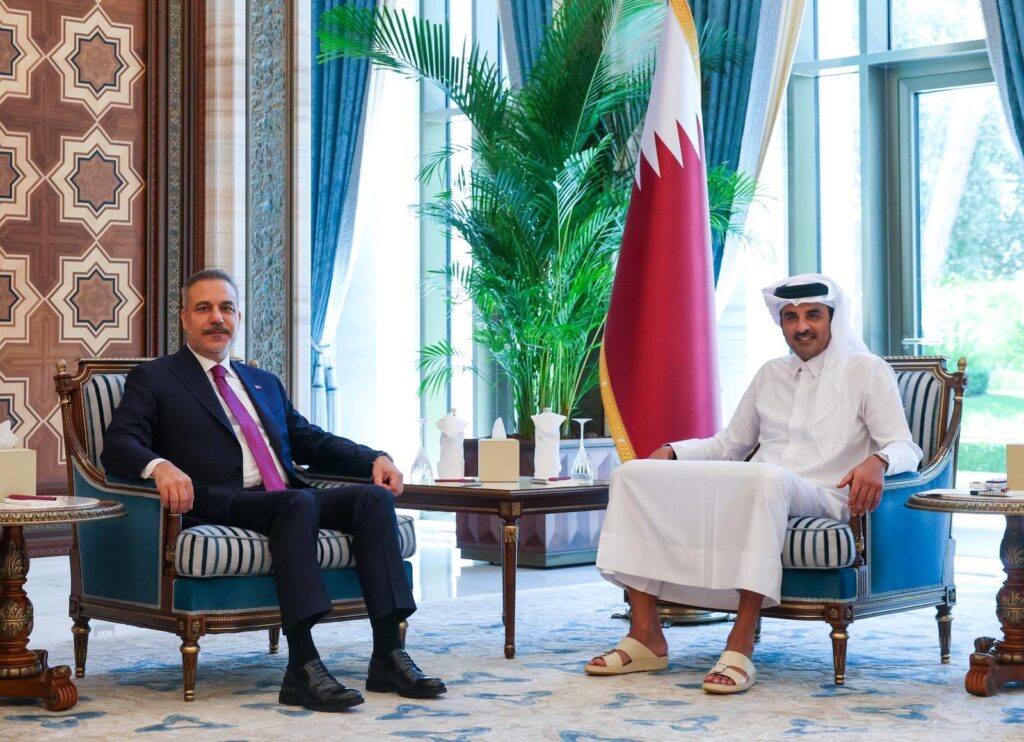
Turkish Foreign Minister Hakan Fidan warned on Tuesday during talks in Qatar that the Strait of Hormuz should not be used as a weapon, saying the security of the waterway was vital to regional stability and the global economy as the US-Israel-Iran war continued to disrupt the Gulf.
Fidan made the remarks at a joint press conference in Doha with Qatari Prime Minister and Foreign Minister Sheikh Mohammed bin Abdulrahman bin Jassim Al Thani, the state-run Anadolu news agency reported.
“The problem we are facing in the Gulf must in no way cause the issue of Gaza to be forgotten,” Fidan said.
He also said what he called Israeli expansionism remained a threat to regional stability and security.
Fidan met earlier Tuesday with Qatari Emir Sheikh Tamim bin Hamad Al Thani as part of his working visit to Doha.
Qatar, a Gulf monarchy that hosts a Turkish military base, is one of Ankara’s closest regional allies and has played a mediation role in the Iran war.
Reuters reported Monday that Fidan’s visit would focus on the war’s impact on the Gulf and efforts to ensure safe navigation in the Strait of Hormuz, citing a Turkish diplomatic source.
The source said Fidan was expected to reiterate Turkey’s support for Qatar after Iranian attacks and to underline Ankara’s view that safe navigation through Hormuz must be restored for regional security and economic stability.
The Strait of Hormuz, located between Iran and Oman, connects the Persian Gulf with the Gulf of Oman and the Arabian Sea and is one of the world’s main energy chokepoints.
Oil flow through the strait averaged 20 million barrels per day in 2024, equal to about 20 percent of global petroleum liquids consumption, while around one-fifth of global liquefied natural gas trade also passed through the waterway, mainly from Qatar, according to the US Energy Information Administration.
The International Energy Agency said in a February 2026 fact sheet that about 93 percent of Qatar’s liquefied natural gas exports and 96 percent of the United Arab Emirates’ liquefied natural gas exports pass through the strait, making any disruption a risk for global energy markets.
The Qatari prime minister said at the press conference that Qatar and Turkey supported Pakistani mediation to end the war and reopen the Strait of Hormuz while warning Iran not to use the waterway to “blackmail” Gulf countries.
The visit came after Turkey, a NATO member that borders Iran, has been in contact with the United States, Iran and Pakistan since the start of the war, while calling for an end to hostilities, condemning attacks on Iran and criticizing Tehran’s strikes on Gulf states as unacceptable.
Turkey and Qatar have expanded defense, trade and diplomatic ties over the past decade, with Turkish Foreign Ministry sources saying before the visit that Fidan would also discuss preparations for the 12th meeting of the Turkey-Qatar High Strategic Committee, expected to be held in Turkey later this year.