


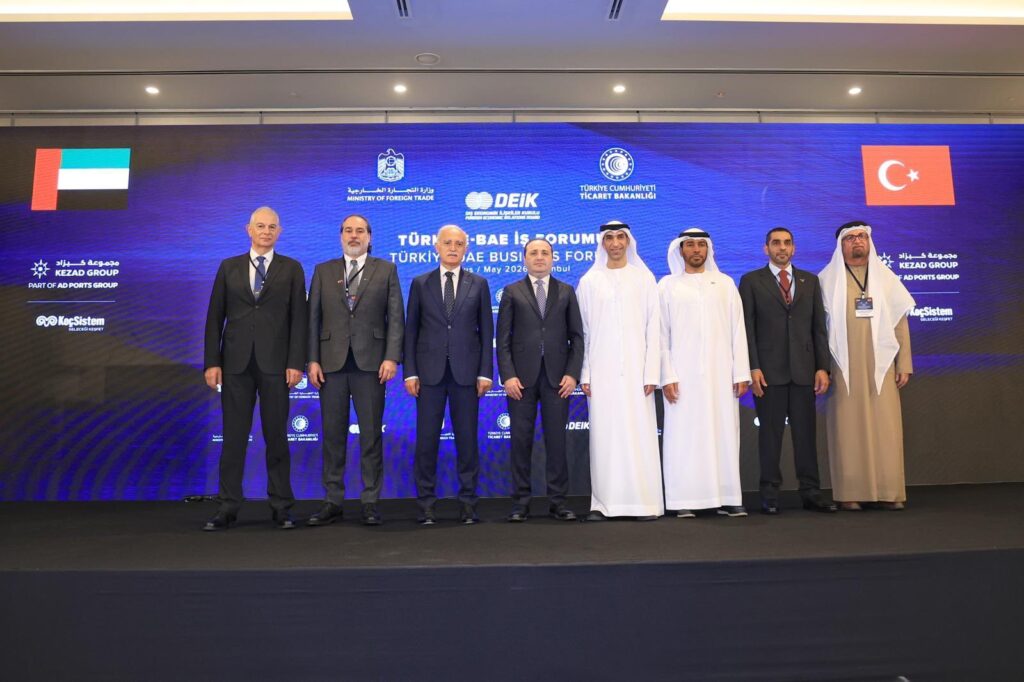
The United Arab Emirates has said non-oil foreign trade with Turkey exceeded $45.2 billion in 2025, nearly triple the level recorded before a 2023 economic partnership agreement took effect, making Ankara Abu Dhabi’s fifth-largest non-oil trade partner, Turkey’s state-run Anadolu news agency reported on Friday.
The figure, announced by UAE Foreign Trade Minister Thani bin Ahmed Al Zeyoudi during meetings and a business forum in İstanbul, marked a 15.5 percent increase from 2024 and underscored the pace of a rapprochement between two governments that were once bitter rivals.
Al Zeyoudi met with Mustafa Tuzcu, Turkey’s deputy trade minister, and addressed the Turkey-UAE Business Forum, where officials discussed ways to expand trade, investment and cooperation under the Comprehensive Economic Partnership Agreement (CEPA), the state-run Emirates News Agency (WAM) reported.
The CEPA was signed in Abu Dhabi on March 3, 2023, and entered into force on September 1 of the same year.
The agreement covers trade in goods and services, investment facilitation, intellectual property, technical barriers to trade, rules of origin and trade defense measures, according to the ministry.
Al Zeyoudi said non-oil trade between the two countries had nearly tripled compared with 2022, before the agreement was signed and entered into force.
Turkey’s Foreign Economic Relations Board (DEİK), which organized the forum, said the event brought together Al Zeyoudi, Tuzcu, DEİK President Nail Olpak, business council officials and business representatives from both countries in İstanbul on May 8.
The $45.2 billion figure was not reconciled with DEİK’s estimate of about $19 billion in bilateral trade for 2025. DEİK President Olpak said figures can vary, but neither side publicly explained why the Emirati figure was more than twice the Turkish business group’s estimate.
DEİK said the forum included sessions on renewable energy partnerships, food security, agricultural trade, innovation and technology along with bilateral business meetings.
Tuzcu described the UAE as one of Turkey’s most important trade partners in the Gulf region and said Emirati companies are among the major investors in Turkey.
He said Turkish contractors have undertaken 154 projects worth $20 billion in the UAE, making the country the 10th-largest market for Turkish contractors by project value.
The Turkish Ministry of Trade said when the agreement entered into force in 2023 that 80 percent of tariffs were covered by concessions and that Turkey expected gains in sectors including automotive, white goods, petrochemicals, textiles, carpets, footwear, plastics, machinery and electronics.
The ministry said the deal was designed to raise trade and investment to a higher level and support cooperation in third countries.
The growing trade relationship follows a rapid political détente that began in 2021, after years of rivalry over conflicts and political alignments across the Middle East and North Africa.
Turkish President Recep Tayyip Erdoğan said in August 2021 that Turkey and the UAE had made progress in improving relations after a rare meeting with a senior Emirati official, at a time when Ankara was seeking to ease tensions with several Arab powers over Libya, Gulf disputes and the eastern Mediterranean.
In November 2021, Turkey and the UAE signed 10 agreements in energy, environment, finance and trade during a visit by Abu Dhabi Crown Prince Sheikh Mohamed bin Zayed Al Nahyan to Ankara, and the UAE announced a $10 billion investment fund for Turkey.
The relationship had earlier been marked by sharp public criticism.
Turkey accused the UAE of taking positions against Turkish interests in the region, while the two countries backed opposing sides in Libya and differed over the Muslim Brotherhood, Qatar and regional uprisings after 2011.
Relations also deteriorated after the UAE normalized relations with Israel under the US-brokered Abraham Accords in 2020.
The Abraham Accords established full diplomatic relations between the UAE and Israel and called for cooperation in areas including investment, finance, aviation, trade, health care and technology.
Turkey’s Foreign Ministry condemned the UAE-Israel deal at the time, accusing Abu Dhabi of betraying the Palestinian cause and calling the move hypocritical.
Erdoğan also said in August 2020 that Turkey could suspend diplomatic relations with the UAE or recall its ambassador over the normalization deal with Israel.
However, as the UAE continued to face criticism from pro-Palestinian voices and regional analysts for maintaining relations with Israel during Israel’s military campaign in Gaza, which has prompted genocide accusations and legal proceedings at the International Court of Justice, Turkey’s ties with the UAE improved.
The Associated Press reported in November 2024 that Emirati airlines FlyDubai and Etihad continued flights to Israel while many other international carriers halted routes, describing the flights as both an economic and political sign of the UAE’s commitment to the relationship.
The Middle East Council on Global Affairs said in a 2025 analysis that the UAE had maintained ties with Israel despite regional backlash over Gaza, prioritizing strategic, technological and economic interests.
The expansion of Turkey-UAE trade shows how far Ankara and Abu Dhabi have moved from the confrontational language of 2020, even as the UAE’s relationship with Israel remains a source of criticism across the region.