


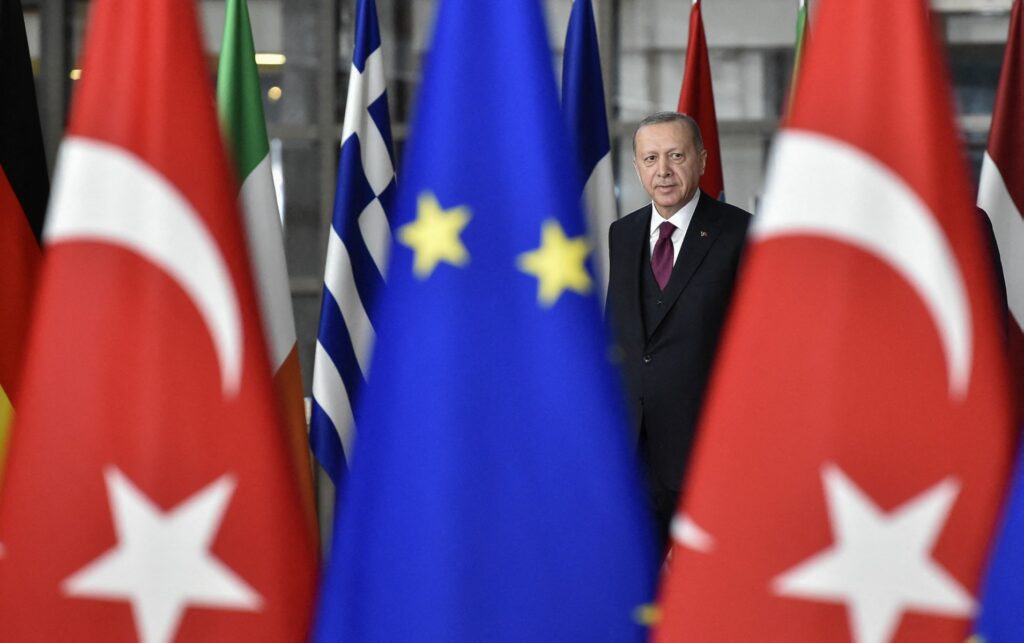
Europe would remain incomplete and less able to manage crises without Turkey, Turkish President Recep Tayyip Erdoğan said Saturday in a statement marking Europe Day.
Erdoğan said Turkey remains an “essential and indispensable” part of Europe’s future as a candidate country for EU membership, according to Turkey’s Communications Directorate.
“A European architecture that does not include Turkey in its rightful place will remain incomplete and vulnerable in managing crises,” Erdoğan said.
Europe Day, marked on May 9, commemorates the 1950 Schuman Declaration, the French proposal that helped lay the foundation for European integration after World War II.
Erdoğan said the declaration represented a commitment to building a shared future on the continent based on peace, cooperation and mutual respect.
He said the principles on which the EU was founded 76 years ago are being tested by wars, political crises and economic problems with global consequences.
Those crises, Erdoğan said, require the EU to pursue more inclusive and unifying policies.
“As we have previously stated, the European Union’s need for Turkey exceeds Turkey’s need for the bloc, and this need is expected to grow even further in the future,” Erdoğan said.
He said Ankara wants to advance relations with the EU on a “win-win basis” based on mutual obligations and a full membership perspective, adding that Turkey expects the same “sincere will” from Brussels.
Turkey has been an EU candidate country since 1999 and began accession talks in 2005, but the process has been stalled for years due to disputes over Cyprus, democratic backsliding in Turkey and opposition from some EU member states.
Erdoğan’s message came after several weeks of strain in EU-Turkey ties.
European Commission President Ursula von der Leyen said on April 19 that the EU should complete enlargement so the continent does not fall under “Russian, Turkish or Chinese influence,” prompting criticism from Turkey and some European figures.
The European Commission later said Turkey is an “undisputed economic and political partner” in the region.
Turkey was also absent from an informal EU leaders’ summit in Cyprus, where European leaders discussed Ukraine, the Middle East and regional security with several partners from the eastern Mediterranean and the Middle East.
The venue made Turkish participation politically difficult because Turkey does not recognize the Republic of Cyprus, an EU member state, and supports the Turkish Cypriot administration in the northern part of the island, which is recognized only by Ankara.
Foreign Minister Hakan Fidan also criticized the EU this week during a visit to Austria, asking what Brussels was still waiting for given Turkey’s role in Ukraine, the Middle East, the Balkans, trade and defense.
Fidan said Turkey-EU trade is close to $250 billion and could rise to $500 billion if the customs union were updated.
Turkey and the EU have had a customs union since 1995 covering industrial goods, but Ankara has long sought an update to include areas such as services, agriculture and public procurement.
Fidan also criticized the EU’s internal decision-making, saying one small member state could block steps that would benefit hundreds of millions of people, an apparent reference to Cyprus.
Devlet Bahçeli, leader of the far-right Nationalist Movement Party (MHP) and Erdoğan’s main political ally, also criticized von der Leyen’s remarks, saying Europe was experiencing “political blindness” and “cannot do without Turkey.”
The exchanges reflect the contradiction at the center of EU-Turkey relations.
Europe sees Turkey as useful for security, migration, defense, energy, supply chains and diplomacy in regions including Ukraine, Syria, the Black Sea and the eastern Mediterranean.
But many EU governments remain reluctant to revive Turkey’s membership path or give Ankara a larger role in Europe’s security architecture because of concerns over rule of law, human rights, foreign policy divergence and disputes involving Greece and Cyprus.