


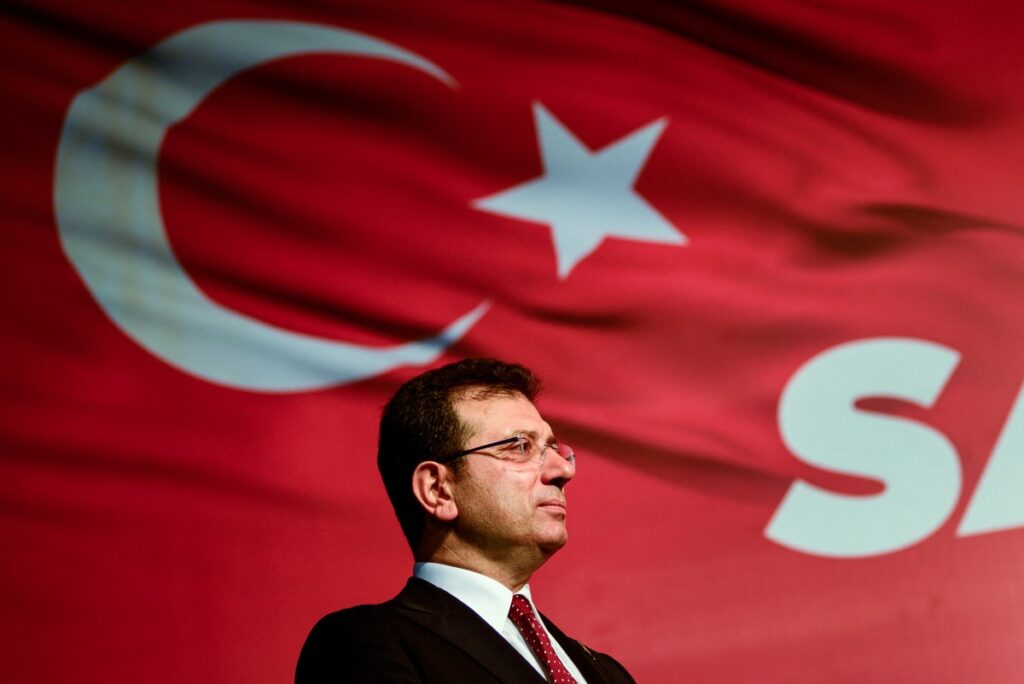
Jailed İstanbul Mayor Ekrem İmamoğlu, in an opinion piece published Tuesday in Politico, urged the European Union not to treat Turkey like Russia and China, saying Ankara’s distance from Europe is rooted not in geography but in democratic backsliding and the erosion of the rule of law.
İmamoğlu, the elected mayor of İstanbul and the presidential candidate of Turkey’s main opposition Republican People’s Party (CHP), has been held in pretrial detention for more than a year. He said he wrote the article from a prison cell in Silivri, a district west of İstanbul that hosts one of Turkey’s largest prison complexes.
“My imprisonment isn’t merely a personal legal matter,” İmamoğlu wrote. He said his detention reflected a deeper rupture in Turkey’s democracy, rule of law and relations with the EU.
The article responded to remarks by European Commission President Ursula von der Leyen, who said at a Hamburg event marking the 80th anniversary of the German weekly Die Zeit on April 19 that the EU “must succeed in completing the European continent so that it is not influenced by Russia, Türkiye or China.”
The comments, which put Turkey alongside two of the EU’s strategic rivals, prompted a backlash in Ankara. Commission spokesperson Paula Pinho later said the reference to Turkey was a recognition of its “geopolitical clout, size and ambitions” in the Western Balkans and was “not meant as a comparison with any other country.”
The European Parliament’s Foreign Affairs Committee on April 15 adopted a draft Turkey report by 44 votes to 10, with 17 abstentions. The report, prepared by Spanish Socialist rapporteur Nacho Sánchez Amor, concluded that Turkey was “lacking EU accession momentum due to democratic backsliding” while identifying a “window of opportunity” for closer sectoral cooperation on foreign and security policy.
The text now heads to a plenary vote in Strasbourg. Sánchez Amor also wrote on X that grouping Turkey with Russia and China was “geopolitically flawed” and inconsistent with EU signals favoring stronger security and defense cooperation with Ankara.
İmamoğlu said the two developments pointed to a broader problem: the absence of a credible shared vision for Turkey’s future with Europe.
İmamoğlu said Turkey’s EU candidacy, formally ongoing since 1999, had become “largely hollow,” with accession talks surviving on paper but stalled politically. He accused the Turkish government of claiming EU membership as a strategic goal while weakening the democratic and legal foundations needed for such a relationship.
“The EU still wavers between principle and vested interests in its dealings with Turkey, unable to articulate a strategic vision,” he wrote.
İmamoğlu said the European Parliament’s draft report went beyond routine criticism of Turkey’s democratic backsliding by describing in more concrete terms the pressure on the opposition and the weakening of democratic institutions since his detention on March 19, 2025.
He said the report also showed that Turkey was missing a “window of opportunity” at a time when EU enlargement policy was regaining momentum because Ankara had failed to carry out the necessary reforms.
“This is no longer just about a frozen accession file,” he wrote. “It is about strategic direction, and whether the EU and Turkey can still imagine a meaningful future together.”
İmamoğlu said Turkey should not be put on the same level as Russia and China because of its long institutional relationship with Europe, its role in the Council of Europe and its place in NATO.
He said Turkey was part of Europe’s security architecture, from the Black Sea to energy routes, migration and industrial production, and that the EU could not strengthen its long-term resilience by excluding Ankara.
“An EU that sidelines Turkey would ultimately weaken its own long-term security and economic resilience,” he wrote.
But İmamoğlu also said Turkey’s own democratic decline had driven it away from Europe. He cited weakened institutions, a politicized judiciary, pressure on the opposition, defiance of European Court of Human Rights judgments and the erosion of local democracy.
“What has distanced Turkey from the EU is not geography but the cumulative damage caused by authoritarian drift,” he wrote.
He said a government that had moved Turkey away from Council of Europe standards could not credibly present itself as the guardian of European values.
İmamoğlu called for a new political direction based on law, liberty and pluralism, saying these should be treated not as external demands from Europe but as rights belonging to Turkish citizens.
He said a future Turkey governed by his political movement would build relations with the EU on equality, values and mutual interest rather than a passive wait for admission.
“What we ask of the EU is simple,” he wrote, calling on the bloc to stop viewing Turkey through “fear, cliché and short-term political calculations.”
İmamoğlu said his belief in Turkey’s democratic future with Europe had not changed despite his imprisonment.
“It should not be left waiting at the EU’s gates,” he wrote.