


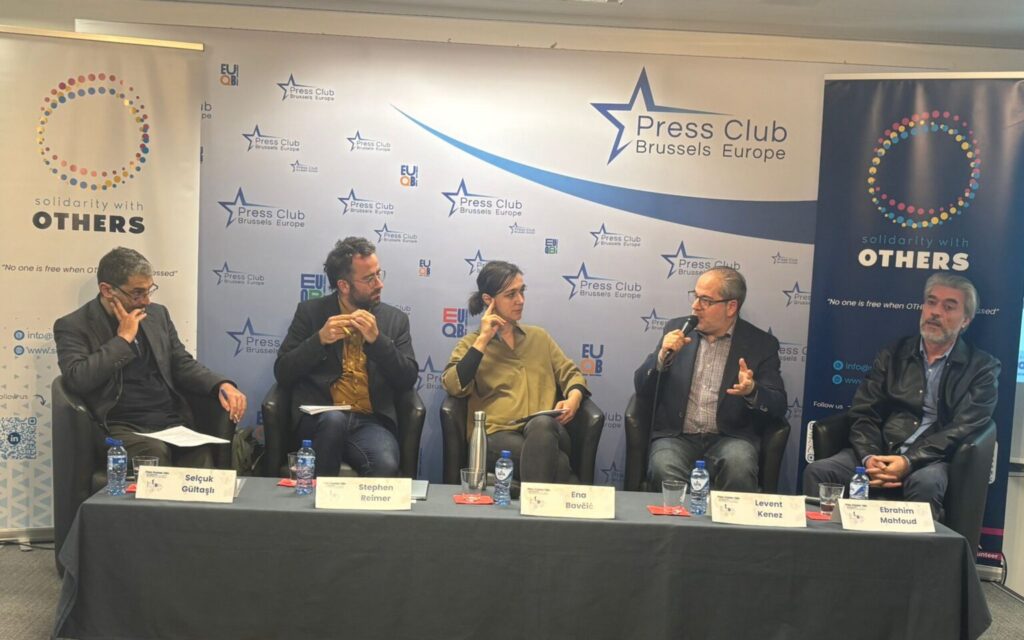
A panel discussion held in Brussels on Tuesday brought together journalists living in exile, researchers and press freedom advocates to discuss how journalists continue to face threats even after leaving their home countries, the TR724 news website reported.
The event, organized by the Brussels-based NGO Solidarity With OTHERS to mark World Press Freedom Day, was the second edition of its Press Freedom Talks and took place at the Press Club Brussels.
The discussion was moderated by journalist Selçuk Gültaşlı. Speakers included Levent Kenez, a Turkish journalist living in exile in Sweden; Ebrahim Mahfoud, a Syrian journalist living in Belgium; Ena Bavčić, senior EU advocacy officer at the European Centre for Press and Media Freedom; and Stephen Reimer, a researcher and visiting lecturer at the Paris School of International Affairs at Sciences Po.
Kenez, one of the dozens of journalists who left Turkey in the aftermath of a failed coup on July 15, 2016, to avoid a government crackdown, spoke about his own experience as an exiled journalist.
As an example of the transnational repression faced by journalists in exile, he cited Turkey’s pressure on Sweden during Stockholm’s NATO accession process, saying Ankara used dissidents and journalists abroad as a bargaining chip.
Ankara held up Sweden’s membership process, with the extradition of Kurdish refugees and other Turkish dissidents among the main sticking points.
Turkish officials even had raised the possible closure of Nordic Monitor, a Sweden-based investigative news website run by Kenez and another exiled Turkish journalist, during talks with Swedish officials several years ago.
Then-Turkish deputy foreign minister Burak Akçapar in October 2023 told lawmakers that the “Nordic Monitor issue” would remain part of negotiations with Sweden, according to publicly available parliamentary minutes.
Stockholm has repeatedly stressed that its judiciary is independent and has the final say in extraditions. It ultimately became a NATO member in March 2024.
Kenez said the episode showed how authoritarian governments can use diplomatic processes to pressure host countries over exiled journalists.
As another example of transnational repression, Kenez said Turkish officials also tried, unsuccessfully, to prevent exiled journalists from making presentations at UN institutions and described censorship by social media platforms as one of the major obstacles facing journalists in exile.
Mahfoud, the Syrian journalist, talked about the difficulties exiled journalists face in the countries where they settle. He said that while living in Italy he was prevented from working as a journalist because he did not have a press card.
Hundreds of Syrian journalists have been forced into exile since 2011 to escape arrest, torture or death, making Syria one of the leading countries for journalists fleeing into exile. Despite the fall of the Bashar al-Assad regime in December 2024, many journalists remain outside the country, according to reports from press groups.
Mahfoud said Belgium offered a more favorable environment for continuing his work but added that employment opportunities for exiled journalists remain extremely limited.
He called for greater support and more professional opportunities for journalists in exile.
For her part, Bavčić said transnational repression affects not only journalists and other targeted individuals but also their families and the wider community, adding that journalists in exile face not only physical threats but also digital attacks and other forms of pressure.
Press freedom groups have increasingly warned that journalists in exile in Europe are vulnerable to lawsuits, online harassment, surveillance and intimidation linked to their reporting or their countries of origin.
Bavčić said the European Centre for Press and Media Freedom, where she works as a senior EU advocacy officer, tries to support journalists in various areas including legal assistance.
Reimer said authoritarian governments increasingly exploit international mechanisms to target journalists, dissidents and civil society actors beyond their borders, pointing in particular to the abuse of INTERPOL Red Notices as a tool of transnational repression.
INTERPOL notices are intended to help locate and arrest people wanted for serious crimes, but rights groups have long warned that authoritarian governments can misuse the system to pursue political opponents, journalists and activists abroad by portraying them as ordinary criminal suspects.
Reimer said such tactics allow governments to extend pressure beyond their own borders, creating legal uncertainty and fear for critics who have already fled repression at home.
The panel’s moderator, Gültaşlı, drew attention not only to the problems faced by journalists in exile but also to journalists imprisoned in Turkey, including now-closed Samanyolu TV executive Hidayet Karaca and journalists Mehmet Baransu and Ali Ünal, who have been behind bars for more than nine years.
Turkey has long been criticized by press freedom groups for the imprisonment and prosecution of journalists, particularly following the failed coup in July 2016, after which the government launched a sweeping crackdown on media outlets, civil society groups, academics and perceived critics.
Solidarity With OTHERS also released a report titled “Exiled Voices in the Age of Transnational Repression” on the sidelines of the panel discussion. The report is based on interviews with 35 journalists, many of them in exile, and details their experiences, the pressure they face and the gaps in protection mechanisms.
The report found that although most displaced journalists continue their work after leaving their home countries, nearly all described ongoing transnational repression, online harassment, legal insecurity, financial instability and deep psychological scars.