


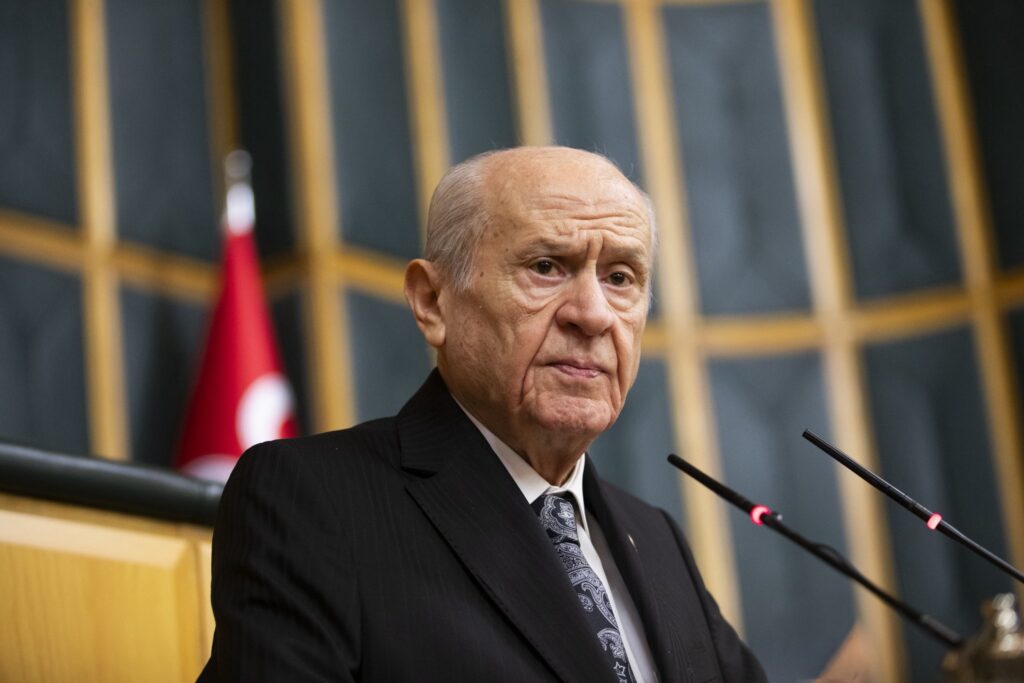
Devlet Bahçeli, the chairman of Turkey’s far-right Nationalist Movement Party (MHP), has proposed that jailed Kurdistan Workers’ Party (PKK) leader Abdullah Öcalan be given a formal role in Turkey’s ongoing peace initiative, suggesting the title of “coordinator for the peace process and transition to politics,” the Anka news agency reported.
Speaking at his party’s parliamentary group meeting on Tuesday, Bahçeli said the next stage in the process should involve “political and legal steps” and claimed that Öcalan’s status could no longer be ignored.
“If there is a gap in status for Abdullah Öcalan, this gap should be addressed in a way that serves the goal of a terrorism-free Turkey,” Bahçeli said.
“I propose that this position be called coordinator for the peace process and transition to politics,” he added.
Bahçeli said other formulations could also be considered but made clear that his goal was for Öcalan, whom he described as the PKK’s founding leader, to serve under such a designation.
“The status issue is important for us,” Bahçeli said. “It’s not possible to carry out the process in a healthy way by pretending this issue does not exist.”
Öcalan, 77, has been held on İmralı Island since his capture in 1999 and is serving a life sentence. He has played a central role in past and recent efforts to end Turkey’s decades-long conflict with the PKK, which is designated as a terrorist organization by Turkey and its Western allies.
Bahçeli’s remarks on Tuesday marked his clearest proposal yet on how Öcalan’s role could be defined within the peace process.
Bahçeli, a longtime nationalist hardliner and a key ally of President Recep Tayyip Erdoğan, has played a central role in reviving the debate on a possible settlement. In October 2024 he asked Öcalan to instruct his group to renounce its armed campaign while hinting that the end of PKK violence could lead to Öcalan’s freedom.
Öcalan made a landmark call in February 2025, urging the PKK to convene a congress, lay down its arms and formally disband.
Following the call the PKK announced in May 2025 that it would lay down its weapons and dissolve itself.
Öcalan’s call was widely viewed as a potential turning point in efforts to end the conflict, although questions remained about the legal and political framework that would accompany such a process.
The pro-Kurdish Peoples’ Equality and Democracy Party (DEM Party) has repeatedly called this year for legal steps regarding Öcalan’s status.
The party has proposed that Öcalan be recognized as a “chief negotiator,” claiming that conditions should be created for him to meet with anyone he wants in Turkey and that his contacts with his own organization should be made more direct.
“For permanent peace, Mr. Öcalan’s status must be recognized through legal regulation and secured under the law,” DEM Party Co-chair Tülay Hatimoğulları said in February, calling for swift legislative steps in parliament.
Since then, DEM Party delegations have met with Öcalan on İmralı several times as part of the initiative.
Turkey previously engaged in a peace process with the PKK between 2013 and 2015, during which Öcalan played a key role from prison by issuing messages calling for a ceasefire and negotiations. The process collapsed in 2015 amid renewed violence, leading to intensified military operations and a broader crackdown on Kurdish political actors.
A parliamentary commission tasked with advancing the peace efforts and established last August recently finalized a draft report outlining legal reforms linked to the peace process.
The report does not explicitly address Öcalan’s possible release and does not use the term “right to hope.”
However, it refers to European Court of Human Rights (ECtHR) and Turkish Constitutional Court rulings concerning sentence enforcement. Legal experts note that such language implicitly touches on the “right to hope” principle, which requires that even prisoners serving life sentences have a realistic prospect of release after a certain period.
Critics have noted that the commission has no enforcement power, no independent monitors and that its work remains tied to Erdoğan’s own political calculations, including his need for additional parliamentary support to extend his presidency beyond its 2028 constitutional limit.
The PKK, founded by Öcalan in 1978, has waged an armed insurgency against the Turkish state since 1984, claiming more than 40,000 lives.