


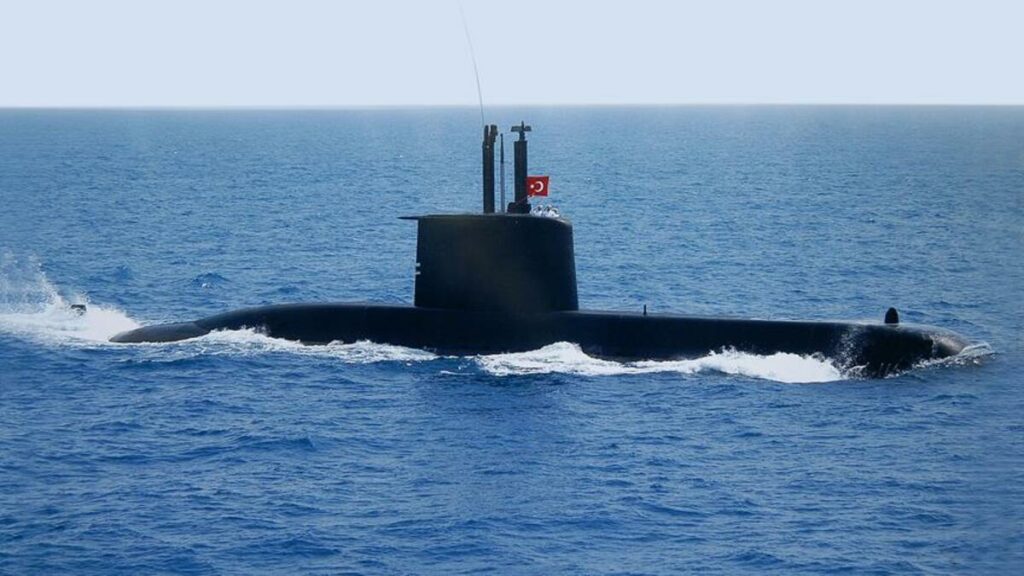
Turkey has begun planning design, feasibility and future production work for a nuclear-powered submarine, Defense Minister Yaşar Güler said in an April 22 written parliamentary response reported by the Cumhuriyet daily on Wednesday, describing the project as part of Ankara’s efforts to increase deterrence in nearby seas and pursue a “global power” vision.
Güler was responding to a parliamentary question submitted on April 3 by an opposition lawmaker. He said Turkey aimed to improve its naval power by expanding its defense industry across several sectors and developing submarines with long range and low detectability.
The minister said the Turkish Naval Forces were open to cooperation on nuclear propulsion technology with friendly and allied countries, particularly NATO members, while work continued to use domestic technology in Turkey’s Nuclear-Powered Submarine Project (NÜKDEN).
Güler said the choice of platforms was based on Turkey’s national military strategy, threat assessments for surrounding seas and the political-military environment.
He said the goal of building a nationally designed submarine and a nuclear-powered submarine under the ongoing National Submarine Project (MİLDEN) and NÜKDEN was part of Turkey’s plan to increase deterrence against regional threats in the eastern Mediterranean and surrounding seas and to become a global power.
The project concerns nuclear propulsion, not nuclear weapons. A nuclear-powered submarine uses a reactor for propulsion, allowing it to remain submerged far longer and operate at greater range than diesel-electric submarines.
An early reference to such a capability appeared in January 2024 in a Turkish Naval Forces journal review of France’s Barracuda-class submarines, though it was not presented as an official policy announcement. The first high-level public statement came from Turkish Naval Forces Commander Adm. Ercüment Tatlıoğlu in an interview published in the May 2025 issue of Warships International Fleet Review, when he said Turkey aimed to move toward nuclear-powered submarines after the MİLDEN project.
Later that month, Rear Adm. Timur Yılmaz, commander of the Turkish Submarine Fleet, publicly identified the program as NÜKDEN at the 12th Naval Systems Seminar at the İstanbul Naval Museum on May 27, 2025. He linked the need for such submarines to Turkey’s planned national aircraft carrier task groups.
Nuclear-powered submarines can escort aircraft carrier groups at high speed over long distances, conduct surveillance ahead of a task force and provide underwater protection that conventional submarines cannot sustain for the same duration.
Turkey is also developing a national aircraft carrier, known as MUGEM. The planned vessel is expected to be about 285 meters long and displace around 60,000 tons, compared with the 232-meter, roughly 27,000-ton TCG Anadolu, Turkey’s largest naval vessel. It is intended to carry manned and unmanned aircraft.
Turkey already has experience in conventional submarine construction through the Reis-class program at Gölcük Naval Shipyard and the MİLDEN project. NÜKDEN would require capabilities beyond that base.
The main hurdles include designing or obtaining a naval reactor, developing nuclear safety procedures, training specialized crews, building maintenance infrastructure and managing the nuclear fuel cycle. Turkey’s civil nuclear program, including the Akkuyu nuclear power plant, can help develop a broader nuclear ecosystem but does not by itself provide naval reactor technology.
Güler said Turkey was open to cooperation with NATO allies and other friendly countries. The United States, the United Kingdom and France operate nuclear-powered submarines, but the technology is tightly controlled.
AUKUS, a security pact announced in 2021 between Australia, the United Kingdom and the United States, is one of the few recent examples of cooperation on nuclear-powered submarines. Under the pact, Australia is to acquire nuclear-powered submarines, but the arrangement does not amount to unrestricted access to the underlying propulsion technology.
Russia also has nuclear submarine technology and is Turkey’s partner in the Akkuyu nuclear power plant, but cooperation on naval nuclear propulsion would be politically sensitive because of Turkey’s NATO membership, Western sanctions on Russia and the war in Ukraine.
Cost is another obstacle. Nuclear-powered submarines require not only the vessel itself but also reactor technology, safety systems, long-term maintenance, specialized bases and trained personnel.
Turkey’s defense spending has increased in recent years, but the number of major programs under way means resources would have to be carefully prioritized. Defense News reported that Turkey’s 2026 defense and security budget stands at $27.34 billion, while the Defense Ministry accounts for $19.08 billion. Procurement accounts for 44.1 percent of the ministry allocation, which works out to roughly $8.4 billion.
That makes design and feasibility work more realistic in the near term than full-scale production. The known state of the programs suggests Turkey is better situated to continue the MUGEM aircraft carrier project, which relies on conventional propulsion and the country’s existing shipbuilding base, than to move quickly into nuclear-powered submarine production.
NÜKDEN would require a larger technological step, including reactor development or transfer, nuclear safety infrastructure, trained crews, maintenance facilities and long-term operating funds.
Running MUGEM and NÜKDEN at the same time would be possible only if the programs are spread over many years, with MİLDEN and the aircraft carrier program maturing first and nuclear propulsion work moving forward later. A fully operational, domestically built nuclear-powered submarine in the 2030s would be a demanding target and would require sustained budget priority.
Defense analyst Arda Mevlütoğlu has said countries with domestic nuclear submarine capabilities are generally permanent members of the United Nations Security Council, a sign of the technical and political difficulty of such programs.