


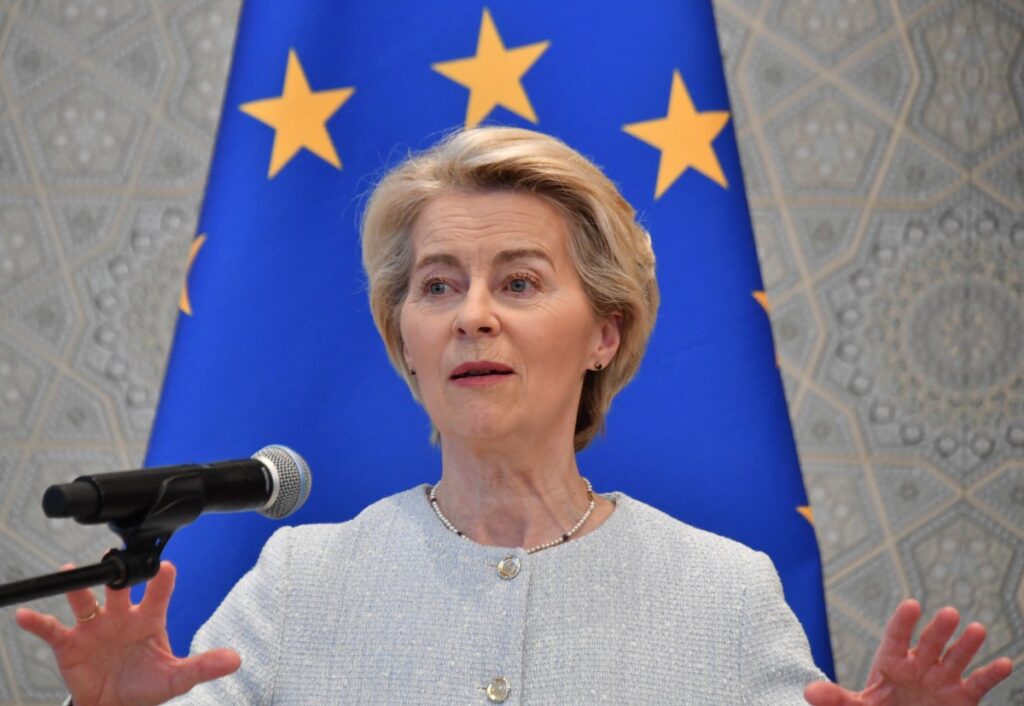
European Commission President Ursula von der Leyen attracted criticism on Tuesday after grouping Turkey with Russia and China as sources of influence the European Union must guard against.
Speaking at German weekly Die Zeit’s 80th anniversary event in Hamburg, von der Leyen said Europe must “complete the European continent” so it is not shaped by Russian, Turkish or Chinese influence, according to the outlet’s report on the event.
Von der Leyen: "We must succeed in completing the European continent so that it is not shaped by Russian, Turkish, or Chinese influence".
I believe this is the first time ever that an EC President has placed Ankara in the same category as Moscow and Beijing
(note the order btw) pic.twitter.com/vgKlklvM6U
— Oğuz Arıkboğa (@OguzArikboga) April 20, 2026
Critics underlined that Turkey is a candidate for European Union membership, a member of NATO and a country many European officials describe as important for regional security, migration and energy transit.
📌Von der Leyen reportedly placing Turkey alongside Russia and China is politically telling. It reflects how parts of Europe still struggle to think of Ankara as a strategic partner, even while Europe’s security, energy, and industrial future increasingly requires dealing with… https://t.co/OCKop3qLoy
— Riccardo Gasco (@RiccardoGasco) April 21, 2026
Riccardo Gasco, a foreign policy researcher focused on Turkey and Europe, said in a post on X that the reported comment was “politically telling” and showed that parts of Europe still struggle to think of Ankara as a strategic partner even as Europe’s security, energy and industrial future increasingly require working with Turkey.
Turkiye is literally part of Europe, & member of NATO. What on earth has it got to do with China? @vonderleyen Seems to have lost the plot. https://t.co/NMSGyjRY74
— Meral Hussein-Ece (@meralhece) April 21, 2026
Meral Hussein-Ece, a British Liberal Democrat member of the House of Lords, questioned why von der Leyen had mentioned Turkey in the same context as China, saying, “Turkiye is literally part of Europe, & member of NATO. What on earth has it got to do with China?”
Grouping Turkey with #Russia and #China crosses a discursive threshold the Commission had carefully preserved. Even as accession has been effectively frozen, previous #EU language kept Turkey in the “candidate” and mostly “indispensable partner” register, a backsliding state to… https://t.co/QBuwC8WGb5
— Seren Selvin Korkmaz (@selvinkorkmaz) April 21, 2026
Seren Selvin Korkmaz, a political scientist and commentator, said von der Leyen’s wording marked a shift in European Commission language on Turkey. She said Brussels had long treated Turkey as a candidate country and an indispensable, if troubled, partner, but that framing Turkey as an outside source of influence suggested it was now being cast as politically and geographically outside Europe despite its role in NATO, its control of the Turkish Straits and its place in Europe’s energy security.
Economist Timothy Ash, who covers Turkey along with emerging Europe and the Middle East, called the remark “complete ignorance” and said Europe could not defend itself without Turkey. In a separate post he said von der Leyen appeared not to understand that any future European security architecture without the United States would depend in part on countries such as Ukraine, Turkey, Finland and Poland.
This is the crux of why Turkey could have never been a EU member state, even if its domestic democratic and human rights credentials were much more promising.. She should also have the same robust public voice and state that EU is canceling accession bid by Turkey. https://t.co/mExTBAxqfY
— Ziya Meral (@Ziya_Meral) April 21, 2026
Ziya Meral, a foreign and security policy analyst, said the comment reflected a deeper problem in Europe’s approach to Turkey, arguing that it showed why Turkey was never treated as a genuine future European Union member even in periods when its democracy and human rights record appeared more promising. He said Brussels should be open about whether it has effectively ended Turkey’s accession path.
Turkey has been an official candidate for EU membership since 1999, but its accession process has been stalled for years because of concerns about democratic backsliding, human rights and the rule of law under President Recep Tayyip Erdoğan.
At the same time, Brussels continues to view Turkey as a key partner on migration, trade, energy transit and regional security. As a NATO member with a large military, control over access to the Black Sea through the Turkish Straits and a position between Europe, the Middle East and the Caucasus, Turkey remains central to Europe’s geopolitical calculations even as its ties with the bloc remain strained.