


Orhan Sait Berber
Concerns about the violation of women’s rights in Turkey, including the detention of pregnant and ill inmates and children living in prison with their mothers, were raised at a United Nations panel discussion in New York this week following a sweeping crackdown after a failed 2016 coup.
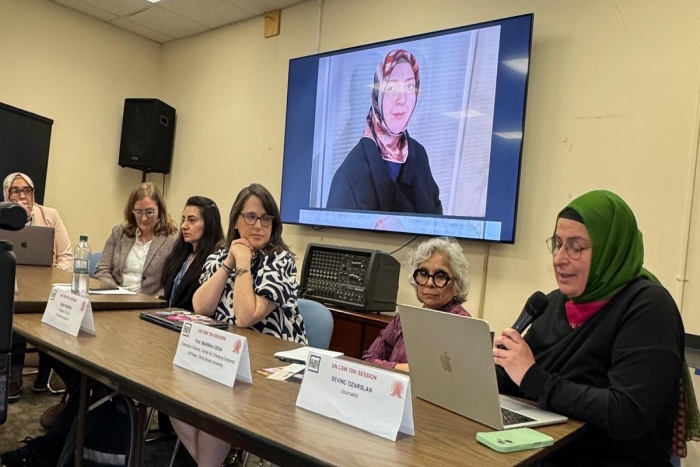
The panel discussion, held March 16 on the sidelines of the 70th session of the UN Commission on the Status of Women (CSW70), brought together academics, advocates and civil society representatives.
During the discussion, Turkey was cited as a case where women have faced detention, prosecution and social exclusion in the years since the coup attempt.
Many of those affected have been targeted over alleged links to the faith-based Gülen movement, which Ankara accuses of orchestrating the coup, an allegation the movement strongly denies.
Turkish journalist Sevinç Özarslan, who lives in exile in Germany, was among the speakers.
“When you tell the truth, you are silenced. All my social media accounts have been blocked in Turkey,” she said, referring to what she described as ongoing censorship targeting journalists reporting on rights violations.
Özarslan said women have been disproportionately affected by the post-coup crackdown, with some detained during pregnancy, shortly after giving birth or while seriously ill.
Thousands of women as well as men have been detained and arrested in Turkey following the coup attempt due to their alleged links to the Gülen movement as part of an anti-coup fight. Some of those women were new mothers who had to take their babies to prison with them and some were pregnant, while others were elderly or sick.
She also cited rulings by the European Court of Human Rights (ECtHR), saying many of those prosecuted were later found not to have committed a crime.
Since the coup attempt, Turkish authorities have used factors such as having an account at Bank Asya, using the ByLock messaging application or subscribing to certain newspapers as evidence in terrorism-related prosecutions. The ECtHR has ruled in multiple cases that use of the ByLock app alone does not constitute a criminal offense, but arrests related to its alleged use have continued.
Özarslan also raised concerns about prison conditions, including limited access to healthcare and allegations of ill-treatment during detention and medical procedures.
Claims of abuse in detention have previously attracted public attention. In 2020 opposition lawmaker and human rights advocate Ömer Faruk Gergerlioğlu brought allegations of strip-searches in prisons and detention centers to parliament, prompting public debate and a social media campaign in which detainees shared similar accounts.
Calling on the international community to act, Özarslan said that “systematic violations against women must not be ignored” and warned that silence would allow such abuses to continue.
Concerns raised during the panel discussion come amid ongoing scrutiny of prison conditions in Turkey.
A 2025 report by the Civil Society in the Penal System (CISST) found that as of October 1, 822 children under the age of 6 were living in prison with their mothers, up from 759 a year earlier.
Earlier figures show a similar pattern. In 2023, 470 mothers were in prison with 520 children ages 0 to 6, while in 2019 rights groups reported that at least 743 children were living behind bars with their mothers, a figure that later rose to 780.
International standards, including the UN Bangkok Rules, say pregnant women, new mothers and women living with their children in prison should be treated according to their specific needs and that children should not be treated as prisoners.
Turkish law states that prison sentences for pregnant women and mothers within six months after childbirth should be postponed, although rights groups say these protections are not always applied in practice.
Stockholm Center for Freedom’s report titled “Torture, Ill-treatment and Prison Conditions in Turkey: 2025 in Review” examined prison conditions in Turkey and documented a range of alleged violations affecting women, including concerns over treatment, healthcare access and detention conditions.
Academics and activists from various countries also said gender-based violence has become a systemic phenomenon under authoritarian rule.
Speakers said global solidarity must be strengthened to address violations of women’s rights.
Rachel Miner, founder of Bellwether International, a nonprofit aiming to protect global religious freedom, described her organization’s work supporting women affected by political violence.
“In genocides, men are often killed and women subjected to sexual violence. This is not limited to one region; it affects millions of women globally,” she said.
Miner said her organization works on developing sustainable tools to help women recover from trauma, focusing on their experiences and supporting them to rebuild their lives within their own communities.
Dr. Shilan Fuad Hussain, a Marie Curie researcher known for her work on Kurdish women, shared findings from her research on forced marriage, female genital mutilation and so-called honor killings.
She highlighted not only the violence women face but also their resilience, saying many resist through education, solidarity and small acts of defiance within restrictive systems.
Hussain, who was born in Iraq and later moved to Europe, said her research also examines similar dynamics within diaspora communities, where patriarchal structures can persist despite changes in geography.
Cindy Morris, co-founder of Women Who Change the World, a platform aimed at connecting and empowering female leaders, said efforts to weaken women’s agency are often central to authoritarian governance.
Sociology professor Manisha Desai of Stony Brook University, known for her work on ethnic and religious nationalism, said ethnonationalist and religious supremacist ideologies have become a global phenomenon.
“These ideologies are no longer limited to specific regions,” she said, calling for multiracial and interfaith coalitions to counter transnational fundamentalism and xenophobia.