


A reported Central Intelligence Agency (CIA) plan to arm Iranian Kurdish groups has trapped Turkish President Recep Tayyip Erdoğan between accepting Kurdish autonomy on Turkey’s borders or defying US President Donald Trump and risking the economic devastation Ankara suffered during their 2018 confrontation, according to experts.
CNN and Reuters reported this week that the Trump administration is coordinating with Iranian Kurdish militias to launch cross-border attacks on Iranian security forces “in the coming days” as part of the broader US-Israel military campaign that began February 28 and killed Iranian Supreme Leader Ayatollah Ali Khamenei and more than 1,000 Iranians. Trump has personally called Iraqi Kurdish leaders and the Kurdistan Democratic Party of Iran leader to discuss the plan.
Kurdish military empowerment is a red line they will act on. If USA openly backs Kurdish forces against Iran, Turkey has only two options: capitulate or leave NATO to act militarily. Ankara considers the Kurds a strategic *existential* threat on its border.
— ⬢ Jens Wiëchers (@jwiechers) March 3, 2026
“Kurdish military empowerment is a red line they will act on,” said security analyst John Wiechers. “If USA openly backs Kurdish forces against Iran, Turkey has only two options: capitulate or leave NATO to act militarily. Ankara considers the Kurds a strategic *existential* threat on its border.”
Why Kurdish autonomy terrifies the Turkish government
Ankara fears any successful Kurdish self-governance near its borders could reignite separatist momentum among its own Kurdish population and destroy the fragile peace process with the Kurdistan Workers’ Party (PKK) that culminated in the group’s May 2025 decision to disband. The PKK waged a four-decade insurgency that killed more than 50,000 people before laying down arms following a call from jailed founder Abdullah Öcalan.
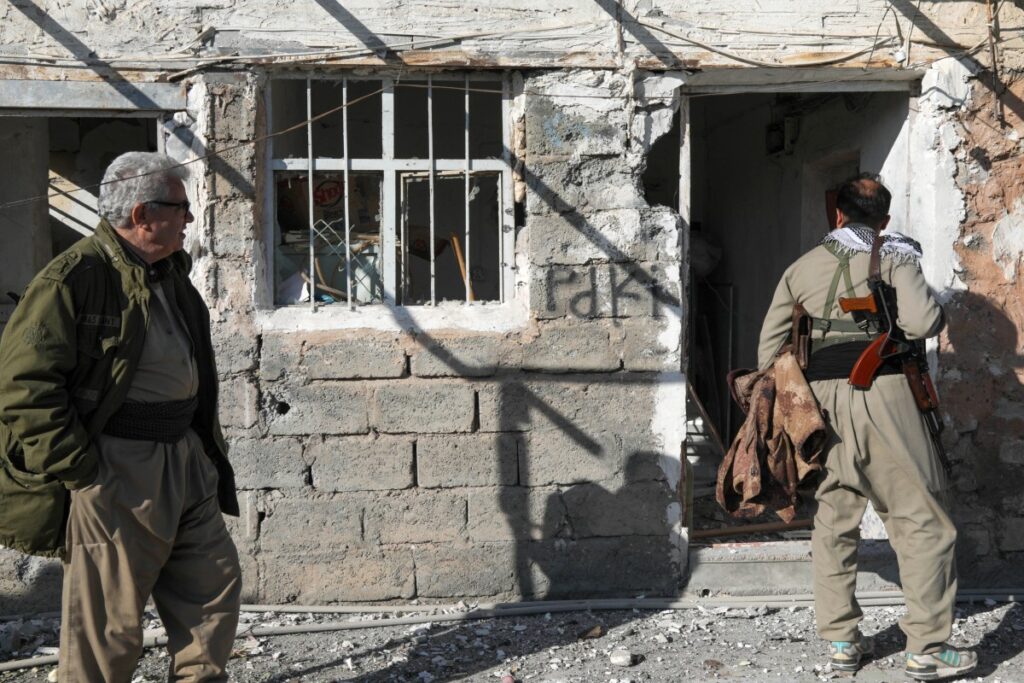
The Party for a Free Life in Kurdistan (PJAK), an Iranian Kurdish armed group with historical ties to the PKK, refused to lay down arms in 2025 and remains active in northwestern Iran along Turkey’s 500-kilometer border. Ankara views PJAK as effectively an extension of the PKK operating under a different name.
They must know in Washington and Tel Aviv that nudging Iranian Kurds toward a rebellion will seriously test Turkey's alliance with the US and make Turkey's hitherto suspect hostility toward Israel real. It will push Turkey toward actively supporting Iran. One has to wonder then,…
— Arman Grigoryan (@Arm__Grig) March 4, 2026
“They must know in Washington and Tel Aviv that nudging Iranian Kurds toward a rebellion will seriously test Turkey’s alliance with the US and make Turkey’s hitherto suspect hostility toward Israel real,” said Arman Grigoryan, associate professor of international relations at Lehigh University. “It will push Turkey toward actively supporting Iran.”
Turkey’s parliament is reviewing a peace commission report that would facilitate reintegration of former PKK fighters. Iranian Kurdish autonomy would undermine the government’s argument that Kurds should pursue political goals through democratic participation rather than armed struggle.
Turkey wants Iran weak, not collapsed
Ankara prefers a weakened, isolated Iran to full regime change, analysts said. Haşim Tekineş, a policy analyst at the Belgium-based instituDE think tank, explained that a secular Iran could improve US and Israeli relations with Tehran, creating a regional balance that weakens Turkey’s leverage.
Is there a Turkish red line when it comes to the Kurds in Iran?
Any Trump–Netanyahu engagement with the Iranian Kurds would ring alarm bells in Ankara, which has just breathed a sigh of relief after defeating the Syrian Kurds. So how might Erdogan react to Trump on Iran?
As at… https://t.co/qSCz8mLjia
— hasim (@hasimtekines) March 3, 2026
“Ankara would likely prefer a weaker, isolated Iran,” Tekineş wrote on X on Monday. “This helps explain why Erdoğan mourned Khamenei’s death and framed the war as a violation of international law.”
Turkey depends on Iran for roughly 20 percent of its natural gas imports and has maintained strong diplomatic ties with Tehran despite regional rivalries. Instability in Iran could trigger refugee flows into Turkey, which already hosts more than 3 million Syrian refugees, a politically explosive issue that has damaged Erdoğan’s popularity.
Foreign Minister Hakan Fidan said Monday that Turkey worked to prevent the US-Israel military campaign and “delayed the start of the war” through diplomatic efforts. Fidan said Turkey’s priority is “preserving the stability of Iran and the region.”
The 2018 Trump trauma
In 2018 Trump imposed harsh sanctions on Turkey over Ankara’s detention of an American pastor, causing the Turkish lira to lose 30 percent of its value in weeks and triggering an economic crisis from which the country has never fully recovered. Trump also sent Erdoğan a letter urging him not to be “a fool.”
“Erdogan knows he cannot afford to fall out with Trump,” Tekineş said. “He is not Obama or Biden. Conflict with Trump in 2018 had severe consequences for the Turkish economy. Trump threatened to ‘destroy’ it. And he did.”
Turkey is seeking to rejoin the F-35 fighter jet program after being expelled in 2019 for purchasing Russia’s S-400 air defense system and may need Trump’s influence to restrain Israeli Prime Minister Benjamin Netanyahu. Ankara cannot afford another economic confrontation with the US at a time when inflation remains above 30 percent.
Historical precedents
Turkey’s government remembers US engagement with Iraqi Kurds during the Iraq wars as a strategic betrayal that fueled anti-American sentiment. The pattern repeated in Syria in 2014, when President Barack Obama chose to work with Syrian Kurdish forces against the Islamic State group rather than rely on Turkey.
Erdoğan had initially tried recruiting Syrian Kurds to join Turkey’s campaign to topple Syrian President Bashar al-Assad in 2012. When Syrian Kurds rejected Turkey’s overtures, Erdoğan pressured Obama to avoid working with them — a miscalculation that backfired when Obama partnered with the Kurdish-led Syrian Democratic Forces (SDF) anyway.
Turkey spent years fighting those US-backed Syrian Kurdish forces, viewing them as a terrorist extension of the PKK. Erdoğan considers the recent weakening of Syrian Kurdish autonomy following Assad’s December 2024 fall a major strategic victory. The prospect of watching that evaporate through a new US-Kurdish partnership in Iran represents the worst-case scenario for Ankara.
Turkey unlikely to confront US
Despite describing Kurdish autonomy as an existential threat, most analysts predict Turkey will avoid direct confrontation with the US, at least initially.
“Erdogan would first try to change Trump’s mind through diplomatic channels,” Tekineş said. “But if that fails, Ankara might consider joining the process rather than being sidelined. If it senses weakness in the Iranian regime, it could seek influence over Iranian Kurds alongside Trump’s plan.”
That flexibility reflects lessons learned from Iraq and Syria, where Turkey’s early opposition to US-Kurdish cooperation left Ankara sidelined. One geopolitical commentator wrote that Turkey “will not exhaust men and options until it comes immediately to Turkish territorial integrity,” suggesting Ankara will wait rather than commit resources unless directly threatened.
The likely scenario involves private diplomatic pressure on Trump to limit the Kurdish role, heightened border surveillance, coordination with Iraqi Kurdish leaders in Erbil to shape which Iranian Kurdish groups receive support and contingency planning for buffer zones inside Iran to block refugee flows.
The unknowable variable
What analysts cannot predict is Erdoğan’s response if Iranian Kurds establish autonomous control over northwestern Iran, even temporarily. That would force a choice between the domestic Kurdish peace process, central to Erdoğan’s “Terrorlsm-free Turkey” agenda, and tolerating a precedent that could unravel that peace.
This heavily implies that Trump, at Netanyahu's urging, is trying to foster a Kurdish uprising in Iran supported by a possible ground invasion of Iran by Kurdish forces in Iraq.
Has anyone told Erdogan? https://t.co/1Qj7YkKJqD
— Gregory Brew (@gbrew24) March 3, 2026
“Has anyone told Erdogan?” energy analyst Gregory Brew asked, echoing bewilderment about whether the Trump administration coordinated the Kurdish plan with its NATO ally.
Turkey has issued no official statement on the reports. Foreign Minister Fidan had talks Monday with Nechirvan Barzani, president of the Kurdistan Regional Government in Iraq, though neither side disclosed details. Erdoğan has condemned US-Israel strikes on Iran but has not mentioned Kurdish involvement.
According to Reuters, Iranian Kurdish militias have consulted with the US on attacking Iranian security forces in western Iran. The groups are training for operations designed to weaken Tehran’s military and create space for urban uprisings. A ground incursion could begin within days, Kurdish sources told Reuters. The US has not officially confirmed the plan.
Erdoğan’s ability to navigate between Trump’s demands and Turkey’s security imperatives may determine whether Ankara emerges from the crisis as a relevant regional power or a sidelined spectator.