


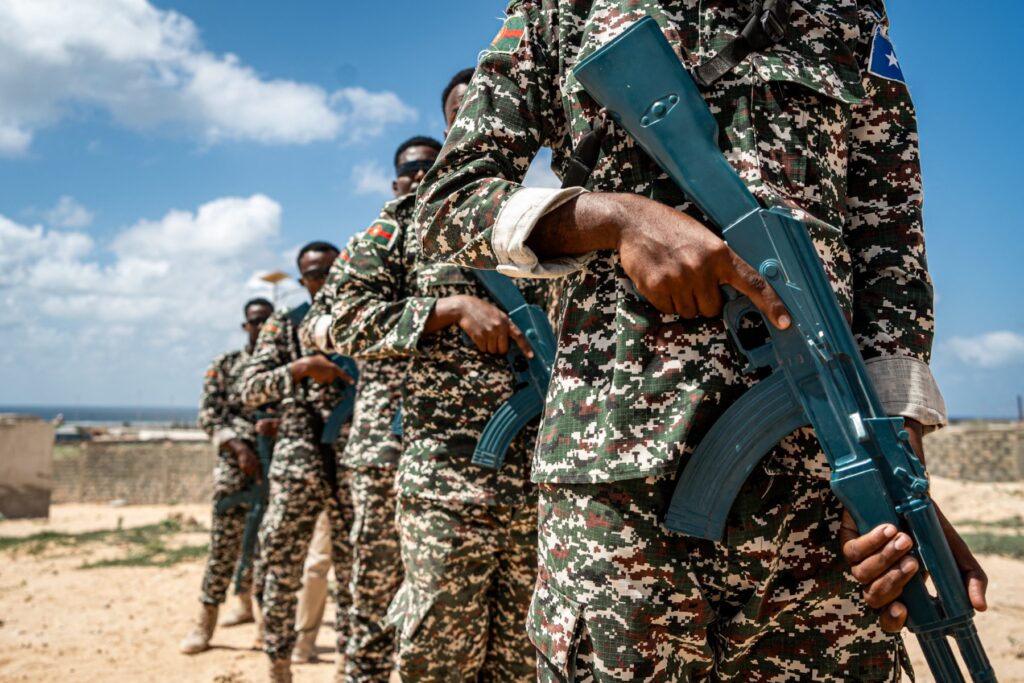
Somalia’s information minister has said Turkish military support has helped Somali forces push back al-Shabaab, while dismissing suggestions that Ankara’s recent buildup is tied to Israel’s recognition of Somaliland.
Information Minister Daud Aweis Jama made the remarks in an interview with the Turkish Cumhuriyet daily published on Thursday, a day after attending a Turkey-Somalia relations event at the Turkish Presidency’s Directorate of Communications in Ankara.
Asked whether the increased military shipments had made a difference on the ground, Jama said the Somali National Army had run multiple operations, pushed into new territory and neutralized several al-Shabaab commanders.
Turkey’s military presence in Somalia has rapidly grown. F-16s were deployed to Mogadishu in late January, flown by Turkish Air Force personnel stationed there. Somali media reported Turkish-supplied tanks arriving at the capital’s port, with footage circulating online. Turkey’s Defense Ministry describes the deployments as counterterrorism support; some analysts see them also as protecting Ankara’s energy investments in the region.
Several of those analysts have read the buildup as a reaction to Israel’s December recognition of Somaliland. Turkey’s largest overseas military base, Camp TURKSOM, has been in Mogadishu since 2017.
Jama told Cumhuriyet there was no direct connection between the shipments and the Israel move. “Somalia and Turkey have had military cooperation against al-Shabaab for a long time, and what is happening now is part of that.” He thanked President Recep Tayyip Erdoğan, saying the Turkish leader had stated during a recent Ethiopia visit that Somaliland remains part of Somalia.
Israel’s recognition drew formal objections from the African Union, the European Union, Egypt, the Gulf Cooperation Council and the Organisation of Islamic Cooperation.
On energy, Jama said the Turkish deep-sea drilling vessel Çağrı Bey heading to Somali waters could change things. “This vessel reaching Somalia will bring us very close to becoming one of the world’s oil producers,” he told Cumhuriyet. No commercial discovery has yet been made; the mission is exploratory. The ship left the Turkish port of Taşucu on February 15, escorted by three warships, and is expected to begin drilling at the Curad-1 well in April.
Turkey’s Defense Ministry separately denied on Thursday that Russia’s S-400 long-range air defense systems might be sent to Somalia, calling the reports baseless. The ministry said Somalia operations are conducted under bilateral agreements and that the S-400s were acquired for Turkey’s own forces.
Turkey’s engagement with Somalia dates to 2011, when Erdoğan — then prime minister — flew to Mogadishu during a famine. That visit opened the door to what became a broad relationship covering military training, investment and energy.
Somalia holds a non-permanent UN Security Council seat through 2026 and was recently voted onto the African Union Peace and Security Council for the first time, for a three-year term starting in 2026.
Somaliland declared independence in 1991 after Siad Barre’s government collapsed. It has had its own currency, army and police ever since, but went almost entirely unrecognized internationally until Israel’s move in December.