


Bünyamin Tekin
Turkey’s decision to join a new US-led body meant to oversee Gaza’s ceasefire and reconstruction could force Ankara and Israel into some level of coordination despite deep political hostility, a former Turkish diplomat said, as criticism spread in Turkey that the initiative sidelines Gazans and turns the enclave’s future into an outside-run project.
Mustafa Enes Esen, a former Turkish diplomat now a researcher at the Brussels-based InstituDE think tank, said the Board of Peace was initially presented as a limited mechanism focused on sustaining the ceasefire and coordinating reconstruction but evolved into a broader structure after the White House announced details on January 16.
“When the Board of Peace was first launched, its mandate was limited to overseeing the ceasefire in Gaza and coordinating reconstruction efforts,” Esen said. “However, when the White House made its announcement on January 16, it became clear that the board had evolved into something far more ambitious.”
Turkey’s participation centers on its seat on the Gaza Executive Board, a separate 11-member body named by the White House to support a technocratic Palestinian administration. The executive board includes Turkish Foreign Minister Hakan Fidan along with United Nations official Sigrid Kaag, United Arab Emirates International Cooperation Minister Reem Al-Hashimy, Egypt’s intelligence chief Hassan Rashad and Israeli-Cypriot businessman Yakir Gabay.
President Recep Tayyip Erdoğan was also invited to join Trump’s broader “Board of Peace,” separate from the Gaza Executive Board, but Turkish officials have not issued a definitive public response on whether he will personally take a seat.
Esen said Turkey, Qatar and Israel may have to “come to terms with their differences” for the executive board to function, warning that disagreements could force repeated US intervention.
“The fact that Turkey, Qatar and Israel will have to work together means, in practice, that they will have to come to terms with their differences,” he said. “Otherwise, the board may face problems in taking decisions and/or implementing them, which would require frequent US intervention to smooth things over.”
Davos signing, limited European uptake
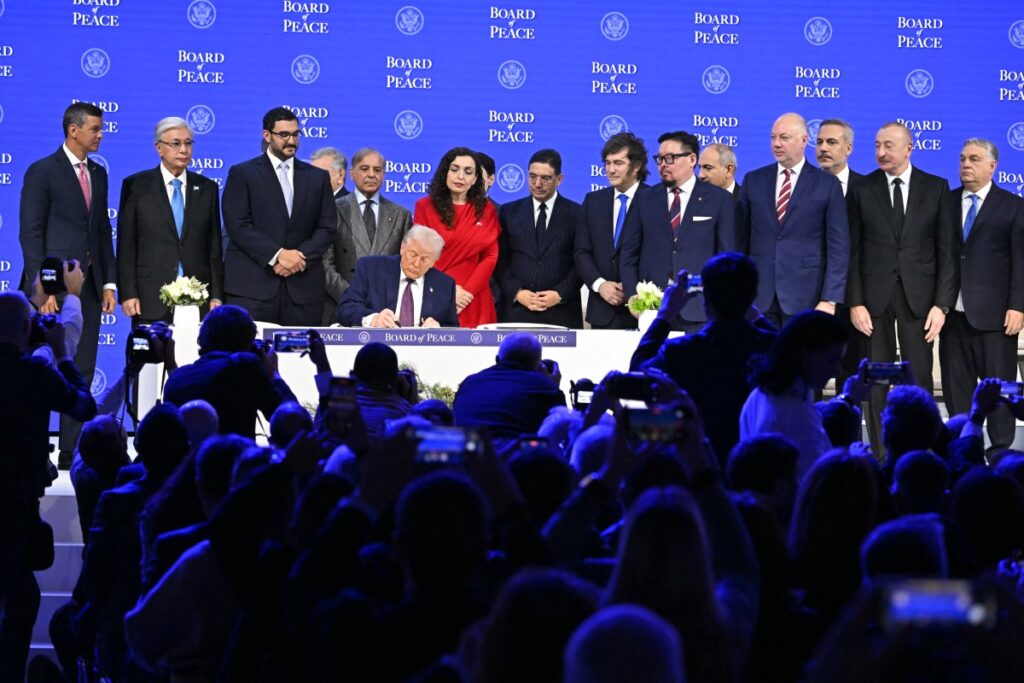
Fidan attended a signing ceremony at the World Economic Forum in Davos and signed the document on behalf of President Erdoğan.
Esen said European governments responded with caution to what some critics described as a parallel body to the United Nations.
“Some critics accused Trump of creating a parallel body to the United Nations,” he said. “This perception helps explain why many European governments responded lukewarmly to the invitation. In Davos, only Hungary and Bulgaria attended the ceremony among European countries alongside Trump.”
German Chancellor Friedrich Merz told reporters that Berlin could not accept the plan “in its current form,” citing constitutional concerns about governance structures.
Britain has also held back. The Guardian quoted UK Foreign Secretary Yvette Cooper as saying the country was “not ready” to sign on to Trump’s “Board of Peace,” raising concerns including the reported involvement of Russian President Vladimir Putin.
Ankara sells prestige and access
Esen described Turkey’s seat as a foreign policy win that gives Ankara prestige and direct access to the Trump administration’s inner circle on a high-profile regional file.
“This board provides Turkish leaders with a direct line of communication with the Trump administration, including Steve Witkoff and Jared Kushner,” he said, referring to Trump’s special envoy and his son-in-law.
He argued that given Trump’s personal style of politics, that access could help Turkey advance its other foreign policy agendas.
Participation could also bring a commercial upside, Esen said, pointing to a major reconstruction bill.
“The UN estimates that rebuilding Gaza could cost around $70 billion,” he said. “This opens the door for Turkish construction companies to take on major reconstruction projects.”
Critics say Gazans are being cut out
Oponents and commentators in Turkey attacked the decision as a contradiction for a government that has cast itself for years as a champion of the Palestinian cause.
A stream of criticism on X portrayed the move as “selling Gaza” and accused Ankara of participating in a project designed by outsiders that would deny Gazans political agency. Several posts mocked the idea of a “peace board” as a construction and real estate scheme.
Former ambassador Namık Tan, now a lawmaker from the main opposition Republican People’s Party (CHP), argued that only a minority of invited countries accepted and framed Turkey’s decision as submission to Washington. He criticized what he called “personal friendship diplomacy.”
Ahmet Kamil Erozan, a former ambassador and foreign relations official for the İYİ (Good) Party, said Fidan had signed the document on Erdoğan’s behalf and mocked the initiative as a real estate venture. Erozan claimed the document did not even mention Gaza by name and suggested the implementation reflected statements and development plans associated with Trump’s son-in-law Jared Kushner.
The criticism echoed a broader line of attack that even if Israel objects to the plan from a maximalist position, the structure still produces an outcome where Israel’s security priorities dominate because Israel controls the practical levers that determine what can function in Gaza, including access and movement.
White House: oversight, reconstruction, governance
The White House presented the plan as an oversight system that supports a temporary Palestinian administration and coordinates civilian and security pillars. It said Bulgarian diplomat Nickolay Mladenov, listed as an executive board member, would serve as high representative for Gaza and act as an on-the-ground link between the Board of Peace and the interim Palestinian administrative body.
Israel has raised concerns about the involvement of Turkey and Qatar, Esen said, reflecting a wider Israeli argument that Ankara’s links with Hamas make it an unreliable partner.
“Israel still has reservations about Turkey and Qatar’s participation in the Gaza Executive Board. There is a trust problem,” Esen said. “Israel believes that they may use their influence within the board to provide shelter to Hamas.”
Esen said the Trump administration views Turkey and Qatar’s connections differently.
“However, the Trump administration considers their relationship with Hamas an asset in implementing the ceasefire and the reconstruction of Gaza,” he said.
Esen argued that the immediate goal is sustaining the ceasefire and that Turkey can play a role even if the wider framework faces questions of legitimacy.
“The immediate aim of the board is to sustain the ceasefire in Gaza. In this context, Turkey can play a constructive role,” he said.
He said the board would move forward whether Turkey joins or not, arguing that staying out would not improve conditions for Palestinians or the prospects of self-rule.
“The board will proceed with or without Turkey’s participation,” he said. “If Turkey is not involved, this is unlikely to improve conditions for the Palestinians or prospects for self-rule.”
He also pointed to the fact that neither Hamas nor Fatah has publicly opposed Turkey’s participation, calling that “telling.”
Still, the intense criticism inside Turkey frames joining a US-designed governance for Gaza as a retreat from Ankara’s pro-Palestinian messaging, where the structure is seen as giving outsiders decisive authority while Gazans remain absent from top decision-making.
Esen underlined that the plan has become a prestige project for Trump, increasing pressure on participants to deliver tangible results.
“Any delays or obstruction could provoke President Trump’s ire, as he may view them as undermining what he sees as a signature prestige project,” he said.