


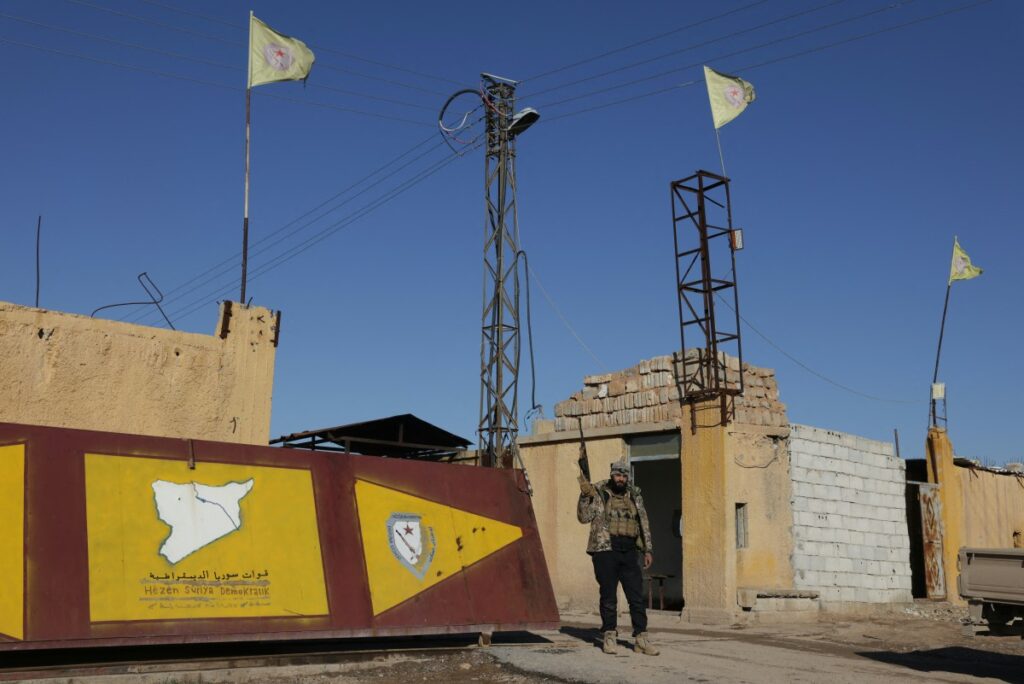
Syria’s transitional government pushed into territory long controlled by the Kurdish-led Syrian Democratic Forces (SDF) after receiving behind-the-scenes assurances from the US, Turkey and Israel, according to a Reuters report that described a series of confidential contacts meant to keep Washington onside while Damascus redrew the map of northeastern Syria.
President Ahmed al-Sharaa’s forces advanced rapidly on Monday, rolling back the Kurdish-led administration that had emerged during Syria’s civil war and had been backed by the US as its main on-the-ground partner against the Islamic State group.
The report said the operation took shape through covert talks held in Damascus, Paris and Iraq, in which US officials signaled they would not stand in the way so long as the offensive remained limited and avoided large civilian harm, particularly in areas where Islamic State detainees are held.
According to Reuters, Turkish officials separately conveyed that Washington would accept an offensive if Kurdish civilians were protected. Syrian officials also sought reassurance in Paris talks involving Israel, where they urged Israeli officials not to encourage the Kurdish-led side to delay integration with Damascus, and received no objection to a limited move.
Anonymous sources told Reuters that the Syrian campaign initially stayed within the understood boundaries but at one point risked going beyond what Washington considered acceptable, prompting US frustration and warnings of renewed sanctions.
The US response during the offensive was limited, including warning flares, while Kurdish officials viewed Washington’s posture as a sign it was stepping back from years of reliance on the SDF.
The report comes as the situation in northeastern Syria has remained volatile despite a new ceasefire and integration framework.
Syrian state media reported late Tuesday that Damascus and the SDF reached a new understanding specific to the Hasaka Governorate that would begin at 8 p.m., giving the SDF four days to present a detailed administrative and military mechanism for the province and saying Syrian forces would remain on the outskirts of Hasaka and Qamishli rather than entering the city centers if the arrangement holds.
The offensive has reshaped Syria’s internal balance of power and tested US policy after the fall of Bashar al-Assad’s government, as Washington recalibrates its relationships with local partners and neighboring powers.
The US military presence in northeastern Syria was long justified by the campaign against Islamic State militants and depended heavily on the SDF, a Kurdish-led coalition that spearheaded ground operations against the group and continues to run detention sites holding thousands of suspected Islamic State members.
US Ambassador to Turkey Tom Barrack argued on Tuesday that the SDF’s combat role has largely ended and that Kurdish political rights would be better secured through incorporation into a unified Syrian state.
The Syrian campaign dismantled much of the Kurdish-led autonomous region that had taken shape after 2015 in the vacuum left by the civil war.
The developments carry major implications for Turkey, which has long treated Kurdish self-rule along its southern border as a security threat.
Turkey considers the SDF closely linked to the People’s Protection Units (YPG), a Kurdish militia Ankara says is tied to the Kurdistan Workers’ Party (PKK), which is designated as a terrorist organization by Turkey and its Western allies. Turkey has launched repeated cross-border operations into northern Syria since 2016 and has carried out drone strikes against Kurdish-led forces, arguing it is preventing a militant corridor from forming along the frontier.
Israel’s involvement is more indirect but increasingly central to Syria’s diplomatic landscape. Earlier this month Israel and Syria agreed in US-mediated talks in Paris to establish a communication mechanism to coordinate on security, intelligence and commercial issues, reflecting a new phase of engagement after Assad’s fall.
Syria’s offensive unfolded amid these shifting alignments, with Damascus seeking to avoid triggering Israeli intervention while also removing what Ankara views as a major obstacle to regional stabilization.
Fighting around Islamic State detention sites has been one of the most sensitive flashpoints.
Instability and clashes near prisons and camps holding Islamic State detainees raised alarms about potential mass escapes and a renewed militant threat, a risk Washington has repeatedly cited in explaining its continued military interest in northeastern Syria.
The ceasefire remains fragile.
On Wednesday Syrian authorities accused the SDF of violating the truce, threatening the chances of a lasting deal, while the SDF denied the allegation and accused government forces of violating the agreement.
The latest developments are also spilling into Turkish domestic politics.
Protests by Turkey’s Kurds have spread in recent days, driven by anger over the Syrian offensive and fears that Kurdish-led areas across the border could be dismantled. Turkey’s Peoples’ Equality and Democracy Party (DEM Party), the country’s main pro-Kurdish party, has held demonstrations near the Syrian border and warned that escalation in Syria could derail Ankara’s stated interest in peace with the PKK.
The civil war in Syria began in 2011 after Assad’s government cracked down on protests, triggering a conflict that drew in regional and global powers and fractured the country. Over time, the SDF gained control of large parts of the northeast with US support, as it led ground fighting against the Islamic State group while managing a network of detention facilities.
Al-Sharaa’s fast-moving campaign has now changed that reality, narrowing the space for a separate Kurdish-led administration and pushing the SDF toward integration.