


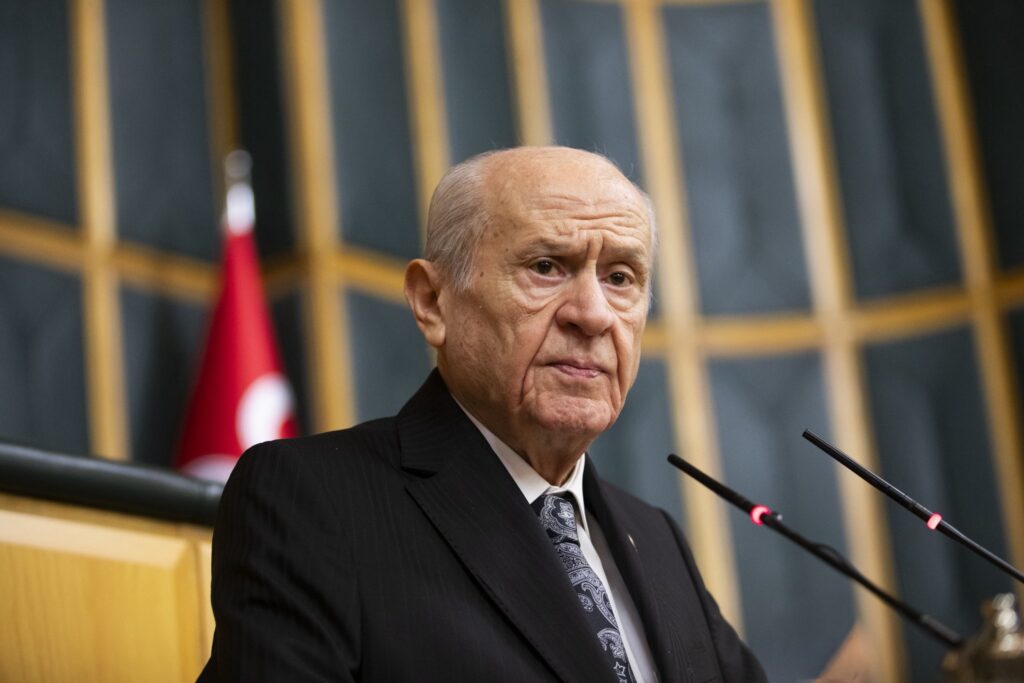
Devlet Bahçeli, leader of Turkey’s far-right Nationalist Movement Party, has warned that rising tensions linked to developments in Syria could derail Turkey’s peace process with the outlawed Kurdistan Workers’ Party (PKK), following an incident in which a Turkish flag was taken down near the Turkey-Syria border.
In a written statement on Wednesday, Bahçeli, who made an unexpected call in October 2024 to jailed outlawed Kurdistan Workers Party (PKK) leader Abdullah Öcalan to renounce violence, initiating a renewed peace process with the group, said provocations aimed at inflaming public anger and testing restraint risked undoing efforts toward what the government describes as a “terrorism-free Turkey.”
Following Bahçeli’s call, Turkey has been engaged in efforts over the past year to draw a line on its four-decade conflict with the PKK, which it refers to as the “terrorism-free Turkey” process.

Last year the PKK announced an end to its armed campaign and began destroying its weapons, but Turkey has insisted that the move include armed Kurdish groups in Syria, which Ankara sees as PKK offshoots.
“Exhausting patience and provoking nerves will bring no benefit to anyone,” Bahçeli said. “The extended hand could easily be replaced by a raised fist,” he added, in a warning that restraint could give way to confrontation.
It marked Bahçeli’s strongest warning to date since the launch of the peace process, raising questions about its future.
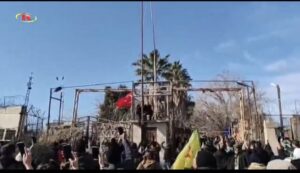
He was reacting to claims that the Turkish flag was taken down from its flagpole at the Turkey-Syria border and trampled during unrest on Tuesday linked to fighting in northern Syria.
Bahçeli described the incident as one of the “most serious provocations” in recent years and accused the pro-Kurdish Peoples’ Equality and Democracy Party (DEM Party), which held its parliamentary group meeting in the border town of Nusaybin on Tuesday in protest of the developments in northern Syria, of bearing primary responsibility.
Turkey launched an investigation into the incident on Tuesday.
The incident took place following pro-Kurdish protests in Nusaybin in Turkey’s southeastern Mardin province over fighting in northeastern Syria, where Syria’s transitional government has pushed into areas long controlled by the Kurdish-led Syrian Democratic Forces (SDF).
Turkey backs Damascus’s military campaign and considers the SDF an extension of the PKK, a group designated as a terrorist organization by Turkey and its Western allies. The SDF has been the main US partner in the fight against the Islamic State group in Syria.
Bahçeli said the incident was part of a broader effort to sabotage both Turkey’s domestic peace process and regional efforts to eliminate armed groups, reiterating Ankara’s position that the SDF and its core People’s Protection Units (YPG) are terrorist organizations.
Burhanettin Duran, President Recep Tayyip Erdoğan’s communications director, on Tuesday blamed supporters of the YPG for the incident and said authorities would identify those responsible and take judicial and administrative action.
Duran also called the incident an “open provocation” targeting Turkey’s peace and its campaign against what it calls terrorism.
Bahçeli, meanwhile, challenged the DEM Party, a supporter of the peace process that has facilitated talks with Öcalan, to clarify its stance toward the PKK, asking whether it stood with the group’s imprisoned leader or supported a future free of armed violence.
DEM Party’s reaction
The DEM Party had already voiced its discomfort over the incident later on Tuesday.
In a joint statement DEM Party co-chairs Tülay Hatimoğulları and Tuncer Bakırhan said disrespect toward the Turkish flag was unacceptable and ran counter to the party’s position.
“We categorically reject the flag incident that took place on the Nusaybin-Qamishli border,” the co-chairs said.

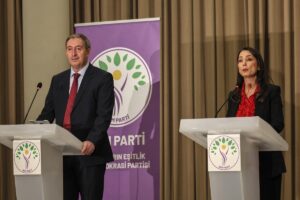
“Disrespect toward the flag, which is a shared value of Turkish society and a symbol of the country, is never acceptable. As the DEM Party, we do not approve of or support this behavior, which diverted a legitimate protest from its purpose.”
In his call in October 2024, Bahçeli asked Öcalan to instruct his group to renounce its armed campaign while hinting that the end of PKK violence could lead to Öcalan’s freedom. His call was endorsed by President Erdoğan, his political ally.
Öcalan responded in February with a message calling on the PKK to disarm and disband.
The PKK decided in May to disband, disarm and end its armed campaign, saying it “has completed its historic mission” in line with Öcalan’s call.
Thirty PKK militants burned their weapons in July in a ceremony in northern Iraq, marking a symbolic first step towards ending the decades-long conflict with Turkey in which more than 40,000 people have been killed.
In August, Turkey set up a cross-party parliamentary committee to lay the groundwork for the peace process and prepare a legal framework for the political integration of the PKK and its militants.
Yet it is not known whether this new process will succeed this time as another attempt launched in 2013 collapsed two years later, sparking renewed clashes between the PKK and the Turkish armed forces.