


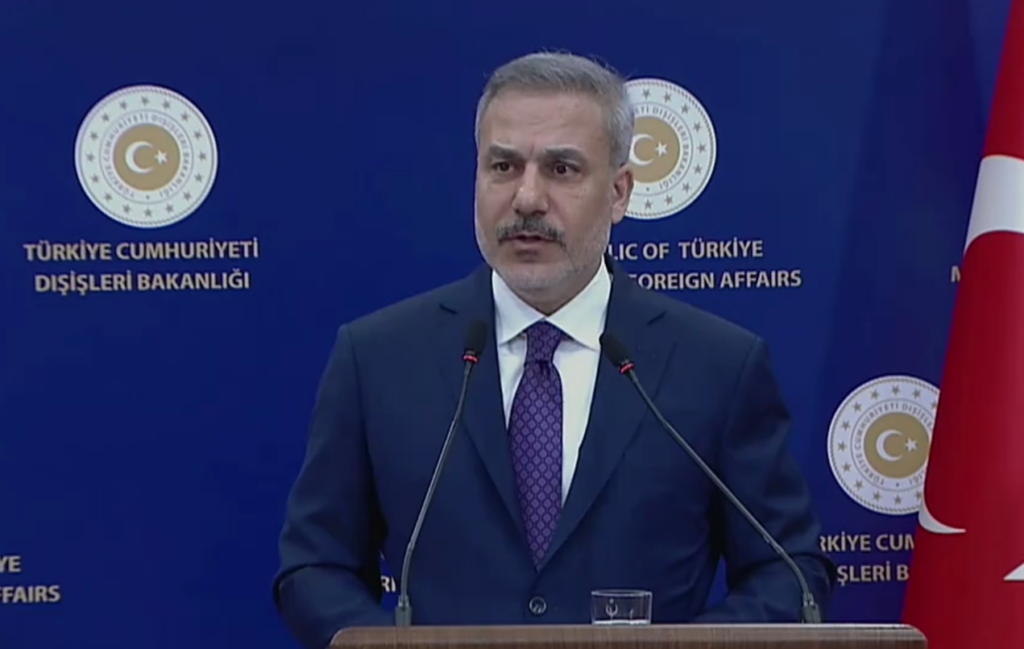
Turkish Foreign Minister Hakan Fidan said on Friday protests in Iran are being “manipulated” by the country’s rivals, arguing that Israel is trying to use public anger over Iran’s economic problems after failing to weaken Iran through military force.
Fidan made the comments in an interview with TRT Haber, Turkey’s state news station, as Iran faces its biggest wave of unrest since the 2022 protests sparked by the death of Mahsa Amini, a young woman who died after being detained by Iran’s morality police.
“Iran has unfortunately been under major sanctions for more than 30 years,” Fidan said.
He said the sanctions have created economic “blockages” and have fueled periodic mass protests and added that Iran has “real grievances” and “structural problems” but claimed the current demonstrations are also being manipulated from abroad.
Fidan pointed to Mossad, Israel’s foreign intelligence service, saying it was encouraging Iranians to rise up against Iran’s clerical leadership through social media.
“Mossad isn’t hiding this,” he said, adding that it was calling on the Iranian public to revolt.
Fidan also said the Iranian public rallied during Israel’s attack on Iran and argued that Israel was now trying to benefit from public frustrations in a period without active fighting.
He said he did not believe Israel would achieve the outcome it expects.
“I see that the ending Israel expects will not happen,” he said, adding that Iranians “know” how to respond.
Iran’s protests began in late December after a sharp fall in the value of the Iranian rial and anger over inflation and the cost of living.
The unrest started in Tehran’s Grand Bazaar, a commercial hub often linked to political flashpoints, then spread to cities across Iran.
What began as protests tied to economic hardship became political demonstrations with chants against Iran’s clerical rule.
Iranian authorities have accused foreign enemies, including the US and Israel, of fueling the unrest.
In recent days the Islamic Revolutionary Guard Corps and Iran’s military have publicly warned that internal security is a “red line,” while state media has broadcast funerals for security force members killed in clashes.
Iran has also imposed broad restrictions on internet and telecommunications access, making it harder to assess the scale of the demonstrations and casualties.
The US-based Human Rights Activists News Agency and other organizations have reported dozens of deaths and thousands of arrests, figures that could not be independently verified in full because of Iran’s communications restrictions and limits on foreign media reporting.
Iranian Supreme Leader Ayatollah Ali Khamenei has blamed the unrest on foreign actors and signaled a tougher crackdown.
International sanctions have weighed on Iran’s economy for years.
The US and other countries have imposed sanctions linked to Iran’s nuclear program as well as other issues, restricting Iran’s access to global financial markets and limiting trade.
The current unrest also comes after a 12-day conflict in June 2025 in which Israel and the US carried out air strikes on Iran.
Turkey, a member of NATO, shares a long border with Iran and has often sought to maintain working relations with both Iran and Israel, even as it has repeatedly criticized Israel’s military actions in the region.