


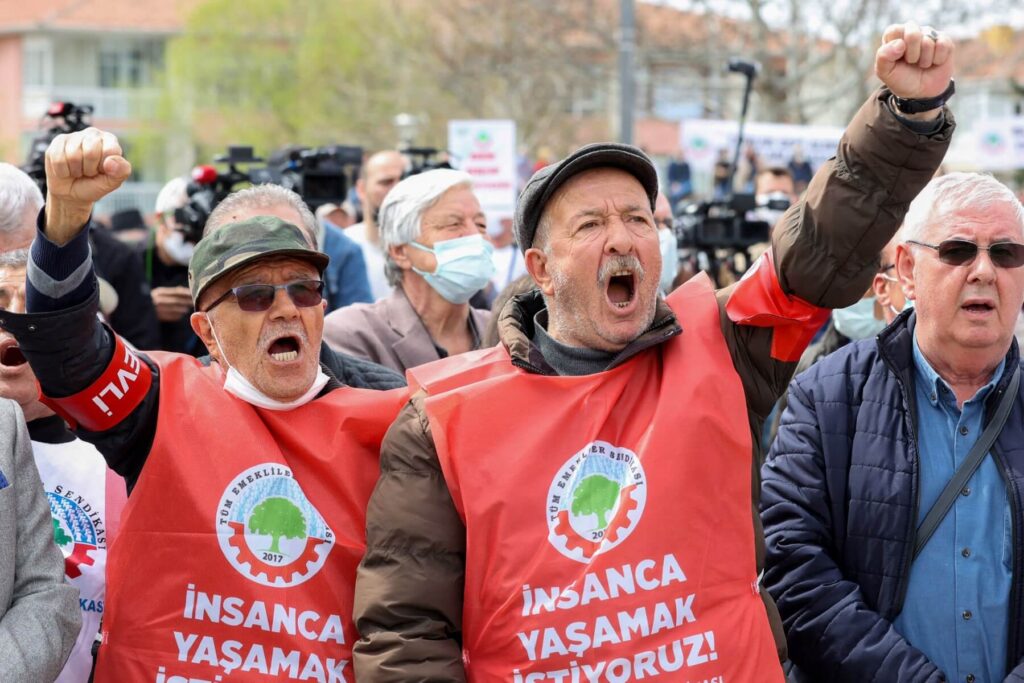
Turkey’s ruling Justice and Development Party (AKP) on Friday submitted a bill to parliament raising the minimum pension to 20,000 Turkish lira ($463) starting in January 2026, with party officials acknowledging that the increase falls short but claiming that budgetary limits have been pushed “to the maximum,” the state-run Anadolu news agency reported.
AKP parliamentary group chair Abdullah Güler said the proposal, which is part of a broader package of social and economic measures, will increase the number of pensioners receiving the minimum payment from 4.01 million to about 4.9 million.
“Is it sufficient? Of course not,” Güler said. “But our economy and our budget have been stretched to their limit. Serious efforts have been made to generate resources.”
Under the proposal the minimum pension would rise from 16,881 lira ($391) to 20,000 lira ($463), an increase of 18.47 percent. If the bill is not enacted before January payments are made, the difference of 3,119 lira ($72) will be paid retroactively once the law takes effect.
Güler said the measure will require a transfer of 69.5 billion lira ($1.6 billion) from the central budget and noted that the increase was designed to not undermine the government’s fight against inflation or fiscal discipline.
The bill also includes an increase in the state’s minimum wage support for employers, raising it from 1,000 lira ($23) to 1,270 lira ($29).
The proposal is expected to be debated next week in the parliament’s Planning and Budget Committee before being sent to the floor for a final vote. If approved it will enter into force following President Recep Tayyip Erdoğan’s signature and publication in the Official Gazette.
According to official figures, Turkey currently has about 17.7 million pensioners. Pension levels are determined by contribution amounts, duration and retirement age, with Güler emphasizing that higher pensions require longer and higher premium payments, a system he said must be made “more transparent and financially sustainable.”
CHP proposal rejected in parliament
The pension announcement came as parliament rejected a proposal by the main opposition Republican People’s Party (CHP) to launch a parliamentary inquiry into pension levels and income inequality among retirees. The motion was voted down with the support of the AKP and its far-right ally, the Nationalist Movement Party (MHP).
CHP lawmaker Veli Ağbaba criticized the decision, saying retirees were being pushed into poverty.
“This is not a salary, it is charity,” he said, arguing that the current income level leaves pensioners unable to meet basic needs.
CHP leader Özgür Özel also sharply criticized the government’s handling of pension increases, accusing the ruling AKP of prioritizing spending that benefits corporations and financial interests over retirees.
In a post on X, Özel said the government was reluctant to allocate 69.5 billion lira for pension hikes while spending far larger sums on highway and bridge guarantees, tax write-offs for large companies, interest payments and the Exchange Rate Protected Deposit (KKM) scheme, an initiative aimed at shielding savings from currency depreciation.
“In this system, there are resources for the wealthy but not for retirees,” he said, warning President Erdoğan that “If people cannot afford the cost of living in 2026, there will be elections.”
Ak Parti’nin kara düzeni!
Sokakta ve Meclis’teki tepkiler üzerine emekliye 1062 lira verip, maliyetin 69,5 milyar lira olmasından yüksünüyorlar!
Peki bu milletin parası nereye harcanıyor?-Bu kaynağın 3,5 katını (238 milyar TL) yollara-köprülere geçiş garantisi olarak…
— Özgür Özel (@eczozgurozel) January 9, 2026
Turkey is scheduled to hold its next general election in 2028, but the talk of an early election frequently comes to the nation’s agenda due to the government’s failure to put the economy back on track, leaving citizens with difficulties in even meeting their basic needs due to the high cost of living.
The pension debate is unfolding against the backdrop of persistently high inflation and a rising cost of living. Official data from the Turkish Statistical Institute (TurkStat) showed annual inflation slowed to 30.9 percent in December, down from 44.4 percent a year earlier.
Average inflation for 2025 stood at 34.9 percent, with sharp increases recorded in education, housing, food and healthcare.
However, the figures are disputed by ENAG, an independent group of economists, which said annual inflation reached 56.14 percent in December, arguing that official data understate real price increases.
Critics say pension hikes tied to official inflation fail to reflect actual living costs, forcing many retirees to seek work to survive. According to recent data, the number of people aged 60 and over applying for jobs in Turkey rose to 19 percent in the first 11 months of 2025, highlighting growing financial strain among pensioners.