


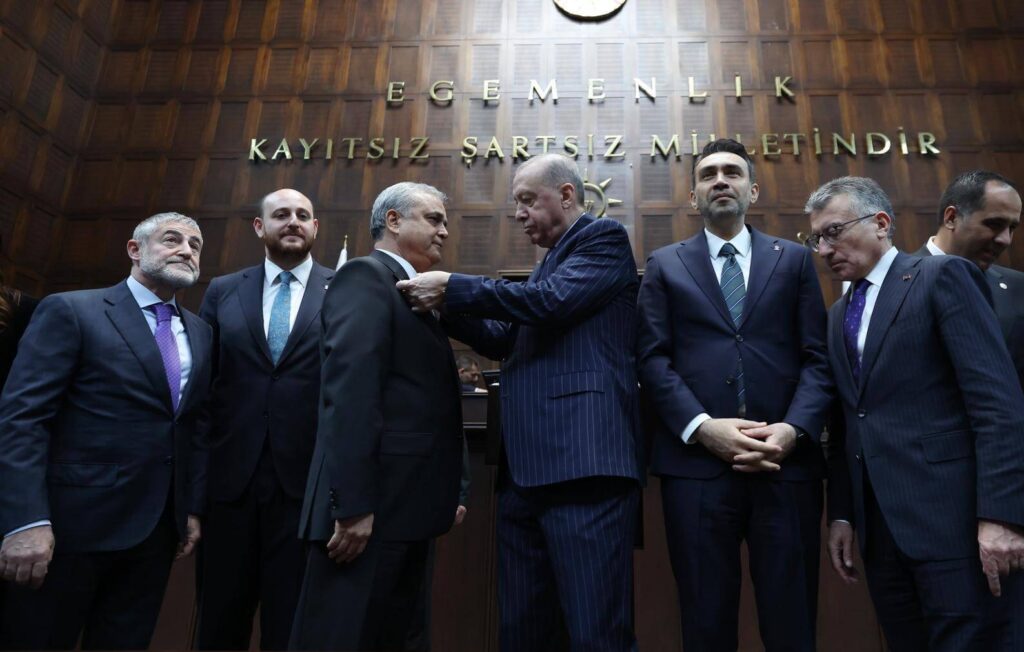
Three lawmakers elected from opposition lists in Turkey’s 2023 general election, including a former member of the main opposition Republican People’s Party (CHP), joined President Recep Tayyip Erdoğan’s ruling Justice and Development Party (AKP) on Wednesday, sparking renewed criticism of party switching and voter mandates.
At the AKP’s parliamentary group meeting in Ankara, Erdoğan personally pinned party badges on Hasan Ufuk Çakır, a former CHP lawmaker from Mersin; İrfan Karatutlu from the Democracy and Progress Party (DEVA); and İsa Mesih Şahin from the Future Party (GP). The ceremony marked the latest defections from opposition ranks to the ruling party.
All three lawmakers were elected on May 14, 2023, under the Nation Alliance, a six-party opposition bloc that nominated candidates primarily through CHP lists, alongside its nationalist ally, the İYİ (Good) Party. The alliance secured 39 seats through CHP lists. Since then, nearly a third of those lawmakers have left their original parties.
Genel Başkanımız ve Cumhurbaşkanımız Sayın Recep Tayyip Erdoğan tarafından, bugünkü Meclis Grup Toplantımızda rozetleri takılarak AK Partimize katılan İstanbul Milletvekili İsa Mesih Şahin, Mersin Milletvekili Hasan Ufuk Çakır ve Kahramanmaraş Milletvekili İrfan Karatutlu’nu… pic.twitter.com/NH6xLDLktm
— AK Parti (@Akparti) January 7, 2026
Addressing the AKP group, Şahin said political paths may diverge but “ultimately meet in the same sea,” pledging to work “like ants” for what he described as a “strong Turkey” under Erdoğan’s leadership.
Karatutlu said he had already supported the government “in mind and conscience” and was now making that support official, saying “this is the time to stand with our president.”
Çakır, whose move has drawn the strongest backlash, took a confrontational tone. He said he had been subjected to slander and injustice but had “never bowed his head,” adding that positions are temporary while honor is permanent.
He described Erdoğan as one of Turkey’s two “commanders-in-chief,” along with Mustafa Kemal Atatürk, and concluded his remarks with a military salute.
CHP'den AKP'ye geçen Hasan Ufuk Çakır:
"İki başkomutan var. Biri Gazi Mustafa Kemal Paşa.
Diğeri Türkiye Cumhuriyeti ordularının başkomutanı Recep Tayyip Erdoğan.
Ben de kendisine selam duruyorum!" pic.twitter.com/ptNta9r5kR
— Etkili Haber Yeni Sayfa (@etkilihaberyeni) January 7, 2026
Controversy surrounding Çakır
Çakır’s defection follows weeks of tension with the CHP. In December he accused party leaders of failing to defend him against coverage by the pro-opposition Halk TV, which reported on his criminal record from 2006 to 2013.
During a heated parliamentary committee meeting on the 2026 budget, Çakır shouted at fellow CHP lawmakers and walked out, accusing them of remaining silent while he was labeled “a criminal.” The CHP later launched disciplinary proceedings against him.
Before a formal expulsion decision was issued, Çakır resigned from the party in December and continued as an independent lawmaker. His intention to join the AKP became public last week.
Journalist Barış Yarkadaş said Çakır confirmed his decision in a conversation with him and claimed that it reflected the wishes of voters in his constituency.
According to Yarkadaş, Çakır said voters told him they had supported the CHP because of him personally and encouraged him to continue his political work “with us, not with the people who slander you.”
That claim was disputed by journalist İsmail Saymaz, a columnist for Halk TV, who said voters supported Çakır in order to oppose the AKP, not to join it. Saymaz criticized the lawmaker for portraying his defection as a popular mandate, saying he should not “attribute his own political somersault to the will of the people.”
A broader pattern
The latest switches add to a broader trend seen in recent years. In 2024 and 2025, several lawmakers elected on opposition platforms later joined the AKP, prompting criticism from opposition leaders and voters.
Among earlier cases were Ahmet Ersagun Yücel, elected from the CHP’s İstanbul list but originally from the İYİ Party, who joined the AKP in August 2024; Ankara MP Mustafa Nedim Yamalı of the GP, who defected in December 2024; constitutional law scholar Serap Yazıcı Özbudun, a founding figure of the GP, who joined the AKP in February 2025; and Konya MP Hasan Ekici, who switched sides in May 2025.
The trend has extended beyond parliament. In August 2025, nine opposition mayors, including six from the CHP, joined the AKP at a ceremony marking the party’s anniversary, amid opposition claims of political pressure during a growing crackdown on CHP-run municipalities.
Impact on parliamentary balance
Wednesday’s defections also affected parliamentary arithmetic. With Çakır’s earlier resignation, the CHP’s seat count had already dropped to 138. Karatutlu’s departure reduced DEVA’s representation to eight seats and left the New Path alliance of DEVA, the GP and the Felicity Party (SP) at the minimum 20 seats required to maintain a parliamentary group.
With the three new admissions, the AKP’s seat count rose from 272 to 275. In the 600-seat parliament, the AKP now holds 275 seats, followed by the CHP with 138, the pro-Kurdish Peoples’ Equality and Democracy Party (DEM Party) with 56 and the Nationalist Movement Party (MHP), an AKP ally, with 47.
Together, the AKP and MHP control 322 seats, strengthening the ruling bloc as Ankara debates possible constitutional changes tied to what the government calls a “Terrorism-Free Turkey” initiative aimed at ending a decades-long conflict between Turkey and the outlawed Kurdistan Workers’ Party (PKK), designated as a terrorist organization by Turkey and its Western allies.
Under parliamentary rules constitutional amendments require at least 400 votes to pass without a referendum, while proposals backed by 360 votes must be submitted to a public vote.
The parliamentary balance is also significant because Erdoğan is due to complete his constitutionally limited two terms in 2028. For him to seek another term, the constitution would need to be amended or parliament would have to call early elections, both of which require the support of at least 360 lawmakers.