


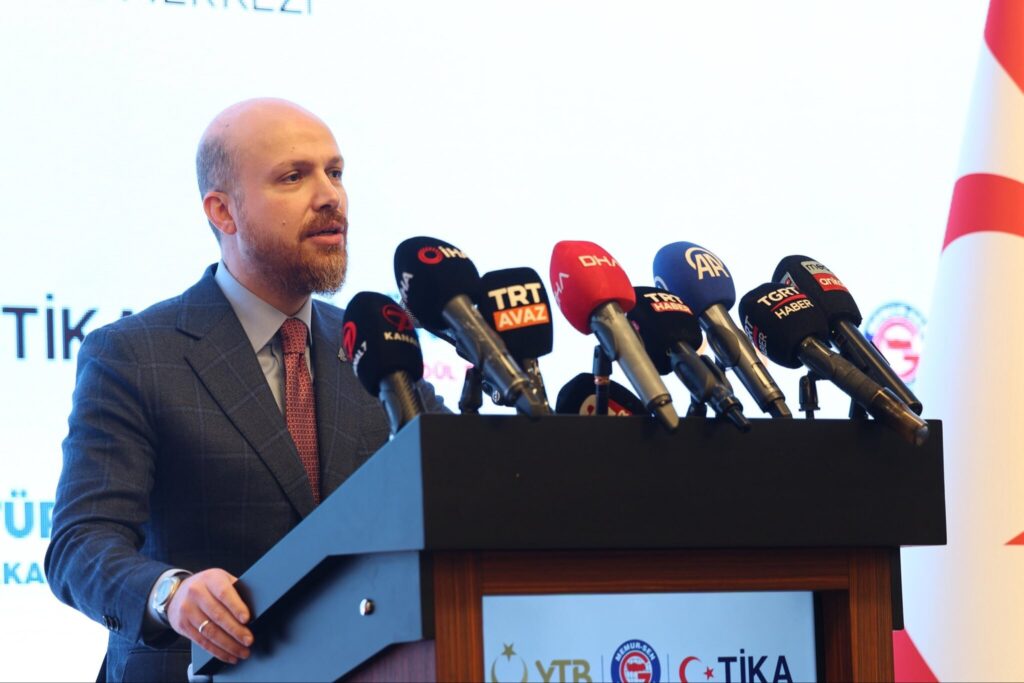
President Recep Tayyip Erdoğan’s younger son, Necmettin Bilal Erdoğan, said Thursday that Turkey’s “old” intellectual class had been sidelined and argued it was shaped by what he described as an inferiority view toward the West, as he called for a “national” intelligentsia.
Bilal Erdoğan, chairman of the board of trustees of the İlim Yayma Foundation, made the remarks at an awards ceremony at the headquarters of Memur-Sen, a large public sector union with ideological ties to the ruling Justice and Development Party (AKP).
The event marked the close of the “Turkic World Academy,” a training program run by Memur-Sen in cooperation with the Turkish Cooperation and Coordination Agency (TİKA) and the Presidency for Turks Abroad and Related Communities (YTB), two Turkish state institutions active in overseas development and diaspora-related programs.
In a speech that ranged from Ottoman history to modern identity debates, Bilal Erdoğan argued that the “old” intellectual class had been shaped by what he called a sense of inferiority toward the West and by the belief that progress required imitating Western societies.
“Before our lands were occupied, the inside of our intellectuals’ heads had been occupied,” he said, describing what he called an “inferiority complex” and a mindset of “we can’t do it” in competition with the West.
He mocked the idea that copying Western symbols could produce economic or technological development, saying Turkey had lived through “more than 200 years” of trying to adopt “only the image” of modernity.
“Thank God, that intellectual class has been sidelined, is being sidelined,” he said.
He said the country was in a period of transition, arguing that a new elite had not yet taken the old one’s place.
Bilal Erdoğan called for intellectual figures who would be respected by society while also being “national.”
He linked his argument to the late Ottoman Empire’s decline, citing historian Erhan Afyoncu and saying demographic collapse helped drive “delusions of Westernization,” identity loss and what he described as cultural decay across society.
The comments circulated quickly in Turkish media, feeding a long-running culture battle in Turkey over secularism, religion and the country’s relationship with Europe and the West.
President Erdoğan and the AKP have spent years criticizing what they describe as an old establishment rooted in secular elites and Western-oriented education and institutions built in the early decades of the Turkish Republic.
The government has used state power to reshape the bureaucracy, education and media by sidelining critics and rewarding loyalists, especially after a failed July 2016 coup.
Bilal Erdoğan’s comments landed as Turkish authorities have run a series of high-profile investigations and detentions that have swept up journalists, social media personalities and figures from business and entertainment in recent months.
Analysts say the operations also serve political goals by weakening rival networks and shaping the field for a post-Erdoğan transition, including scenarios in which a successor emerges from the president’s family or inner circle.