


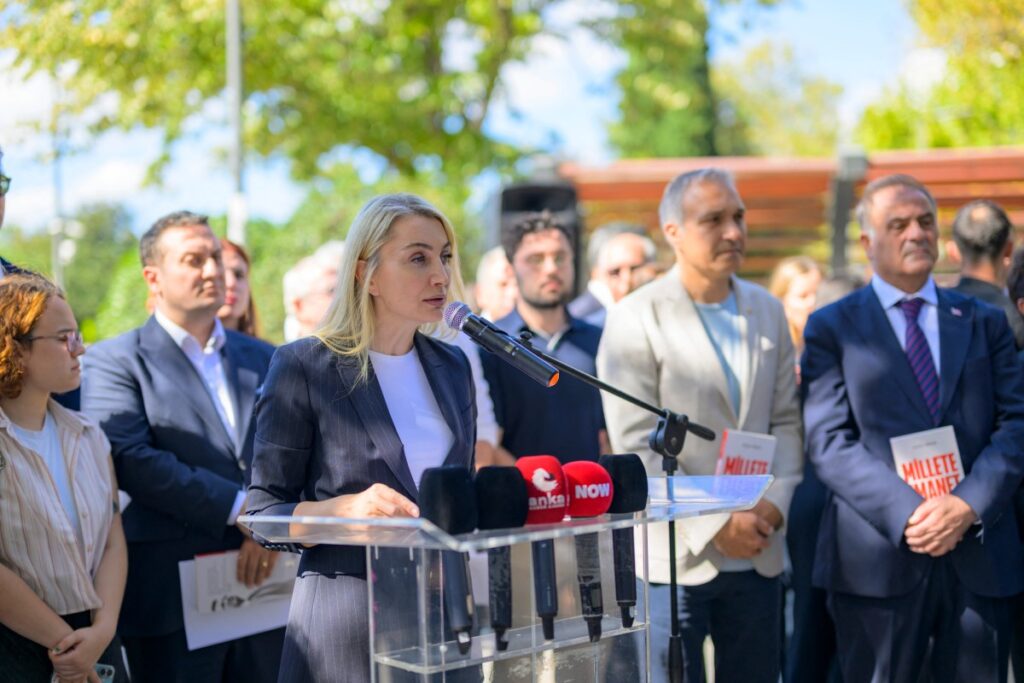
Turkish democracy has suffered serious damage since the jailing of İstanbul Mayor Ekrem İmamoğlu, his wife said, describing the period as painful for their family but saying it has strengthened their resolve.
“It is an extremely difficult time for our children and for me, but we hold onto one another,” Dilek Kaya İmamoğlu told Agence France-Presse in her first interview with foreign media.
Her husband, the most prominent opposition politician seen as capable of defeating President Recep Tayyip Erdoğan, was arrested in March and now faces a combined 2,430 years in prison under multiple charges.
Many critics say the case aims to block İmamoğlu from running in the 2028 presidential election.
Dilek Kaya İmamoğlu said the family has drawn strength from her husband’s message “to never lose hope.”
İmamoğlu’s arrest came just days before he was expected to be named the presidential candidate of the Republican People’s Party (CHP), Turkey’s main opposition party. The move triggered the country’s largest street protests since 2013.
Prosecutors accuse him of leading a criminal network and exerting influence “like an octopus” in a 4,000 page indictment covering allegations ranging from graft and bribery to money laundering. The first court hearing is scheduled for March 9.
“The public conscience cannot be silenced,” his wife said. “These hardships do not lead me to despair but to solidarity. I trust the will and conscience of the people.”
She recalled the morning of the arrest, when hundreds of police officers arrived at their home.
“I was shocked by what I saw. My heart felt like it was beating outside my chest,” she said. “I will never forget the worry in our children’s eyes.”
She said İmamoğlu turned to his family and told them: “We will hold our heads high and never lose hope.”
“Instead of bowing to it, we chose to fight,” she added.
The family is allowed weekly visits at Silivri prison west of Istanbul, where several other prominent government critics are also held.
Despite the charges, she said her husband remains mentally strong.
“He resists by working, taking notes, producing ideas for the country’s future and reading books,” she said.
“‘My freedom is in my mind,’ he says. Messages of solidarity, letters and visitors give him strength. They help him feel that he is not alone inside, but together with millions.”
She voiced disappointment with what she described as silence from Europe, as rights groups accuse European governments of overlooking the erosion of judicial independence in Turkey.
“Frankly, this silence has disappointed us,” she said. “While the will of millions in Turkey is being ignored, countries that claim to defend democracy have often chosen to remain silent.”
She added that their main source of support comes from within Turkey.
“Our greatest support is the solidarity of millions who believe in justice, freedom and democracy,” she said.
Dilek Kaya İmamoğlu also expressed solidarity with the families of other jailed figures, including Kurdish politician Selahattin Demirtaş and philanthropist Osman Kavala, both imprisoned for nearly a decade despite rulings from the European Court of Human Rights calling for their release.
“The endurance of their families guides me, because we are not alone,” she said.
Asked whether she fears her husband could face a similar fate, she said it was impossible not to worry.
“Decisions by the European Court of Human Rights and the Constitutional Court are being ignored. Our constitution is not being applied, and lawlessness is being normalized,” she said.
“With so much injustice, it is impossible to predict the outcome,” she added. “But I want to believe that justice will be applied equally for all, and that Ekrem and his colleagues will eventually be acquitted, for the sake of our country’s 86 million citizens.”
While her husband remains in jail, Dilek Kaya İmamoğlu has taken on a more public role, attending rallies and meeting the families of other detained opposition figures.
She said she has no plans to enter politics.
“The politician in our household is Ekrem,” she said.
Still, she said she feels a responsibility to help heal what she described as deep damage to democracy.
“Press freedom, judicial independence and fundamental rights are under pressure,” she said.
“But no matter how strong that pressure is, the conscience of the people will prevail. That is where I place my hope.”
© Agence France-Presse