


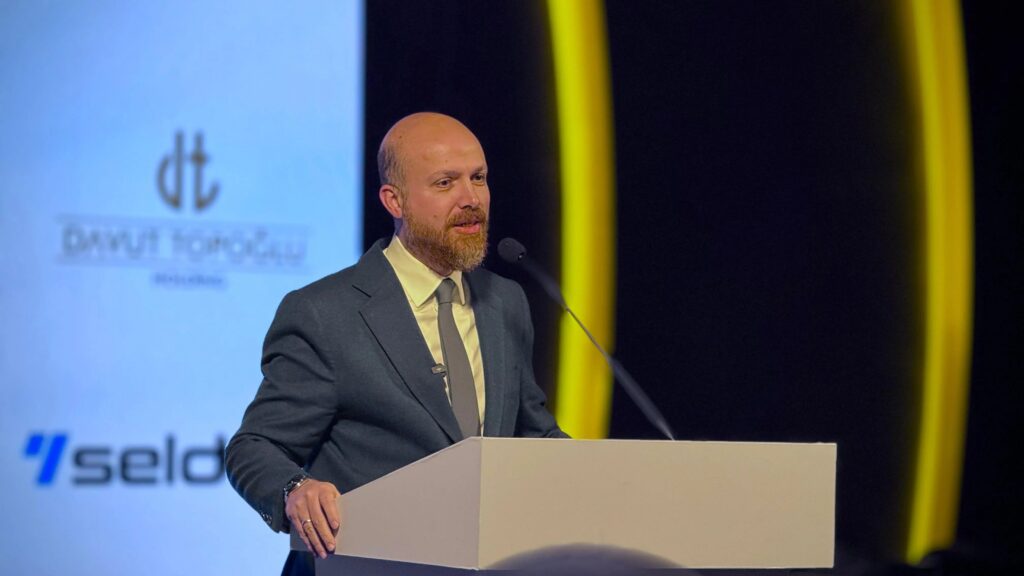
An increase in news coverage and social media comments concerning Necmettin Bilal Erdoğan, the younger son of President Recep Tayyip Erdoğan, has prompted allegations that the president’s inner circle is trying to normalize the idea of family succession.
Bilal Erdoğan, 44, holds no elected office and does not serve in President Erdoğan’s Cabinet.
Yet he has become a frequent subject of political debate because of a shift that critics and supporters both acknowledge, even as they explain it in different ways.
Critical pundits and many social media users say his comments now travel faster through Turkey’s media ecosystem, with more stand-alone headlines, more video clips and more friendly coverage that treats him as a national political actor, not only the president’s son.
Bilal Erdoğan’s public profile mixes civil society work, youth and education networks and periodic involvement in controversies that have appeared in international reporting since the December 2013 corruption investigations that shook Turkish politics.
Bilal Erdoğan became international news in February 2014, when recordings circulated online that appeared to capture then-prime minister Erdoğan telling his son to remove large sums of money from his home, with the context suggesting that Turkey’s strongman was trying to prevent his son from being caught by police with substantial amounts of cash, as were several officials and sons of ministers on December 17, 2013.
The recordings surfaced after police raided the houses of a number of prominent figures in Erdoğan’s inner circle as part of a corruption probe launched by İstanbul prosecutors.
On December 25 one of those prosecutors ordered Bilal’s detention, an order unprecedentedly ignored by law enforcement at the behest of the interior minister in open defiance of the law.
The cases later collapsed as the government purged police and prosecutors involved in the investigation and described the operation as a plot to overthrow the government.
In Turkish political shorthand that episode is still called the “December 17 and 25” investigations, a reference to two series of raids and planned follow-ups.
The detention order as well as the leak tied Bilal’s name to a narrative of Erdoğan’s web of corruption supported by his close family.
In late 2015 Bilal Erdoğan again attracted international attention during a bitter standoff between Turkey and Russia after Turkey shot down a Russian military jet near the Syrian border.
Russia’s Defense Ministry said it had evidence that Turkey’s leadership and President Erdoğan’s family benefited from illegal oil smuggling from territory held by the Islamic State group in Syria and Iraq.
Bilal Erdoğan denied the claim and dismissed the idea that he or his family profited from the Islamic State group’s oil trade.
Turkey’s government also rejected the allegation, with President Erdoğan saying he would resign if claims that Turkey bought oil from the Islamic State were proven.
No criminal case in Turkey or abroad has been launched over the allegation against Bilal Erdoğan, but the episode added a second international storyline to his name.
Italy probe
In 2016 Bilal Erdoğan became the focus of an Italian investigation over allegations that he brought cash into Italy for possible money laundering while studying in Bologna.
President Erdoğan publicly criticized the probe and warned that it could damage relations, which prompted a sharp response from then-Italian prime minister Matteo Renzi, who said Italian judges answer to Italy’s constitution, not to Turkey’s president.
Bilal Erdoğan denied any wrongdoing, and Italian prosecutors later dropped the case.
For Turkish critics the Italy episode reinforced the argument that the Erdoğan family’s legal and political interests can become state interests.
2023 bribery complaint reviewed in Sweden and the US
The most concrete international reporting in recent years came in June 2023, when Reuters reported that anti-corruption authorities in the United States and Sweden were reviewing a complaint that described a plan by a Swedish affiliate of a US company to pay tens of millions of dollars in kickbacks if Bilal Erdoğan helped it secure a dominant market position in Turkey.
Reuters reported that the complaint described discussions that included the possibility of channeling money to institutions linked to Bilal Erdoğan.
Through his lawyer, Bilal Erdoğan denied wrongdoing.
Turkey’s Communications Directorate and pro-government media figures attacked the Reuters report and labeled it as disinformation.
A Turkish court order later sought the removal of the Reuters story, but Reuters said it had appealed the decision.
The 2023 episode mattered for succession talk because the Reuters report described Bilal Erdoğan as a figure some investors see as a gatekeeper with access to his father, even without a government title.
The charities that shape his influence
Bilal Erdoğan has been active in foundations and youth programs, mostly operating in civil society, steering clear of electoral politics.
His critics argue those organizations function as pipelines that connect pro-government networks to education, housing, scholarships and future jobs.
Two Turkish foundations tied to his public identity are the Turkey Youth Foundation (TÜGVA) and the Turkey Youth and Education Service Foundation (TÜRGEV).
TÜGVA is a youth and student organization founded in 2014 that has long been associated in the public mind with Bilal Erdoğan through his participation and advisory role.
TÜRGEV, founded under Recep Tayyip Erdoğan’s leadership when he was mayor of İstanbul, runs dormitories and education programs and is often described in Turkish media as managed by the president’s family.
In the United States the Turken Foundation is a New York-based nonprofit that says its mission includes providing housing and cultural and educational opportunities for Muslim students.
Turken was founded in partnership by TÜRGEV and the Ensar Foundation, another Turkey-based education charity.
Turken’s student housing projects in New York have drawn attention in Turkish and international coverage, including political debate inside Turkey over how such projects are funded and what role they play in projecting influence abroad.
Separately, leaked documents and reporting about TÜGVA have fueled criticism that the foundation operates as a patronage mechanism, including claims that internal lists and references were used to support the placement of members in state institutions.
More visibility translates into heir talk
Critics point to the shift in the media treatment of Bilal Erdoğan, from a private figure who surfaced mainly in scandals to a public speaker whose remarks are packaged for mass circulation, with repeated appearances at events tied to youth, education and culture.
They argue that Turkey’s long-serving leader who centralized authority can face a succession problem inside his own camp, where rivals compete for control of the ruling party, the bureaucracy and business networks.
In that context, critics say, a family successor can look like the safest option for continuity because he can offer protection for the existing governing network after the leader leaves office.
In recent days journalist and opposition lawmaker Ahmet Şık has argued that a series of high-profile investigations and detentions inside the pro-government media world is being read in Ankara as a succession fight.
Şık said commentary has grown that an operation targeting television host Mehmet Akif Ersoy was meant to send a warning to possible contenders at a moment when “Erdoğan after” talk has intensified and Bilal Erdoğan’s name is being mentioned more often as a potential heir.
Şık wrote that Ersoy, the former editor-in-chief of Habertürk TV who was arrested last week for alleged drug use, is widely known as a figure close to Turkish Foreign Minister Hakan Fidan, framing the move against Ersoy as one that could also weaken the networks seen as aligned with Fidan, another name that frequently appears in succession speculation. In that reading, critics interpret the pressure as an effort to narrow the field inside the ruling camp and reduce friction for a family succession scenario.
Even without a declared succession plan, the question has gained traction because President Erdoğan has dominated Turkish politics since 2003, first as prime minister and then as president, during a period when Turkey moved from a parliamentary system of governance to an executive presidency that expanded the powers of the head of state.
That long period in power has created a political reality in which the identity of a successor matters to every faction that depends on the current order and to every opponent who wants to dismantle it.
Bilal Erdoğan has not announced a run for office or taken a formal role in his father’s Justice and Development Party (AKP).
Speaking to Russian state agency TASS earlier this year, he said he doesn’t want to become Turkey’s next president and that he is more focused on nongovernmental work.
But his name remains central in debates about what Turkey’s ruling system would look like after President Erdoğan and whether a republican structure can resist dynastic logic under the pressure of one family’s dominance.