


Turkey’s defense ministry has warned that Greece floating a plan to place missiles on islands along the Aegean Sea risks undoing a fragile easing of tensions between the two NATO allies, calling the idea “detached from reality” and saying the Turkish army will neutralize any threat if needed.
The Aegean Sea lies between Turkey’s western coast and a chain of Greek islands that sit just off that shoreline. The two neighbors have argued for decades over islands, airspace and sea boundaries, even though both are members of NATO.
Greek Defense Minister Nikos Dendias last week set out a new doctrine that would station mobile missile units on “hundreds” of islands facing Turkey and add long-range missiles to Greek warships. He described Turkey as Greece’s “primary threat” despite the alliance and said the new posture would “seal” the Aegean from land and sea.
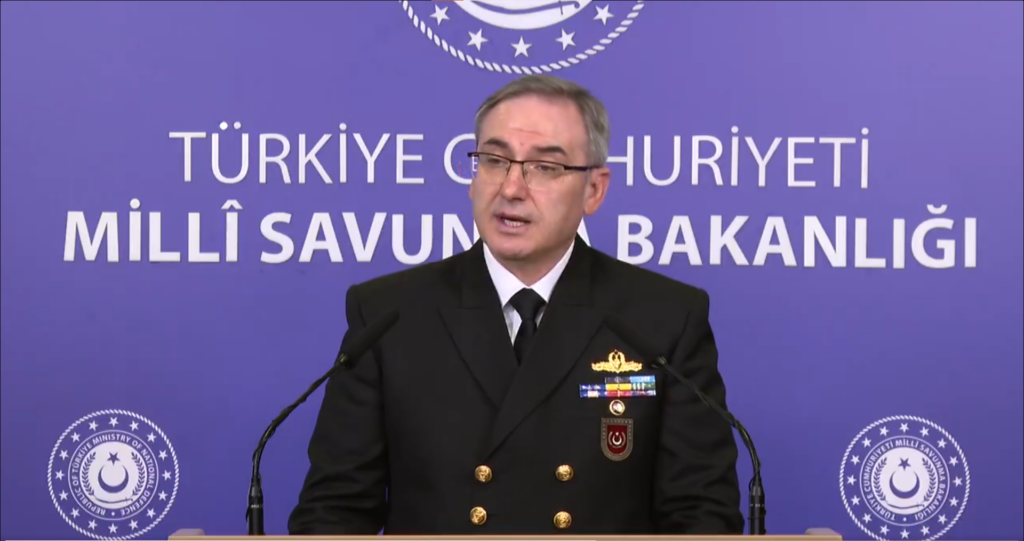
Speaking at a regular briefing in Ankara on December 4, Turkey’s defense ministry spokesman, Rear Adm. Zeki Aktürk, answered questions about Dendias’s remarks.
Aktürk said Turkey monitors “all developments” in the region, “including the military activities of our neighbor Greece,” and repeated that Ankara’s “basic priority” is that the Aegean and the wider region remain a “zone of peace and stability.”
The ministry said some Greek officials engage in “actions and statements that increase tension” and described Dendias’s comments as “contrary to international agreements,” “detached from reality” and “imaginative,” arguing that such talk only harms the “positive atmosphere” created by recent meetings between the two countries’ leaders.
“The Turkish Armed Forces are not a threat to anyone who does not pose a threat to them,” Aktürk said. “But they have the power and determination to neutralize every threat that may be directed against our country.”
Dendias, speaking in Athens on November 28 at a forum titled “Greece in a global perspective,” had said Greek planners have “completely changed” their doctrine.
🇬🇷🇪🇺“Achilles Shield” will protect Greek skies and safeguard European borders.
A multi-layered defensive system covering air, missile and counter-drone protection, as well as components to counter surface and underwater threats.
The air defence combines existing Greek Patriot… pic.twitter.com/lxpDcT7Mqz— Ictinus ®️ (@ictinus_x) December 3, 2025
He argued that a billion-euro frigate can now be destroyed by a relatively cheap unmanned aircraft and said Greece will move to a missile-based defense spread across its archipelago rather than rely on classic naval power inside the narrow Aegean waters.
According to that outline, Greece wants to deploy mobile missile batteries on “hundreds” of islands, not “thousands,” but enough to create what Dendias described as a protective grid, and to put strategic missiles with ranges of about 1,500 kilometers on new frigates that can fire from anywhere in the eastern Mediterranean.
Greek media has reported that Athens is in talks to buy several layers of air and missile defense systems from Israel, including short, medium and long-range systems known by such names as Spyder, Barak MX and David’s Sling and to integrate them into island and mainland sites.
Dendias also highlighted Turkey’s rapid buildup of armed drones, citing the Bayraktar models that Ankara has exported to numerous countries, and said every Greek soldier should receive training on unmanned systems as the army enters what he called the “drone age.”
For Ankara, the idea of turning many of the Aegean islands into missile sites violates an old red line.
Several islands closest to Turkey’s coast were given to Greece after World War I and World War II on the condition that they remain demilitarized under the 1923 Treaty of Lausanne and the 1947 Paris Peace Treaty. Turkey argues that Greece has already broken those rules by placing troops, artillery and armored vehicles on some of these islands and says the new missile plan would deepen that breach.
Greece claims that security conditions changed after tensions over Cyprus in the 1960s and 1970s and that it has the right to defend its territory against what it sees as Turkish pressure at sea and in the air. Athens says Turkish fighter jets carry out frequent flights near or over Greek islands and that Turkey’s large landing fleet and long coastline force Greece to keep strong forces on the islands.
The Turkish Defense Ministry statement did not list specific islands or systems, and it did not threaten any immediate counter-move, but by stressing that the military will “neutralize every threat,” it framed the missile doctrine as one more risk in a narrow sea where both air forces already intercept each other on a regular basis.
The remarks also came after a period in which both sides had tried to cool relations.
Turkey and Greece signed what is known as the Athens Declaration in 2023, a political text meant to lower tensions and improve cooperation after years of disputes over gas exploration, maritime boundaries and airspace claims.