


Ömer Murat*
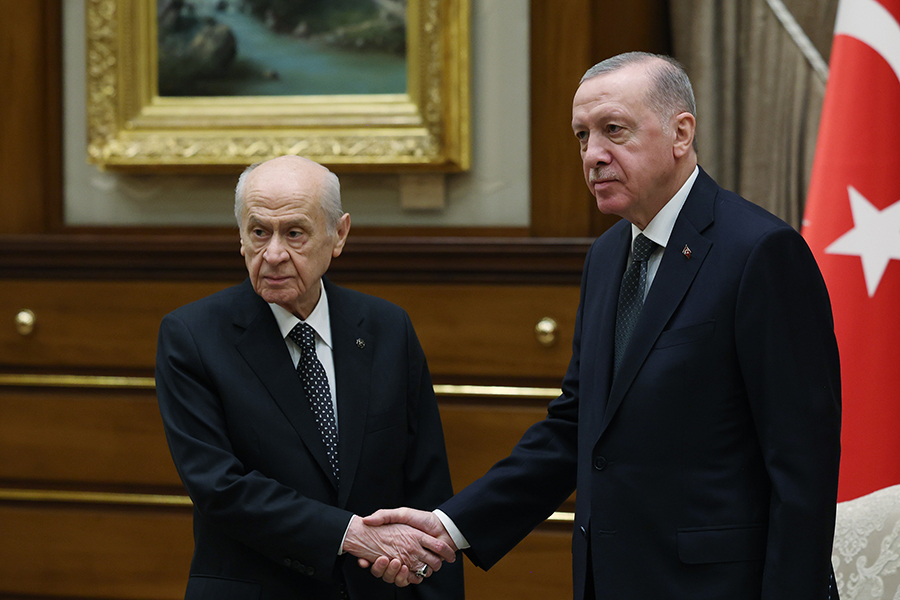
In a fiery speech to his party’s parliamentary group in the Turkish Parliament, Devlet Bahçeli, leader of the far-right Nationalist Movement Party (MHP), launched a scathing attack on Tom Barrack, the United States ambassador to Turkey and special representative for Syria. Bahçeli lambasted Barrack’s comments in Manama, Bahrain, suggesting cooperation between Turkey and Israel “from the Caspian Sea to the Mediterranean,” as a serious diplomatic overreach by an envoy meddling in his host country’s politics. Yet this was more than nationalist bluster; it was the latest battle in a deepening power struggle within Turkey’s ruling alliance of President Recep Tayyip Erdoğan’s Justice and Development Party (AKP) and the MHP.
Bahçeli’s broadside followed the MHP’s conspicuous absence from Erdoğan’s Republic Day reception on October 29, a symbolic snub that exposed rifts within the People’s Alliance between the AKP and MHP. Once united against common political adversaries, this partnership now mirrors the wider schism between Erdoğan and Turkey’s entrenched old guard, whose interests Bahçeli represents.
As Erdoğan’s popularity wanes, reflected in the AKP’s fall to second place in latest local elections held in March 2024, and his health visibly deteriorates, Ankara’s power brokers are quietly maneuvering for the post-Erdoğan era. Yet the AKP and MHP envision starkly different futures. For the old establishment, alignment with Erdoğan has always been tactical, a means to reclaim influence lost during his more than two-decade dominance. They see the AKP’s conservative, religiously inflected model as an existential threat to their secular, Kemalist foundations.
To these elites, reasserting control after Erdoğan is the only way to halt the ideological erosion his rule has wrought. Any succession plan installing a family member or confidant, such as Foreign Minister Hakan Fidan, would, in their eyes, confirm their marginalization and ideological defeat.
For Erdoğan’s circle, however, the driving concern is self-preservation. Many within the AKP have prospered through patronage and corruption, embedding themselves in the bureaucracy through cronyism. They fear retribution once Erdoğan exits the stage and therefore demand a succession framework that guarantees continuity and shields their interests.
Reconciliation appears unlikely, as the fissures run deep. Central to the tension is the arrest of Ekrem İmamoğlu, İstanbul’s popular mayor and the Republican People’s Party’s (CHP) presidential candidate. Erdoğan seems to expect the old guard to block İmamoğlu’s candidacy, and, until that happens, he has authorized a series of judicial operations targeting not only the CHP but also figures tied to the MHP, raising the pressure.
The rift widened in August with the arrest of Selahattin Yılmaz, a notorious crime figure with close MHP links. Despite Bahçeli publicly calling Yılmaz a “comrade,” the arrest went ahead. A similar episode involved Kenan Tekdağ, media representative for Can Holding, whose owners were detained and placed under trusteeship. Bahçeli’s defense proved futile; Tekdağ was reportedly denied even basic bedding in the notorious Marmara Prison in Silivri.
The discord deepened when Erdoğan traveled to Washington in September for talks with US President Donald Trump. Shortly thereafter, Bahçeli branded the United States and Israel as malign actors in an “axis of evil” and urged Ankara to align with Russia and China. Erdoğan dismissed the remarks, claiming ignorance. This studied indifference resurfaced after the October 19 presidential election in the Turkish Republic of Northern Cyprus (KKTC). When Ankara’s preferred candidate, Ersin Tatar, suffered a shock defeat to Tufan Erhürman, Bahçeli urged the parliament in Nicosia to reject the results and petition for annexation as Turkey’s 82nd province. Erdoğan ignored him and congratulated Erhürman.
Bahçeli’s anger was further inflamed by the quiet removal of MHP loyalists from key security posts, a grievance widely echoed in the pro-MHP media but ignored by Erdoğan. Against this backdrop, Bahçeli’s assault on Ambassador Barrack was not a spontaneous diplomatic outburst but a calculated strike within the ruling alliance’s internal war.
To grasp its meaning, one must revisit another passage in Bahçeli’s speech: his denunciation of outlawed Kurdistan Workers’ Party (PKK) remnants joining the Syrian Democratic Forces (SDF), a coalition whose backbone is the People’s Protection Units (YPG), the PKK’s Syrian offshoot. He condemned their effort to form a separate military division within the Syrian army amid negotiations with Damascus as a direct assault on Turkey’s national security and its ambition for a “terrorism-free homeland and region.”
What made this striking was its stark contrast with Bahçeli’s earlier tone. In May, after the PKK announced its dissolution, he had suggested that transferring militants to the YPG could be managed under oversight, an implicit acceptance of the YPG’s continued role in northeastern Syria. That flexibility had comforted Erdoğan, who sought to rebuild ties with Washington under Trump’s renewed presidency.
Erdoğan’s outreach to Trump was motivated by shared populist instincts and by relief at Trump’s indifference to Turkey’s democratic backsliding. The main obstacle to their rapprochement, however, remained Syria. The United States’ longstanding support for the YPG-led SDF in the fight against the Islamic State in Iraq and the Levant (ISIL) had long angered Ankara, peaking in Trump’s first term when he sent Erdoğan a notorious letter urging him not to “be a fool.”
Now, with Bashar al-Assad gone, YPG commander Mazloum Abdi is negotiating with Syrian President Ahmed al-Sharaa for Kurdish autonomy east of the Euphrates. Turkey’s doctrinal red line, categorical opposition to any YPG-administered Kurdish entity it views as a PKK proxy, risks igniting a new conflict. Given the al-Sharaa government’s cordial ties with Ankara, such a clash could undermine Erdoğan’s rapprochement with Trump.
At the center of this delicate balance sits Ambassador Barrack, mediating between Abdi and Sharaa. Reports indicate progress toward integrating the SDF into the Syrian army as an autonomous division, an arrangement effectively enshrining Kurdish self-rule in the region. Erdoğan’s administration appears to be cooperating fully with Barrack, probably viewing such an outcome as key to stabilizing Syria and advancing Ankara’s own tentative Kurdish peace efforts.
Bahçeli’s sudden reversal, denouncing the proposed SDF division as a disguised PKK survival strategy, therefore transcends diplomacy. It is a pointed warning to Erdoğan. Should Bahçeli persist, Erdoğan could face a serious rupture with Trump’s Washington, undermining his foreign-policy pivot and jeopardizing his efforts to reconcile with the PKK as part of a new peace process launched at his initiative last year.
If sustained, Bahçeli’s position could derail Ankara’s coordination with the United States and complicate efforts to stabilize postwar Syria. More significantly, it would widen the rift already destabilizing Turkey’s governing bloc. In this light, Bahçeli’s attack on Barrack was not an isolated outburst but a deliberate signal that nationalist hardliners will no longer acquiesce to Erdoğan’s pragmatic compromises abroad.
Foreign policy in Ankara often mirrors domestic struggle, and Bahçeli’s intervention is a case in point. It reflects an alliance at a breaking point, its unity eroded by diverging survival instincts and incompatible visions for Turkey’s future. As succession maneuvering intensifies, these domestic storms are spilling over into foreign affairs, from the KKTC to Syria, jeopardizing Turkey’s strategic coherence.
* Ömer Murat is a political analyst and a former Turkish diplomat who currently lives in Germany.
Disclaimer: The views expressed in this opinion piece are those of the author and do not necessarily reflect the editorial stance of Turkish Minute.