


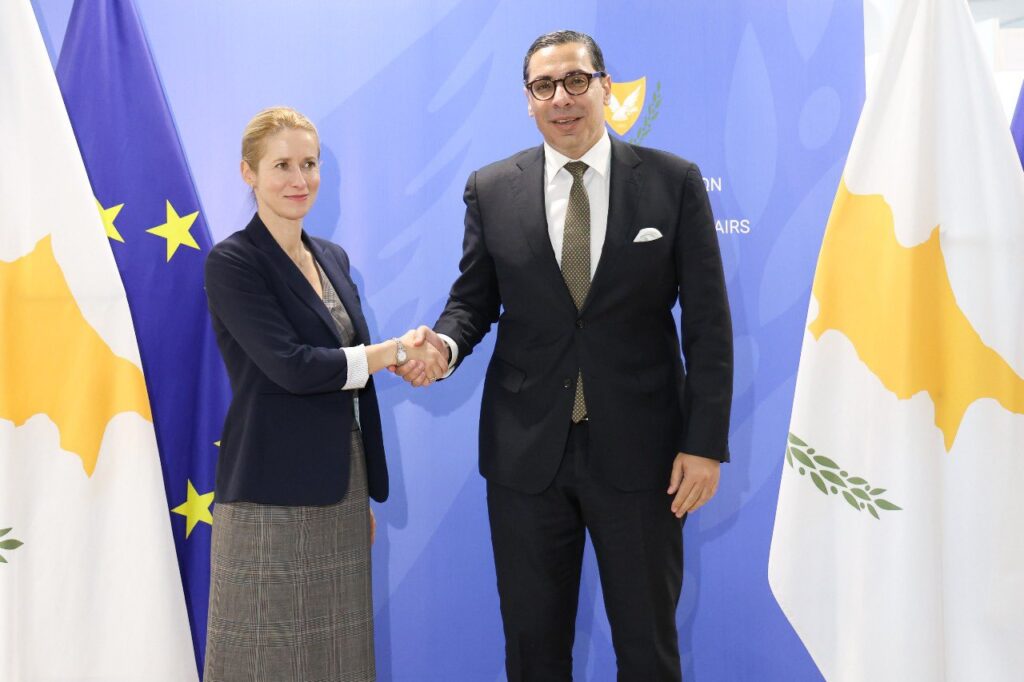
European Union foreign policy chief Kaja Kallas said on Wednesday that it will be the people of Cyprus, not Turkey or the EU, who will govern the divided island in the future, voicing full support for the United Nations-led peace process.
Cyprus will hold the rotating Presidency of @EUCouncil from January.
We share the same priorities — from EU support for Ukraine to boosting our defence
I am confident that our cooperation will continue to strengthen Europe's stability & security.
Press remarks with @ckombos ↓ pic.twitter.com/XfkGipzaqN
— Kaja Kallas (@kajakallas) November 5, 2025
Kallas made the remarks during a joint press conference with Cypriot Foreign Minister Constantinos Kombos in Nicosia, as she began meetings ahead of Cyprus assuming the rotating presidency of the EU Council in January 2026.
She said the Cyprus issue remains “a core matter for EU-Turkey relations and for the stability and security of the Eastern Mediterranean.”
Warmly welcomed today in Nicosia #EU High Representative for Foreign Affairs and Security Policy.
Thank you @kajakallas for the constructive and substantial discussions.
As Cyprus prepares to assume the #Presidency of the Council of the EU, we are ready to work closely with you… pic.twitter.com/TkWEeqak9X
— Constantinos Kombos (@ckombos) November 5, 2025
“It is neither Türkiye nor the EU that will govern the island of Cyprus in the future,” Kallas said. “It is the people of Cyprus, the Greek and Turkish Cypriots, who must live together and find solutions to common challenges.”
The EU’s top diplomat said both communities on the island need a “sustainable solution” and that the bloc “fully backs the UN-led process” led by Secretary-General António Guterres and his envoy.
Cyprus has been divided since 1974, when Turkey occupied the northern third of the island in response to a coup by Greek nationalists seeking union with Greece. The internationally recognized Republic of Cyprus controls the south, while the north is governed by the Turkish Republic of Northern Cyprus (KKTC), recognized only by Ankara.
Kallas said the EU maintains “positive engagement” with Turkey in some areas but stressed that “the deterioration of democratic standards, judicial independence and fundamental rights have de facto frozen its enlargement process since 2018.”
She described Turkey as “a key partner and a significant regional actor,” while emphasizing that relations with Ankara remain linked to the Cyprus question and regional stability.