


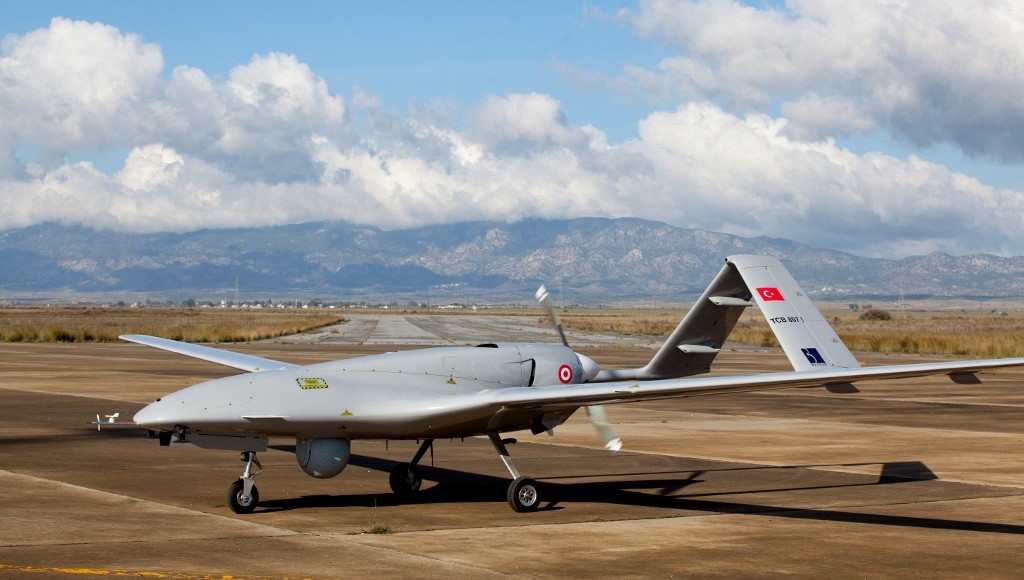
A senior German defense official has called on Berlin to “take a close look” at acquiring Turkish-made drones, reflecting a pragmatic shift in Germany’s security policy as it has been seeking stronger defense partnerships and supply chains since Russia’s invasion of Ukraine, Deutsche Welle’s Turkish edition reported on Thursday.
The official, who works for Germany’s Federal Office of Bundeswehr Equipment, Information Technology and In-Service Support (BAAINBw), spoke on condition of anonymity, praising Turkey’s drone production capacity and military readiness. “Despite all the differences, when we talk about Turkey, we are talking about a strong NATO partner that is in extremely good military condition,” the official was quoted as saying.
The remarks come as Germany undertakes a major effort to rebuild its defense industry after years of underinvestment. Chancellor Friedrich Merz’s recent visit to Ankara highlighted that new approach, emphasizing military cooperation with President Recep Tayyip Erdoğan while downplaying the rights and rule-of-law disputes that have long strained relations.
Turkey’s low-cost, combat-tested Bayraktar TB2 drones, made by defense contractor Baykar, gained global attention after being deployed in Ukraine and Nagorno-Karabakh. Several European Union members, including Poland and Romania, have since purchased them.
Defense analyst Çağlar Kurç told DW that Turkey’s production capacity has become critical for NATO as the alliance faces supply shortages. “While Europe is still trying to realize the Eurodrone project, Turkey already has at least two equivalent systems for almost every mission,” he said.
German defense expert Benedikt Meng noted that cooperation between the two countries is already under way, pointing out that sensors made by Germany’s Hensoldt are integrated into Bayraktar TB2 systems. “Turkey has developed an impressive level of expertise in drones and other aerial platforms,” he said.
Industrial cooperation between Ankara and Berlin has also expanded. Under a deal signed earlier this year, Turkish defense contractor Repkon will begin producing 155-millimeter artillery shells in Germany in 2027. In June, Baykar and Italy’s Leonardo launched a joint venture, LBA Systems, to develop advanced unmanned technologies.
The renewed engagement marks a sharp contrast with Germany’s earlier caution toward arms sales to Turkey. In October 2019 Berlin imposed a partial export ban following Ankara’s military operations in Syria, and in 2017 it relocated about 250 troops from Turkey’s İncirlik Air Base to Jordan amid diplomatic tensions.
The German official acknowledged those earlier disputes but stressed the need for realism. “Turkey must, of course, initiate a democratization process,” the official said. “But at the end of the day, we don’t have many options.”
Turkey’s defense industry has grown rapidly in the past decade, with four Turkish companies — Baykar, Aselsan, Turkish Aerospace Industries (TAI) and Roketsan — ranked among the world’s top 100 defense companies. Ankara is also seeking deeper integration with Europe’s defense system through its bid to join the European Union’s €150 billion Security Action for Europe (SAFE) program, currently under review by the European Commission.