


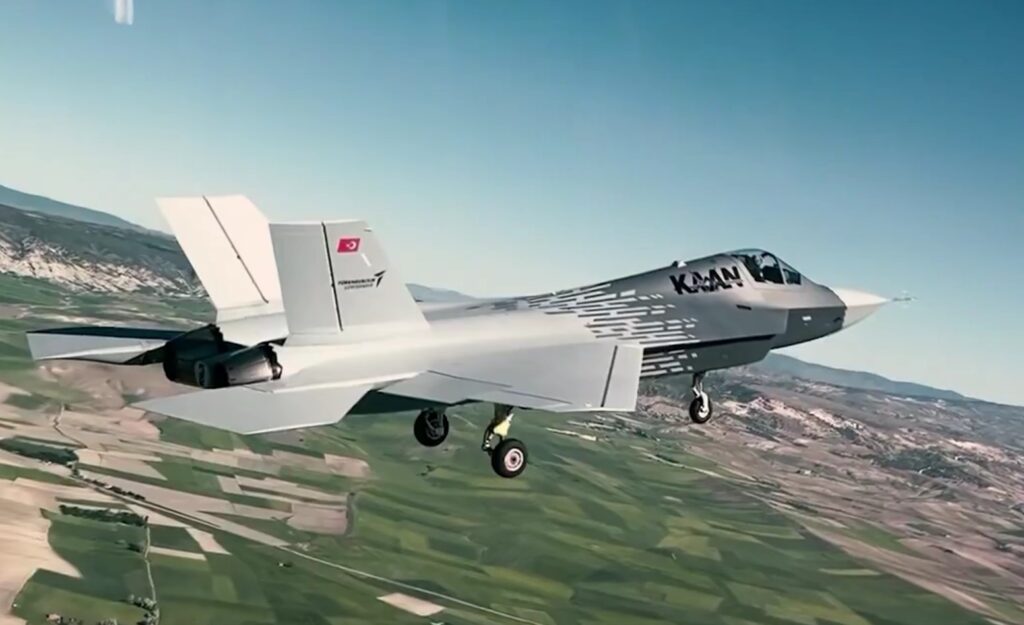
Turkish Industry and Technology Minister Mehmet Fatih Kacır has acknowledged that the country’s new KAAN fighter jet still relies on foreign engines, saying the government aims to replace them with a domestically produced engine in the coming years, the Anka news agency reported.
Speaking to parliament’s Planning and Budget Committee on Tuesday, Kacır said Turkey’s goal is to make the KAAN fully independent from foreign suppliers but noted that the current prototypes depend on imported engines.
He warned that even when payments are made, access to defense systems and technologies from other countries can be disrupted at any time, highlighting the uncertainty surrounding international procurement.
Kacır’s comments followed weeks of debate over the jet’s propulsion after Foreign Minister Hakan Fidan said US export licenses for General Electric F110 engines planned for KAAN test aircraft and early production were stalled in Congress.
Former US diplomat Matthew Bryza told local media that Fidan’s remarks were likely a calculated diplomatic message rather than a new revelation, saying the foreign minister may have sought to remind the Donald Trump administration of Ankara’s expectations amid the delays.
Bryza noted that only a few nations are capable of producing fifth-generation fighter jet engines and that Turkey’s goal of full independence in this field could take decades.
He added that the debate over KAAN’s US-made engines merely confirmed what has long been known.
Haluk Görgün, head of Turkey’s Presidency of the Defense Industry, said afterward that the project’s delivery schedule remains unchanged and that serial production will not depend solely on foreign engines.
He said the program is being structured around Turkey’s national engine projects, with development of the TF35000 main engine and its auxiliary power unit ongoing.
The TF35000, designed for 35,000 pounds of thrust, is being developed by TUSAŞ Engine Industries (TEI) and TRMotor. TEI, founded in 1985, is partly owned by Turkish Aerospace Industries (TAI) and US-based GE Aerospace, while TRMotor operates as a fully owned TAI subsidiary.
TEI already manufactures and maintains components for the F110 engine used in current KAAN prototypes. Both companies are developing local turbine and material technologies such as single-crystal blades and infrared-suppressing exhaust systems to meet stealth and endurance requirements.
Program managers still target initial KAAN deliveries around 2028, with integration of the national TF35000 engine planned for the Block-30 version around 2032, pending development and testing milestones.
The TF35000 project remains in the prototype stage, and Turkey’s strategy envisions a phased transition from foreign to domestic engines once the local system is technically ready.
Turkey has also signed a contract with Indonesia for 48 KAAN jets. Görgün said potential difficulties in obtaining foreign engines would not affect the deal since those aircraft are planned to be powered by the Turkish TF35000 engine by 2032, with deliveries to be completed by 2035.
The parliamentary committee approved the Ministry of Industry and Technology’s 2026 budget on Tuesday.