


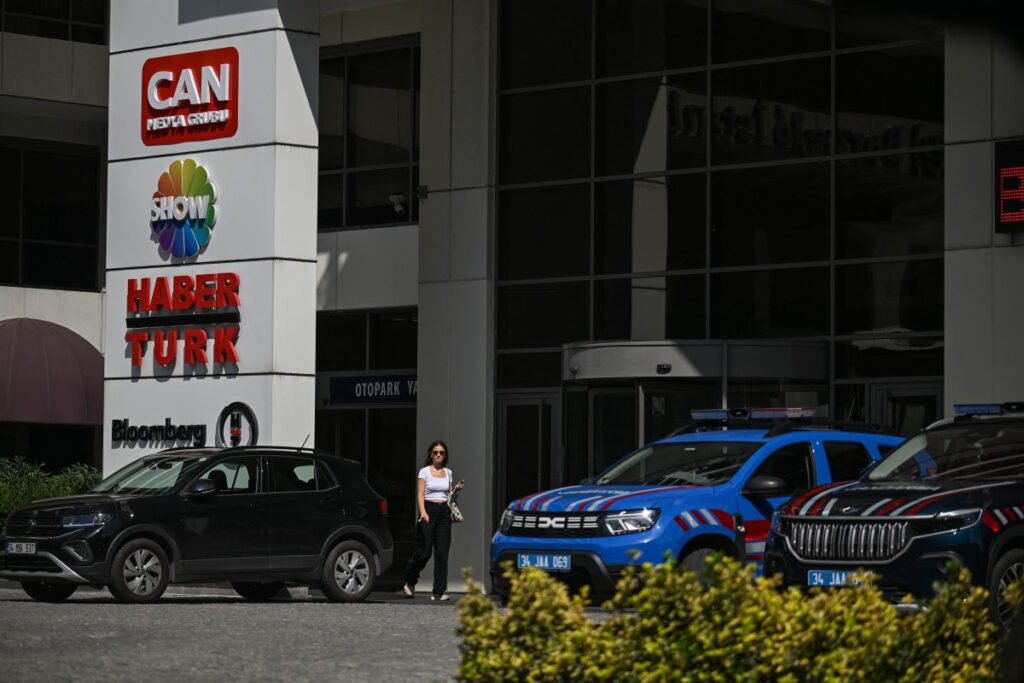
A Turkish court on Monday ordered the arrest of 11 people, including the chairman of Can Holding and a former university rector as part of an expanding investigation into one of Turkey’s largest private conglomerates on charges of tax evasion, fraud and money laundering, the Anka news agency reported.
The İstanbul Chief Public Prosecutor’s Office said in a statement on Monday that the arrests followed the second phase of raids carried out last week, during which 25 people were taken into custody. Fourteen others were released, including Betül Can and Zühal Can, the wives of company owners Şakir Can and Murat Can, who were put under judicial supervision.
Prosecutors said the suspects are being investigated for “membership in a criminal organization” and “money laundering.”
Can Holding Chairman Kenan Tekdağ, who had also been detained during the first phase of the operation in September and later placed under house arrest, was among those jailed pending trial in addition to former İstanbul Bilgi University rector Remzi Sanver.


Sanver is a prominent Turkish academic who taught and conducted research at several universities in Turkey and Europe and served as rector of İstanbul Bilgi University from 2011 to 2015.
Sanver later was secretary-general and spokesperson for the board of directors of the Galatasaray Sports Club between 2021 and 2022.
He is also known for his role in the Grand Lodge of Free and Accepted Masons of Turkey, where he previously served as grand master and, as of 2023, had resumed the position.
Claims of tax evasion through fake invoices
Prosecutors said evidence indicates that several companies within Can Holding issued fake invoices to facilitate tax evasion and illegal profit, noting that the alleged transactions involved “no actual movement of goods.”
Investigators say the operation, conducted by gendarmerie teams in İstanbul, Mersin, Iğdır and İzmir, uncovered 88 billion Turkish lira (approximately $2.1 billion) in suspicious financial activity between 2020 and 2021 in the accounts of Can Holding and 121 affiliated companies.
The funds were reportedly funneled through Enerji Petrol Ürünleri A.Ş. and its subsidiaries, which prosecutors allege were central to the scheme. Authorities have frozen the assets of 16 suspects and the 121 companies linked to the conglomerate.
September 11 seizures
The initial operation on September 11 led to the government seizure of 121 companies — including broadcasters Habertürk TV, Show TV, Bloomberg HT and HT Spor, once part of soda ash producer Ciner Holding but acquired by Can Holding in 2024.
The government also seized İstanbul Bilgi University and the nationwide Doğa College network, which were part of the conglomerate’s extensive education portfolio.
The seized companies have been placed under the management of Turkey’s Savings Deposit Insurance Fund (TMSF), a state body that oversees confiscated assets.
The recent series of corporate investigations and raids has unsettled Turkey’s business community and sparked speculation about the government’s motives.
Can Holding, glassmaker Ciner Group and the İstanbul Gold Refinery are among the latest companies targeted in the probes, which have significantly increased the number of firms placed under the management of the TMSF in the past year.
According to TMSF data, the fund now oversees 1,056 confiscated businesses, up from 675 a year ago, spanning sectors from media, finance and energy to the Kasımpaşa football club.
The fund’s trustees manage assets valued at 328 billion Turkish lira ($10 billion) as of early 2025.
The sharp rise in seizures has fueled fears that the anti-corruption investigations are being used to facilitate politically motivated asset transfers and to tighten government control over key parts of the economy.
Since a failed coup in 2016, Turkish authorities have put hundreds of businesses under state control, often citing links to alleged criminal networks or terrorism financing.
Regulations adopted in February expanded the powers of the TMSF, allowing courts to transfer companies to the fund’s trusteeship based on a “strong suspicion” of financial crimes such as money laundering.
Legal scholars and watchdog groups have warned that Turkey’s use of trusteeships and asset confiscations has eroded property rights and created a climate of uncertainty for investors. They argue that the measures have also been used to curb political dissent and bring influential media outlets and schools under tighter state control.
Founded by entrepreneur Zamanhan Can, Can Holding traces its roots to a trading company established in 1972. Can consolidated his businesses under Can Holding in 1986, later relocating its headquarters to İstanbul in 1990.
The conglomerate has since expanded into multiple industries including education, energy, consumer electronics, technology, logistics, healthcare and media.