


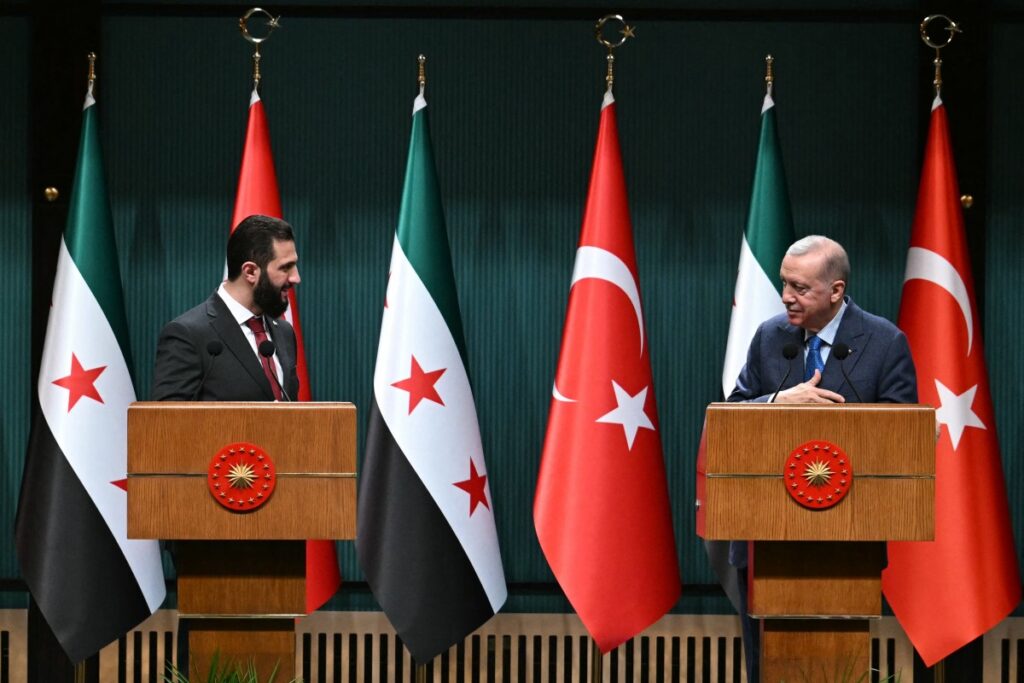
Turkey is preparing to deliver military equipment to Syria as part of a prospective security arrangement that would expand Ankara’s authority to target Kurdish militants along the entire border, Bloomberg reported, citing Turkish officials familiar with the talks.
The planned assistance, expected in the coming weeks, includes armored vehicles, drones, artillery, missiles and air defense systems, the officials said, speaking on condition of anonymity due to the sensitivity of the matter. They said the equipment would be deployed mainly in northern Syria, away from areas bordering Israel.
Neither the Turkish presidency nor Syria’s information ministry commented on the reported plan.
The military support is aimed at bolstering Syrian President Ahmed al-Sharaa, who emerged as the country’s new leader following the overthrow of Bashar al-Assad in December 2024.
Al-Sharaa, a former al-Qaeda commander who led the rebellion against Assad, has sought to consolidate control across Syria and rebuild the country’s armed forces after much of its arsenal was destroyed in Israeli strikes that followed Assad’s ouster. He has a close relationship with Turkish President Recep Tayyip Erdoğan and has visited Turkey several times since assuming the presidency in January.
The initiative reflects Ankara’s continued concern over Syria’s northeast, a region controlled by the Syrian Democratic Forces (SDF), a US-backed coalition led by the Kurdish People’s Protection Units (YPG).
Ankara considers both the SDF and YPG to be terrorist organizations, regarding the YPG as an extension of the outlawed Kurdistan Workers’ Party (PKK), which has fought a decades-long war in southeast Turkey and is designated as a terrorist organization by Turkey and its Western allies.
Officials said Turkey and Syria are discussing an update to a nearly 30-year-old border security accord that allows Turkish forces to target militants operating close to the frontier. Ankara reportedly wants to expand its permissible range of operations to 30 kilometers (19 miles) from the current 5 kilometers.
Between 2016 and 2019 Turkey launched three offensives in northern Syria against Syrian Kurdish fighters and against Islamic State in Iraq and the Levant (ISIL) militants.
Kurdish peace process and regional dynamics
The PKK announced in May that it would lay down its arms and disband, but the peace process has advanced slowly amid uncertainty over disarmament procedures and what steps Ankara might take to address Kurdish political demands.
Turkey is reportedly counting on al-Sharaa to resist Kurdish ambitions for greater autonomy, particularly in areas adjacent to the Turkish border. Turkish officials say Ankara also wants Damascus to limit the SDF’s control over local oil and gas resources, arguing that revenues may be used to fund the PKK.
In March the SDF and al-Sharaa’s government signed a framework agreement under which SDF units would be integrated into Syria’s national army. That process has yet to be completed, though a senior SDF commander told The Associated Press this week that progress is being made.